Which District Office a Master Guide Applies To
Navigating the regulatory landscape for hunting guides in Nevada can feel like trying to find a hidden spring in the middle of a vast desert—confusing, critical, and often frustrating. Many aspiring or even established Master Guides often scratch their heads trying to figure out which specific federal land management district office they need to deal with for their permits, especially when operating across large, diverse units. This comprehensive guide will illuminate the specific district offices Master Guides must apply to for federal land permits, breaking down the often-complex process into manageable insights.
Understanding Nevada's Guide Licensing Landscape
Becoming a hunting guide in Nevada isn't as simple as just hanging out a shingle and putting a pack on your back. There's a layered system of permits and licenses that can feel overwhelming, but each piece is essential for legal and ethical operation. It all starts at the state level, but quickly branches into federal territory, especially in a state like Nevada where so much land is publicly owned.
The Role of the Nevada Department of Wildlife NDOW
At the foundational level, the Nevada Department of Wildlife (NDOW) is the state agency responsible for issuing the primary guide and outfitter licenses. Think of them as the gatekeepers for who can even begin to consider guiding a hunt in Nevada. Their licensing ensures that individuals meet certain criteria, like having appropriate experience, carrying necessary insurance, and understanding state hunting regulations. This state-level license is absolutely non-negotiable; without it, you can't legally operate as a guide anywhere in Nevada.
However, NDOW's license is primarily for state oversight and doesn't automatically grant access to all the public lands that comprise the vast majority of Nevada's hunting grounds. It's a critical first step, but not the last. For more details, you can look into How NDOW Licenses Guides and Outfitters. Their process is thorough, designed to protect both the wildlife and the clients.
Federal Land Requirements for Guides
Here's where it gets a bit more complex, and where many guides can get tripped up. Given that Nevada is predominantly federal land—we're talking Bureau of Land Management (BLM) and National Forests—a state guide license alone isn't enough. Guides must also acquire special permits from the specific federal agencies managing the land they plan to operate on. This is a crucial distinction. You might have your NDOW Master Guide license, but if you're leading a client across a particular BLM wilderness study area or a remote corner of a National Forest, you absolutely need an additional federal permit for that specific area.
These federal permits, often called Special Recreation Permits (SRPs), ensure that guided activities don't unduly impact resources, that the guide carries adequate liability insurance for federal lands, and that they contribute to the management of those lands through fees. It’s a way for federal agencies to manage commercial use of public resources. Neglecting this step can lead to hefty fines, permit revocation, and even criminal charges, which is why understanding Why Nevada Guides Need Federal Land Permits is so vital.
What "Master Guide" Status Entails
In Nevada, a "Master Guide" isn't just a fancy title; it signifies a specific level of licensing and responsibility. A Master Guide is essentially an outfitter who can provide a full range of services, including personally conducting hunts, hiring other licensed guides, and generally orchestrating an entire hunting operation. They're the primary permit holder and are responsible for all aspects of the hunt, from logistical planning to ensuring all sub-guides are properly licensed and operating within legal parameters.
This elevated status means that the Master Guide holds the ultimate responsibility for securing all necessary federal permits for their operations. If a Master Guide sends a sub-guide into a particular BLM unit, it's the Master Guide's federal permit that covers that operation, or they must ensure the sub-guide is also covered under their own federal permit for that specific area. This comprehensive scope of work makes the federal permitting process even more critical for Master Guides, as their operations often span multiple units and diverse federal jurisdictions. What a Nevada Master Guide License Allows is quite extensive, which underlines the need for meticulous compliance.
The Bureau of Land Management BLM and National Forests
Nevada's landscape is a mosaic of different land management agencies, each with its own set of rules and application processes. For hunting guides, the two biggest players are the Bureau of Land Management (BLM) and the U.S. Forest Service (USFS), which manages National Forests. Understanding their roles and how they operate is fundamental to a successful guiding business.
BLM's Jurisdiction in Nevada
The BLM is, without a doubt, the dominant land manager in Nevada. When people talk about "public land" in the state, they are very often talking about BLM ground. This agency manages an enormous amount of territory—we're talking millions upon millions of acres—that are prime habitat for mule deer, antelope, chukar, and even some elk. For a guide, this means a significant portion of their business, if not all of it, will likely take place on BLM-managed lands. Consequently, obtaining the appropriate Special Recreation Permits from the BLM is a cornerstone of a Nevada Master Guide's operation.
The BLM's jurisdiction is divided into field offices, each responsible for specific geographic areas. A guide planning to operate across multiple hunt units that fall under different BLM field offices will need to apply for permits with each relevant office. This is not a one-size-fits-all permit. For instance, guiding in the remote high desert near Winnemucca will involve a different BLM office than guiding a chukar hunt near Ely or an antelope hunt out of Battle Mountain. Understanding BLM Acreage Across Nevada helps put into perspective just how widespread and vital these permits are.
National Forests: Another Layer of Federal Permitting
While the BLM covers the vast majority of Nevada's public lands, the U.S. Forest Service manages the state's National Forests, primarily the sprawling Humboldt-Toiyabe National Forest, which is actually the largest National Forest in the lower 48 states outside of Alaska. These forested areas, often at higher elevations, are critical habitats for elk and high-country mule deer. If a Master Guide plans to lead clients into these timbered mountains and alpine basins, they will need commercial outfitter/guide permits from the specific National Forest or Ranger District that covers their hunting grounds.
Just like the BLM, the Forest Service operates through various Ranger Districts, each with its own permitting authority. So, if a guide runs an elk hunt in the Jarbidge Wilderness (part of the Humboldt-Toiyabe) and a mule deer hunt in the Schell Creek Range (also Humboldt-Toiyabe, but a different Ranger District), they might need separate permits or ensure their overarching permit covers both specific areas and districts. It adds another layer of administrative detail, but it's crucial for legal operation on National Forest Ground in Nevada.
The Joint Permit System Explained
To streamline some of this complexity, the Nevada Department of Wildlife and federal agencies like the BLM have, in some instances, developed what's often referred to as a "joint permit" or a cooperative process. This doesn't mean one piece of paper covers everything, but rather that the agencies work together to coordinate requirements and ensure compliance. The goal is to make it a bit easier for guides to meet both state and federal obligations without completely duplicating efforts.
Often, this means that a guide will submit certain documentation—like proof of insurance, a list of services, and areas of operation—to NDOW, and that information is then shared or verified by the federal agencies. The federal agencies will still issue their own specific permits (SRPs), but the application process might be more harmonized. For example, if a guide applies for a permit with a BLM field office, that office will typically require proof of their current NDOW Master Guide license. This ensures a comprehensive vetting process. Understanding How BLM Nevada Issues a Joint Permit provides greater clarity on how these systems try to work in tandem.
Pinpointing the Correct BLM District Office
This is where the rubber meets the road for a Master Guide: figuring out exactly which BLM or Forest Service office you need to engage with. With Nevada's vastness and the way hunt units often sprawl across different administrative boundaries, it's not always intuitive.
Geographic Responsibility of BLM Field Offices
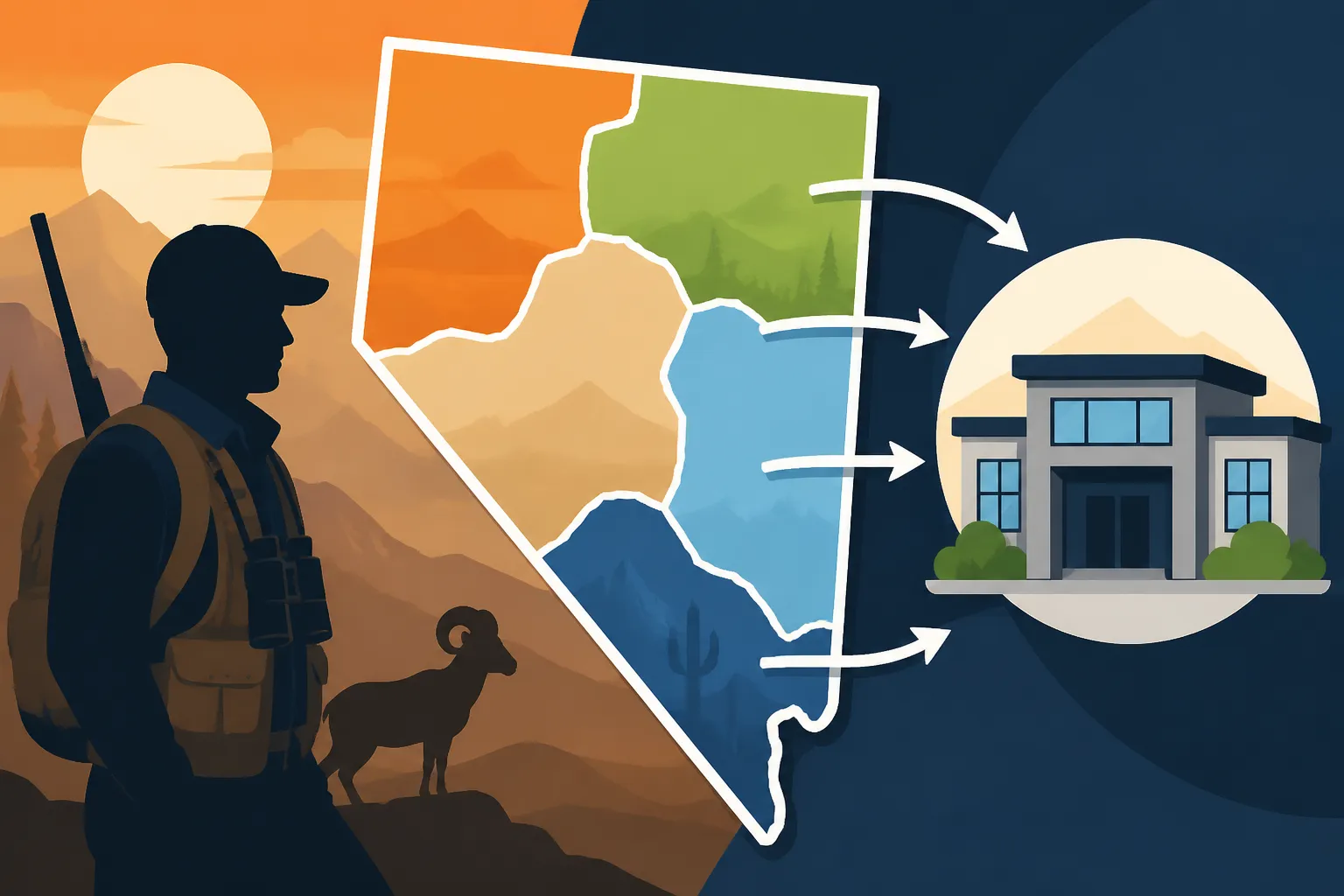
The BLM divides Nevada into several administrative districts, which are further broken down into Field Offices. Each Field Office has a defined geographic area of responsibility. When a Master Guide needs a Special Recreation Permit for commercial guiding, they apply to the specific Field Office that manages the lands where their intended guiding activities will occur. It's essential to get this right, as applying to the wrong office will just cause delays.
Here’s a general overview of some key BLM Field Offices in Nevada and the regions they broadly cover. Keep in mind that unit boundaries can be complex, and a single hunt unit might even straddle the jurisdiction of two different field offices!
| BLM Field Office | General Geographic Area (Counties/Regions) | Representative Hunt Units Covered (Examples) |
|---|---|---|
| Elko Field Office | Northeastern Nevada (Elko, White Pine, Eureka Counties) | Units 071, 073, 075, 102, 103, 104, 231 |
| Ely Field Office | East-Central Nevada (White Pine, Nye, Lincoln Counties) | Units 131, 132, 134, 141, 143, 221 |
| Battle Mountain Field Office | North-Central Nevada (Humboldt, Lander, Pershing, Eureka, Nye Counties) | Units 051, 052, 053, 061, 062, 171, 172 |
| Winnemucca Field Office | Northwestern Nevada (Humboldt, Pershing, Washoe Counties) | Units 011, 012, 013, 014, 021, 022 |
| Southern Nevada Field Office | Southern Nevada (Clark, Lincoln, Nye Counties) | Units 261, 262, 267, 268, 271 |
| Carson City Field Office | Western Nevada (Douglas, Lyon, Storey, Washoe, Churchill, Pershing Counties) | Units 192, 194, 195, 200, 203, 204, 205 |
This table is a starting point, not an exhaustive list. A guide might operate in Unit 102, which is primarily under the Elko Field Office, but perhaps a small part of their operation spills into an adjacent unit managed by the Battle Mountain office. In such a scenario, they'd need to coordinate with both.
Why Knowing Your Hunt Unit Matters
For any guide, knowing the specific hunt units they plan to operate in is paramount, not just for game regulations but also for federal permitting. Nevada's hunt units are clearly defined by NDOW, and these unit boundaries often serve as the key to understanding which federal land management office has jurisdiction. If you're applying for a specific elk hunt in Unit 111, for example, you'd look at a map, identify where Unit 111 is located geographically, and then cross-reference that with the administrative boundaries of the local BLM Field Offices or Forest Service Ranger Districts.
Many guides use advanced mapping software, like those offered by GoHunt or onX, which often include layers showing administrative boundaries for BLM districts and National Forest Ranger Districts. This visual tool is invaluable for ensuring you're applying to the correct office. Without a clear understanding of your proposed area of operation down to the specific hunt unit, you risk misdirecting your application and delaying your ability to operate legally.
Researching Specific Office Jurisdictions
So, how does a guide definitively find out which office covers their intended hunting grounds? The best practice is direct verification. Start by identifying the specific hunt unit(s) you plan to guide in. Then, visit the official websites for the BLM and the U.S. Forest Service in Nevada. Both agencies typically have maps or interactive tools that show their administrative boundaries. For the BLM, you'll look for maps detailing Field Office boundaries. For the Forest Service, you'll want to find Ranger District maps within the Humboldt-Toiyabe National Forest.
If you're still unsure, the most reliable method is to simply call the BLM Field Office or Forest Service Ranger District that appears to be the most relevant based on your initial map research. Explain your planned hunting area (by hunt unit and general geographic features), and they can confirm which office holds jurisdiction and what the specific application process entails. Don't be shy about making these calls; agency personnel are there to help ensure proper permitting and resource management.
Navigating the Application Process for Federal Permits
Once you've identified the correct federal office (or offices!), the next step is to actually go through the application process for a Special Recreation Permit (SRP). This isn't usually a quick, online click-and-done kind of deal; it requires careful attention to detail and a bit of lead time.
Steps to Applying for a Special Recreation Permit SRP
The application for an SRP for commercial outfitting typically involves several key components. While exact requirements can vary slightly between BLM Field Offices and Forest Service Ranger Districts, here's a general outline:
- Obtain Application Packet: Contact the relevant BLM Field Office or Forest Service Ranger District to request their commercial outfitter/guide Special Recreation Permit application packet. Many agencies have these available online, but a phone call can help clarify specific local requirements.
- Submit Operating Plan: This is a crucial document detailing your proposed operations. It typically includes:
- Specific hunt units and geographic areas where you intend to guide.
- Species you'll be targeting.
- Number of clients and estimated use days.
- Proposed methods of travel (e.g., foot, horse, ATV – noting that Motorized Travel Rules on Nevada Public Land are strict).
- Campsite locations, if applicable.
- Emergency procedures.
- Any other relevant details about how you plan to conduct your business on public land.
- Provide Proof of Insurance: You'll need to demonstrate adequate liability insurance. The federal agencies will specify minimum coverage amounts, and often require that the U.S. Government be named as an additional insured.
- Submit State License Information: Proof of your current NDOW Master Guide license is always a requirement. This helps the federal agency verify you're legally operating at the state level.
- Pay Application and Use Fees: There will be an application fee, and once approved, an annual "use fee" or "land use fee" based on your projected gross receipts or number of service days. These fees contribute to the management and maintenance of the public lands you're utilizing.
- Undergo Review and Potential Inspection: Your application will be reviewed for completeness and compliance with federal regulations and land use plans. Depending on the complexity of your operation, there might be an interview or even a site visit from agency personnel.
This process highlights the serious nature of operating on federal lands. It's not just about getting a client a tag; it's about being a responsible steward of the shared resources.
Annual Renewals and Reporting Requirements
Obtaining an SRP isn't a one-and-done deal. These permits are typically issued for a specific period, often one to five years, but they require annual renewal and reporting. Each year, you'll likely need to:
- Submit an Annual Operating Plan (AOP): This might be a simplified version of your initial operating plan, confirming your proposed activities for the upcoming season.
- Provide Updated Insurance Certificates: Proof of continued liability coverage is essential.
- Submit Actual Use Reports: After each hunting season, you'll report your actual client numbers, use days, and areas of operation. This data helps the agencies monitor commercial activity and assess compliance.
- Pay Annual Fees: Based on your reported actual use or continued projected use, you'll pay your annual land use fees.
Staying on top of these annual requirements is vital to maintaining your federal permits and ensuring uninterrupted guiding operations. Missing deadlines or failing to report accurately can jeopardize your ability to renew your permit.
Common Pitfalls and How to Avoid Them
The federal permitting process, while clear on paper, can have its share of real-world headaches. Here are some common pitfalls and tips to avoid them:
- Underestimating Lead Time: Don't wait until August to apply for a September hunt. Federal permit applications can take weeks or even months to process, especially if information is missing or further review is needed. Start early, ideally in the off-season.
- Incomplete Applications: Rushing through the paperwork and leaving sections blank or omitting required attachments (like insurance certificates or your NDOW license) will lead to immediate rejection or significant delays. Double-check everything.
- Ignoring Specific Local Conditions: Each BLM Field Office or Forest Service Ranger District might have slightly different nuances in their local land use plans or permit stipulations. What was acceptable in one district might not be in another. Always read the specific conditions for your permit area.
- Operating Outside Permit Area: This is a major violation. If your permit is for Unit A, don't guide clients into Unit B unless Unit B is also covered by your federal permit. Agencies use reported use data and sometimes conduct field checks.
- Lack of Communication: If you encounter issues, have questions, or need to amend your operating plan, communicate proactively with the agency. They appreciate transparency and often work with guides who are upfront about changes or challenges.
- Not Understanding Permit Limitations: For example, some permits might restrict the use of certain types of vehicles or limit access during specific seasons for resource protection. Read and understand every clause of your permit.
By being thorough, starting early, and communicating effectively, Master Guides can navigate the federal permitting process much more smoothly.
The Importance of Due Diligence for Hunters
While the guide bears the primary responsibility for permits, hunters also have a role to play in ensuring a legal and ethical hunt. Choosing a properly permitted guide isn't just about peace of mind; it's about protecting yourself and the integrity of the sport.
Verifying a Guide's Credentials
As a hunter, before you commit to a guided hunt, especially in a state like Nevada with so much public land, it's absolutely within your right—and highly recommended—to verify your guide's credentials. Don't be afraid to ask for proof of both their Nevada Master Guide license and their federal land permits for the specific areas you'll be hunting. A reputable guide will be happy to provide this information.
You can often verify a guide's state license directly through the NDOW website or by contacting them. For federal permits, a guide might show you a copy of their Special Recreation Permit. You can also contact the specific BLM Field Office or Forest Service Ranger District responsible for the hunting area and inquire if a particular outfitter holds a valid permit. This kind of research is part of doing your Questions to Ask a Nevada Outfitter before you book.
Why Federal Permits Protect Hunters
Hiring a guide with proper federal permits protects you in several ways:
- Legal Assurance: You can be confident that your hunt is taking place legally on public lands. Hunting with an unpermitted guide on federal land could lead to complications for both the guide and the client, potentially jeopardizing your tag and even leading to fines.
- Safety and Insurance: Federal permits often mandate specific levels of liability insurance. This means that if an unforeseen accident or incident occurs during your guided hunt on federal land, there's a greater likelihood of financial protection in place.
- Resource Stewardship: When a guide pays federal use fees, those funds often go back into managing and maintaining the public lands and resources you're enjoying. By choosing a permitted guide, you're indirectly supporting responsible land management and conservation efforts.
- Professional Standards: The process of obtaining federal permits typically requires a guide to adhere to certain professional standards and operating plans. This often translates to a more organized, safer, and ultimately more successful hunting experience for you, the client.
It’s about more than just finding an animal; it’s about a legitimate and responsible experience.
Resources for Hunters to Check Guides
Thankfully, there are resources available to help hunters do their due diligence:
- Nevada Department of Wildlife (NDOW): This is your first stop for verifying state-level licenses. Their website usually has a searchable database or contact information to inquire about licensed guides. Verifying a Nevada Guide License is a critical first step.
- Bureau of Land Management (BLM) and U.S. Forest Service Websites: Once you know which federal office governs your planned hunting unit, you can usually find contact information for their permitting departments on their official websites. While they may not publish a public list of all permit holders, they can often confirm if a specific outfitter holds a valid permit.
- Online Platforms and Directories: Websites like BookYourHunt often list outfitters and sometimes include information about their licensing and permits. Similarly, detailed hunting information sites like GoHunt might offer insights or forums where hunters discuss reputable outfitters, though direct verification is always best. These platforms can be a great starting point for finding potential guides, but always follow up with direct agency checks.
- References: Ask potential guides for references from past clients. A legitimate guide will have plenty of satisfied customers who can attest to their professionalism and compliance.
By taking these steps, you empower yourself to make informed decisions and ensure your Nevada hunting adventure is not only memorable but also fully legal and ethical from start to finish.
Disclaimer
This article is for general informational purposes only and does not constitute professional advice. Laws, prices and regulations vary by location and change over time. Consult a qualified professional for guidance on your specific situation.