Why Glassing Beats Walking in Sage Country
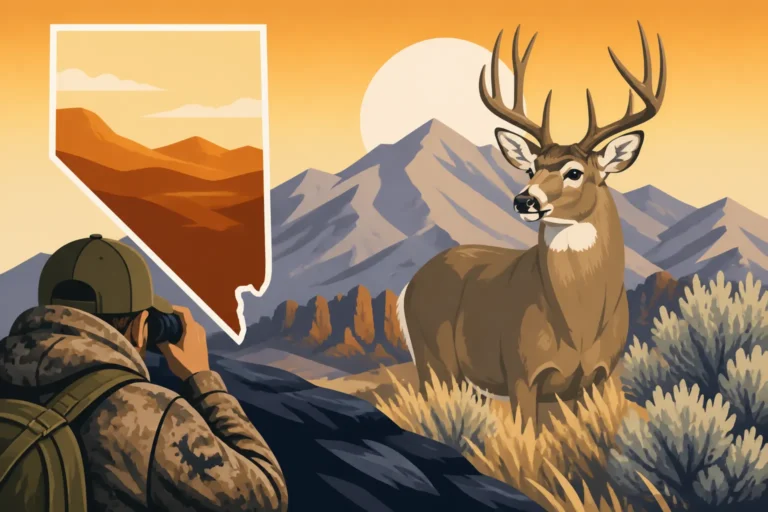
It's an age-old frustration, isn't it? You arrive in Nevada's vast, seemingly endless sagebrush country, full of anticipation, only to spend hours slogging through the brush, feeling like you're covering miles but seeing absolutely nothing. The truth is, walking aimlessly in this expansive landscape is a recipe for exhaustion and disappointment. This guide is dedicated to unlocking the true potential of hunting in Nevada by showing you exactly why mastering the art of glassing will always put you ahead of the game compared to simply putting one foot in front of the other.
The Unique Challenges of Nevada's Sagebrush Sea
Hunting in Nevada isn't like hunting in the dense timber of other states. Here, you're faced with a landscape that challenges traditional hunting methods and demands a different approach. The sheer scale and the way game animals utilize the terrain require a hunter to think strategically, not just physically.
Vastness and Deceptive Terrain
Nevada's public lands are legendary for their size, and when you're standing on a ridge looking out over miles of rolling sagebrush, it's easy to feel utterly dwarfed. The scale is immense, and what looks like a flat, easy walk on a map can quickly become a series of steep draws, hidden washes, and rocky outcroppings that make direct travel slow and incredibly difficult. You might spend an entire morning walking what feels like forever, only to realize you’ve barely covered a fraction of the area you intended to.
The terrain itself is deceptive. Mule deer, elk, and antelope are masters of concealment in this open country. A small dip in the ground, a patch of bitterbrush, or even a few scattered juniper trees can hide a trophy animal from view, even when you're relatively close. Walking through these areas, you're often walking past game, not to it. Animals can melt into the landscape with surprising ease, and by the time you've walked into their comfort zone, they've often heard or smelled you and slipped away long before you ever get a glimpse. This constant feeling of being outmaneuvered is a common frustration for hunters new to the Great Basin.
The Elusive Nature of Desert Big Game
Nevada's big game animals, particularly its mule deer and pronghorn, are incredibly adapted to their wide-open habitat. They possess exceptional eyesight, hearing, and a sense of smell that far surpasses our own. When you're walking, you're a moving target, constantly broadcasting your presence through sound, scent, and silhouette. The wind shifts, a twig snaps, or your profile appears on a skyline, and boom – they're gone. These animals rely on their senses and the vastness of the landscape for survival, often bedding in spots where they can observe their surroundings without being easily seen themselves.
Finding a bedded buck or a tucked-away herd of elk by walking alone is like finding a needle in a haystack. They learn quickly to identify and avoid human presence. Their natural camouflage and stillness allow them to disappear right before your eyes. This is especially true for mature bucks and bulls, who didn't get big by being careless. They tend to frequent areas with escape routes and vantage points, making a direct approach on foot a constant battle against their superior senses. Understanding Why Nevada Deer Hunting Is a Glassing Game is key to success in this environment.
The Art and Science of Effective Glassing
Instead of blindly covering ground, smart hunters use their eyes and specialized tools to conquer the vastness. Glassing isn't just looking; it's a systematic approach to surveying the landscape, allowing you to find game efficiently and plan your next move with confidence.
Essential Optics for Nevada's Long Sightlines
When you're hunting in country where you can see for miles, your optics become your most important piece of gear, arguably more so than your rifle. You wouldn't try to drive across the state without proper tires, and you shouldn't try to hunt this terrain without quality glass. A good pair of 10x binoculars is a non-negotiable starting point, perfect for scanning closer areas and quickly identifying movement. However, for truly picking apart those distant hillsides and finding that bedded buck half a mile away, you'll want something more powerful. Many experienced Nevada hunters swear by 12x or even 15x binoculars mounted on a tripod for extended viewing comfort and stability.
But the real workhorse for long-range reconnaissance is a high-power spotting scope. Something in the 20-60x or 20-80x range, again, mounted on a rock-solid tripod, will allow you to discern antler size, confirm species, and truly study an animal's behavior without ever having to take a step. This level of magnification allows you to identify key features of a buck, helping you make a confident decision on whether to initiate a stalk. The importance of a steady platform for your optics cannot be overstated; even the slightest wobble at high magnification will blur your image and cause eye strain. Invest in the best optics you can afford; they are your eyes across the Optics Power for Nevada's Long Sightlines.
Mastering the Grid Glassing Method
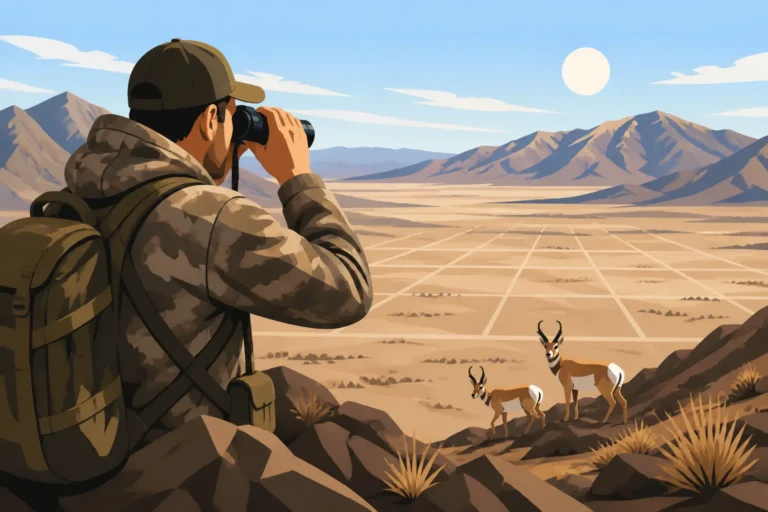
Effective glassing isn't just pointing your binoculars at a hillside. It's a methodical process, a "grid search" for animals within the landscape. The goal is to leave no stone unturned, no clump of sage unchecked. Here’s a basic breakdown of The Grid Glassing Method, Step by Step:
- Find a Vantage Point: First, identify a high point that gives you an expansive view of the area you want to hunt. This could be a ridge, a small knoll, or even the top of your vehicle if you're road-hunting. Ensure you have a stable position for your tripod.
- Divide and Conquer: Mentally (or physically, if using a reticle) divide the area in front of you into manageable sections. Start with the closest section, perhaps a quarter-mile wide, and scan it thoroughly before moving further out.
- Slow and Steady: Begin your scan at the leftmost edge of your chosen section, starting from the top of the ridge and slowly working your way down to the bottom of the draw. Once you've scanned that vertical strip, move your optics a few inches to the right and repeat the vertical scan.
- Overlap Your Scans: Make sure each scan slightly overlaps the previous one. This prevents you from missing an animal that might be right on the edge of your field of view.
- Look for "Pieces": Don't just look for an entire animal. Look for antlers, ears, a patch of hide, a horizontal line in a vertical world, or any unnatural shape, color, or movement. A flicking ear, a patch of white rump, or the glint of an antler in the sun can be your first clue.
- Change Focus: Once you've thoroughly scanned a near section, adjust your focus for a farther section and repeat the process. Work your way across the entire basin, from near to far, left to right. This systematic approach, rather than haphazardly panning, dramatically increases your chances of spotting game. Patience is key; it often takes many minutes, sometimes hours, for an animal to reveal itself, even if it's been there the whole time.
Reading Thermals and Light
Animals are masters of their environment, and understanding how thermals and light play a role in their daily patterns can give you a significant advantage. Thermals are air currents that rise and fall with the sun, carrying scent with them. In the morning, as the sun warms the ground, thermals rise uphill. In the evening, as the air cools, they fall downhill. Knowing this helps you predict where your scent will travel and how animals might position themselves. A savvy hunter will try to glass from a position where the prevailing wind and thermals carry their scent away from the animals they're trying to locate. This is particularly crucial when you're planning a stalk; neglecting to Reading Wind on a Long Sage Stalk can blow your entire hunt.
Light also dictates when and where animals are most visible. Early morning and late evening are prime glassing times. The low-angle sun creates long shadows that highlight contours and can reveal animals bedded on opposite slopes. The "golden hour" light can also make animal coats stand out against the landscape. During the harsh midday sun, animals often seek shade, making them harder to spot. However, don't write off midday glassing entirely. Sometimes a subtle shift in light or an animal simply standing up to stretch can reveal its presence, proving that patience truly pays off at any time of day. Knowing the Best Time of Day to Glass a Basin is critical for successful observation.
Why Glassing Outperforms Covering Ground on Foot
When you weigh the pros and cons, especially in Nevada's unique hunting environment, glassing offers a clear advantage over continuous walking. It's about working smarter, not just harder.
Maximizing Your Scouting and Hunting Efficiency
Think about the sheer amount of ground you can effectively survey from a single vantage point with good optics. While you're stationary, glassing one basin, a walking hunter might only cover a small fraction of that same area, and with significantly less detail. By carefully utilizing a good Tripod Setup for Glassing From a Ridge, you can literally scan square miles of potential habitat in the time it would take to walk a few hundred yards. This incredible efficiency means you're more likely to locate animals, and not just one, but potentially multiple herds or individual animals in different locations.
Once you spot an animal, especially a potential target buck or bull, glassing allows you to study it in detail. You can assess its size, antler configuration, and behavior. You can observe its escape routes, identify potential bedding areas, and watch its feeding patterns. This crucial intelligence gathering, done from a safe distance, is invaluable for planning a precise and effective stalk. Instead of stumbling upon an animal and reacting hastily, you can develop a thoughtful strategy, knowing exactly what you're approaching. This methodical approach is a cornerstone of modern Western hunting and drastically improves your odds of a successful harvest. Companies like GoHunt provide mapping tools that are incredibly useful for identifying potential glassing points and planning efficient scouting routes.
Conserving Energy for the Stalk
Nevada's sagebrush country is physically demanding. The elevation changes, the uneven footing, and the sheer distances can quickly wear you down. Imagine spending hours slogging up and down hillsides, only to finally spot an animal, but you're too exhausted to execute a stealthy stalk. It's a common scenario, and it's demoralizing. Glassing, by contrast, allows you to conserve your energy for the moment that truly matters: the stalk itself.
By spending your time behind the glass, you minimize physical exertion during the initial search phase. This means when you do finally locate that trophy animal, you'll be fresh, focused, and ready to implement your plan. A successful stalk often requires significant bursts of energy, careful foot placement, and sustained mental focus. You'll need every ounce of energy to navigate the terrain quietly, stay hidden, and close the distance, whether it's How Far to Stalk a Bedded Mule Deer or a herd of antelope. Keeping your legs fresh is an often-overlooked advantage that glassing provides, directly contributing to your ability to make a clean, ethical shot when the opportunity arises. Remember to stay hydrated and keep your energy up by Preparing Physically for Long Glassing Days, regardless of your method.
Reducing Your Scent and Movement Signature
Every step you take, every rustle of clothing, every human scent molecule you release into the air, increases your chances of alerting game. In wide-open sage country, animals are highly attuned to anything out of the ordinary. A hunter walking through a basin is a beacon of disturbance, easily detected by the keen senses of deer, elk, and antelope.
When you're glassing, you're typically stationary, often tucked behind a ridge or in a concealed position, minimizing your visual profile and reducing the amount of scent you're spreading. By staying put, you become a less obvious threat, allowing animals to move naturally and reveal themselves. This passive approach often yields more sightings of undisturbed game, which are more likely to stay put and offer a shot opportunity. It’s a game of stealth and patience, where minimal disturbance greatly enhances your chances of success.
Practical Tips for Glassing Success in Nevada
Even with the right mindset and equipment, glassing takes practice and a few strategic considerations to truly master. Here are some actionable tips to elevate your glassing game in Nevada's challenging terrain.
Choosing the Right Vantage Point
Selecting the ideal glassing spot is half the battle. You want to find a position that offers a panoramic view of the basin or hillside you intend to hunt, but critically, also provides concealment for yourself. Look for finger ridges that extend into a canyon, allowing you to see into multiple drainages without exposing your full silhouette. Isolated knobs or small peaks can offer excellent 360-degree views. Always consider the sun's position throughout the day; you don't want to be constantly looking directly into the sun, as this causes glare and eye strain. Early morning, try to position yourself with the sun at your back, illuminating the opposing slopes. In the evening, reverse this, allowing the setting sun to highlight animals.
Furthermore, think about your backdrop. Try to glass from a position where you blend into the terrain, minimizing your profile against the sky. A good vantage point isn't just about seeing far; it's about seeing effectively and without being seen yourself. Remember, you might be staying in this spot for hours, so comfort and stability are key.
Utilizing Technology for E-Scouting
In this digital age, technology can give you a significant leg up before you even set foot in the field. Platforms like GoHunt and other mapping applications are invaluable for E-Scouting a Nevada Unit Before the Season. From the comfort of your home, you can pore over satellite imagery and topographic maps to identify potential glassing knobs, likely travel corridors, bedding areas, and water sources.
Look for areas where different habitat types converge, like the edge of a sage flat meeting a rocky bluff, or where a dense patch of juniper breaks up the open country. These are often prime locations for animals. Mark potential glassing locations on your map, noting elevation changes and access routes. By doing this homework, you can arrive at your unit with a well-researched plan, spending less time wandering and more time effectively hunting. GoHunt's detailed maps and data can really streamline this process, helping you pinpoint high-potential areas.
Patience and Perseverance
This might be the most crucial tip of all: glassing demands patience. It's not a fast-paced activity; it's a slow, deliberate method that rewards perseverance. It's easy to get discouraged after 30 minutes of seeing nothing, but animals rarely just appear on command. They might stand up from a bed, shift their position, or walk out from behind a juniper at any moment.
Commit to spending extended periods in each glassing spot. Sometimes it takes an hour or more for your eyes to truly adjust to the landscape and begin picking out subtle details. Take breaks to rest your eyes, then return to the glass with fresh focus. Don't underestimate the power of simply waiting. Many times, what initially appears to be an empty hillside will eventually reveal a hidden buck or a small herd of elk as they stretch, feed, or move. The biggest mistake many hunters make with glassing is not giving it enough time. Let the landscape unfold before you.
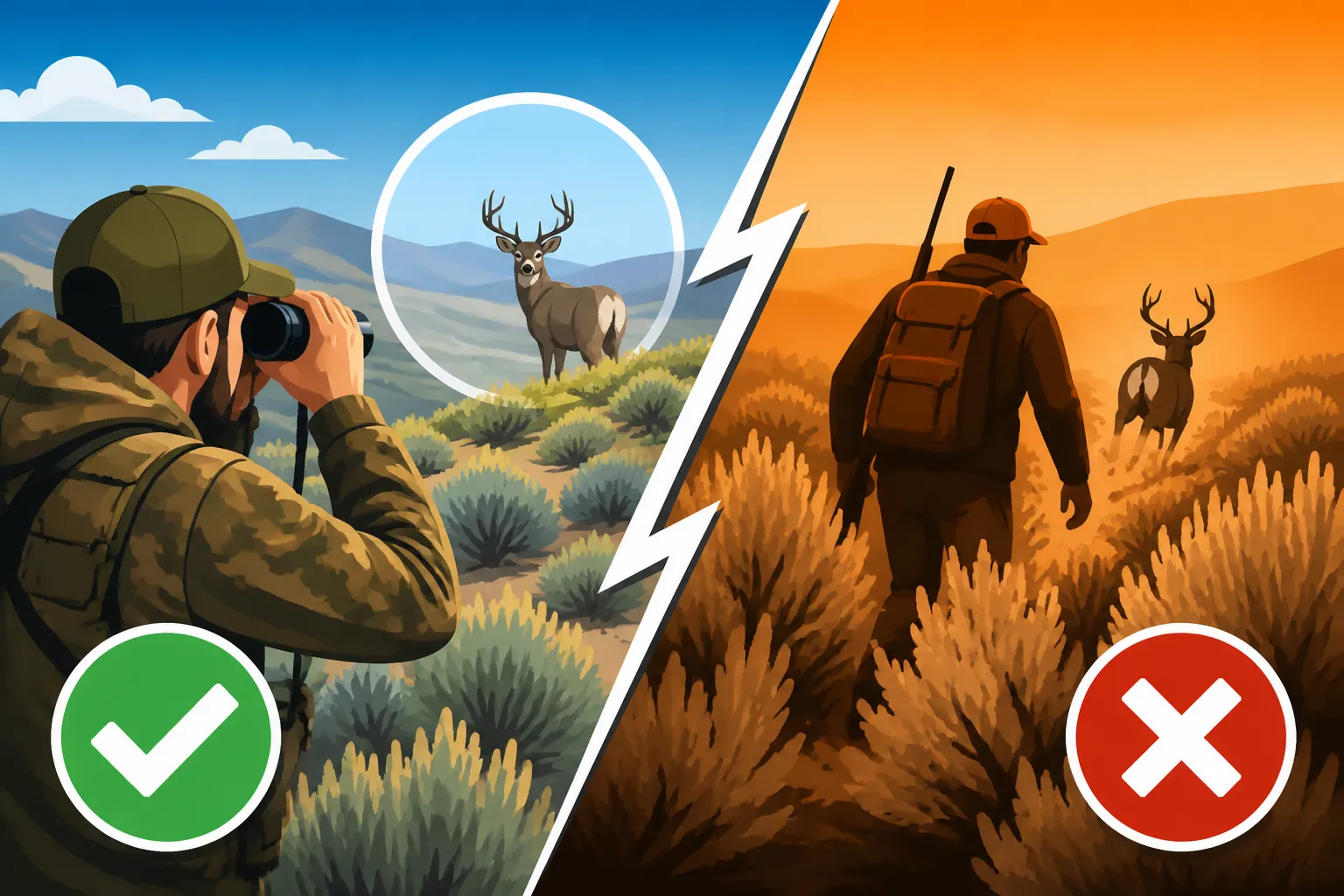
Glassing vs. Walking: A Quick Comparison
To put it all into perspective, here's a brief breakdown of the core differences and advantages of each method in Nevada's vast hunting grounds.
| Feature | Glassing | Walking |
|---|---|---|
| Efficiency | Surveys vast areas quickly from one spot. | Covers limited ground, often haphazardly. |
| Energy Use | Low during search phase, high for stalk. | High and sustained, leads to quick fatigue. |
| Stealth | Minimal scent and movement signature. | High scent and movement, alerts game easily. |
| Animal Discovery | Identifies animals from a distance, undisturbed. | Often spooks animals before they're seen. |
| Information Gain | Allows detailed study of animals & terrain. | Limited info, reactive decisions. |
| Equipment Focus | Quality binoculars, spotting scope, tripod. | Boots, backpack, physical endurance. |
| Best For | Open, expansive terrain like Nevada's sage. | Dense cover, limited sightlines, tracking. |
Disclaimer
Hunting is an inherently dangerous activity. Always prioritize safety, follow all local and state regulations, and ensure you have the necessary licenses and permits. The information provided here is for educational purposes only and should not replace proper hunter education or professional guidance. Always hunt ethically and responsibly.