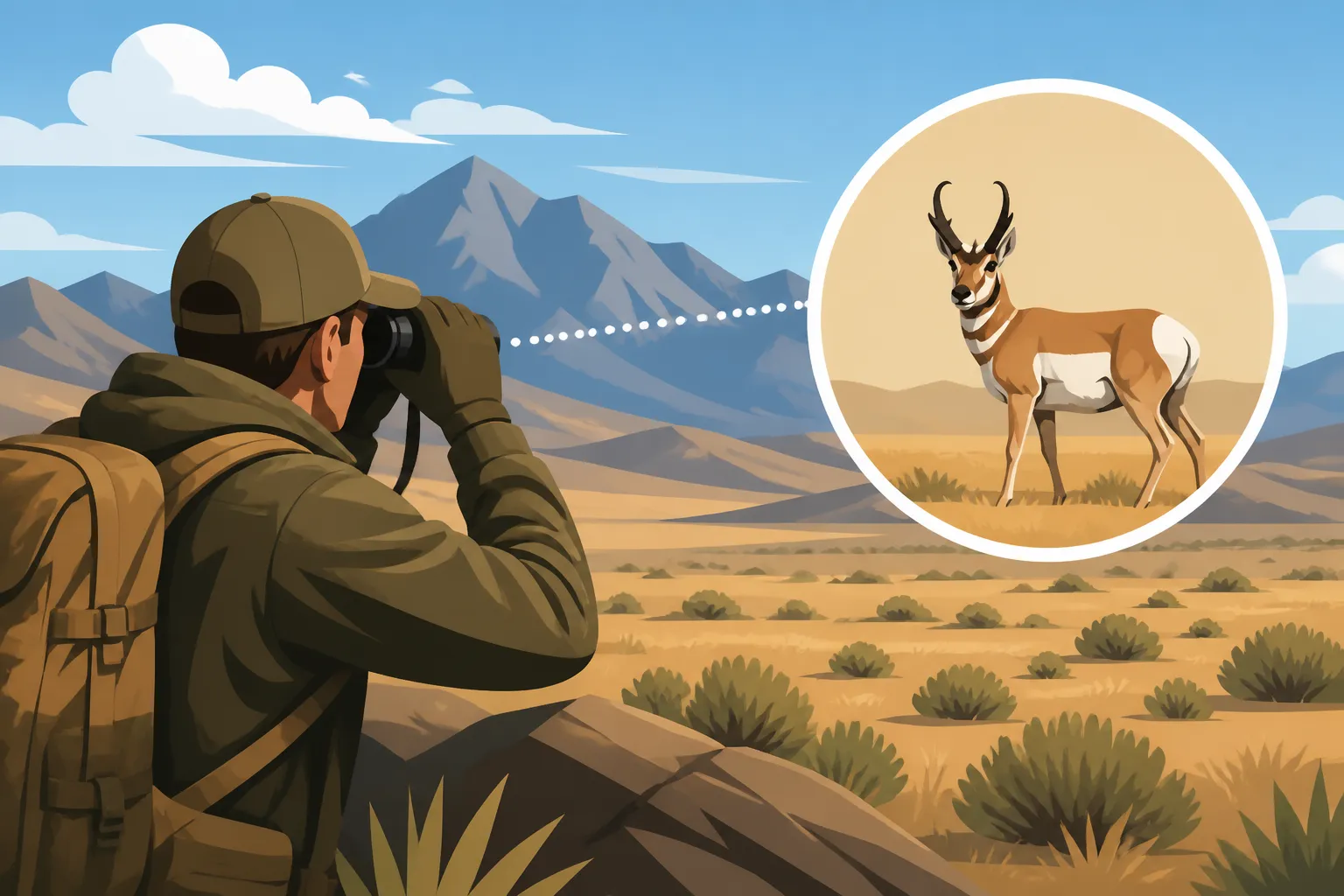
Field Judging a Pronghorn Buck From Distance
You've spent years putting in for that coveted Nevada pronghorn tag, dreaming of chasing "speed goats" across the vast, open basins of the Silver State. Now that you've drawn, the real challenge hits: how do you reliably judge a buck from a distance when everything looks tiny and distorted through your optics? It's a common frustration in country where an animal can be a mile away one minute and over the horizon the next. This guide will delve deep into the art and science of field judging a pronghorn buck, helping you make confident, quick decisions when the moment of truth arrives.
The Challenge of Judging Pronghorn in Nevada's Open Country
Nevada's landscape, characterized by its wide-open sagebrush flats and rolling hills, presents a unique set of difficulties when it comes to field judging pronghorn. Unlike hunting deer in dense timber where you might only get fleeting glimpses, pronghorn are almost always out in the open, but often at extreme distances that play tricks on your eyes. It’s a game of patience, optics, and quick, accurate assessment.
Why Distance and Speed Make It Tough
Imagine glassing a vast expanse of sagebrush near, say, a unit bordering the Schell Creek Range, when a flicker of movement catches your eye. Through your binoculars, you pick up a small herd of antelope. They’re a mile away, maybe more, just specks in the heat waves dancing off the ground. Pronghorn are masters of their open environment, built for incredible speed and covering immense distances with seemingly effortless grace. This means that a buck you spot might not linger in one place for long. He could be feeding calmly, then suddenly decide to travel several hundred yards in minutes, or even bed down in a slight depression, disappearing from view entirely. The sheer scale of the landscape makes every animal look smaller, and judging anything accurately at these ranges without quality optics and a practiced eye is incredibly difficult. You’re not just fighting distance; you're battling the optical illusions created by shimmering air and the constant movement of these wary animals.
The environment itself adds to the complexity. The subtle coloration of a pronghorn blends surprisingly well with the tan and gray tones of the Nevada desert. A buck might be standing perfectly broadside, giving you a textbook view, but the next moment he could turn his head, obscuring the critical horn features you need to see. This fleeting opportunity to judge, combined with their inherent caution, means you rarely have the luxury of extended observation without risking them bolting. Knowing how fast a pronghorn can actually run really drives home this point—they can cover ground quicker than almost any other big game animal. This rapid movement often forces you into making a snap judgment, which is exactly what we want to avoid if possible, but sometimes unavoidable when trying to close the last hundred yards on a pronghorn.
The Urgency of a Quick Decision
Drawing a Nevada pronghorn tag is a monumental achievement for many hunters, often taking years of applying and building points. With such a highly coveted tag, the pressure to make the most of it is immense. You've invested time, money, and emotional energy into this hunt. When that buck finally appears, seemingly out of nowhere, you often don't have the luxury of a leisurely decision-making process. Opportunities can be fleeting, especially if you're executing a spot and stalk antelope on Nevada's open flats. A buck might pop over a rise, present a shot, and be gone before you've had time to process all the details.
The worst feeling is passing on a buck you thought was too small, only to realize later, or from another angle, that he was a true trophy. Or, conversely, making a long stalk on a buck you overestimated, only to find he was much smaller once you get close. Both scenarios are heartbreaking after the effort involved in a western hunt. The urgency comes from the knowledge that this might be your only chance for a quality shot, or even your only opportunity to see a mature buck on your limited tag. This pressure is real, and it’s why honing your field judging skills before the hunt is so critical. You want to be able to quickly and confidently assess a buck's potential, making an informed "go/no-go" decision without second-guessing yourself when the adrenaline spikes.
Key Characteristics for Field Judging a Pronghorn Buck
When you're trying to size up a pronghorn buck across a vast Nevada basin, you need a mental checklist of key features. It's not just about raw length; it's a combination of horn mass, shape, and even certain facial features that paint a complete picture.
Horn Length and Mass
The first thing most hunters look for is horn length. A good rule of thumb for estimating length is to compare it to the length of the buck’s ear. Pronghorn ears are typically around 5-6 inches long. If the horns appear to be twice the length of the ear, you're likely looking at a buck with horns in the 10-12 inch range. Truly exceptional bucks will have horns that extend significantly beyond this, sometimes three times the ear length or more, pushing into the 14-16 inch class. However, don't rely solely on length; mass is equally, if not more, important for a truly impressive buck.
Mass refers to the thickness of the horn, especially from the base up to the prong. A common mistake is to only look at the length and overlook the bulk. Picture a mature buck's horns as thick, heavy columns that hold their girth well past the ears and continue with good mass right up to the prong. A younger buck, even with decent length, will often have slender, "pencil-thin" horns. The "prong" or fork itself is another crucial indicator. Note its location relative to the tip of the ear. On a mature buck, the prong will usually be located above the ear, sometimes significantly so, indicating good length and an overall older animal. A buck whose prong is at or below the ear is typically younger and still developing. Look for horns that are thick, dark, and appear to have a solid, robust quality throughout their length.
The Black Patch (Cheek Patch)
This is a surprisingly reliable and often overlooked identifier for bucks. All mature pronghorn bucks will have a distinct, dark black patch on their lower jaw or cheek area. It's like a prominent beard or sideburn. This patch is usually very noticeable, especially on a buck that is broadside or slightly quartering away. Does, on the other hand, either lack this patch entirely or have only a very faint, almost invisible smudge.
This black patch is a fantastic quick filter. When you first pick up a herd at a distance, quickly scan for those prominent black cheek patches. Any animal without a clear, dark patch is likely a doe or a very young buck. This immediately helps you narrow down your focus to potential targets. For instance, when you're looking at a group of Pronghorn on Nevada's Valley Floors, this patch can be the first clue to identify a buck amidst the herd. It’s consistent, easy to spot with decent optics, and doesn't require estimating dimensions like horn length. If you're using a spotting scope power for open country, this feature will really pop and give you confidence in identifying a male.
Horn Shape and Divergence
The overall shape and how the horns diverge from the head also contribute significantly to a buck's trophy potential and aesthetic appeal. While some bucks have horns that sweep straight up and then back, others might have a more pronounced curl or flair. Look for symmetry and a pleasing overall form. Wide-flaring horns can look impressive, adding to the visual width, but sometimes excessively wide horns might sacrifice mass or length in other areas. Conversely, horns that are too narrow or "stovepipe" straight might lack the desirable classic pronghorn look.
The divergence, or how far apart the horns spread, is another characteristic. Some bucks will have horns that spread wide, giving them an impressive, broad appearance, while others will be tighter. A buck with good "cutters" – the points that come off the main beam – that project out prominently can also add to the overall score and visual appeal. When you're trying to make a quick decision, pay attention to the entire silhouette of the horns. Do they rise gracefully? Do they hold their mass? Does the prong project forward clearly, or is it merely a slight bump? Often, you'll see bucks with "hooks" at the very tip, a slight curl inward or backward, which can add character. These nuances, when viewed through good optics, can help you decide on a buck before he moves out of sight.
Overall Body Size and Demeanor
While not as definitive as horn characteristics, a buck's overall body size and demeanor can provide supporting clues to his age and potential horn size. Mature bucks tend to have a larger, more muscular build compared to younger animals. They often have thicker necks and a more robust body frame. Young bucks might look lanky, almost like teenagers still growing into their bodies.
A mature buck often carries himself with a certain confidence or dominance within the herd. He might be the first to lift his head, the one who keeps an eye on approaching threats, or the one that stands slightly apart from the main group of does and younger bucks. Of course, this isn't a hard and fast rule, as even a young buck can sometimes show dominant behavior, especially when bucks are going into rut. However, if you see a noticeably larger-bodied antelope with thick horns and a prominent black patch, you're likely on the right track. Remember, a smaller body doesn't automatically mean a small rack, but generally, the older, more mature bucks have had more seasons to grow impressive headgear.
Practical Tips for Effective Distance Judging
Knowing what to look for is one thing, but actually seeing it and making a call in the field is another. You're fighting heat distortion, vast distances, and the natural camouflage of these animals. Having the right tools and a solid strategy makes all the difference.
The Role of Quality Optics
Let's be real, in Nevada's open country, your optics are your best friend—they're practically your hunting partner. You absolutely cannot reliably field judge pronghorn without top-tier binoculars and a quality spotting scope. Trying to do it with lesser equipment is like trying to read a roadmap in the dark; you'll miss critical details and likely make a mistake. For starters, a pair of 10x or 12x binoculars are your primary scanning tool. They allow you to cover vast areas efficiently and quickly locate animals. A good binocular size that survives an all-day session will be comfortable to hold and stable for extended glassing.
Once you spot a potential target, that's when your spotting scope comes into play. With its higher magnification (think 20-60x or even 80x), you can really zoom in and examine the fine details of the horns, like mass, the exact location of the prong, and the presence of the black cheek patch. This is crucial for Optics power for Nevada's long sightlines. A tripod for your spotting scope is non-negotiable; trying to handhold it at high magnification is pointless due to image shake. Before you even step foot in the unit, tools like GoHunt can be invaluable for e-scouting, helping you identify potential areas where bucks might hang out, giving you a head start on where to direct your glass. Having a steady platform is just as important as the glass itself for those critical moments of observation.
Using Environmental Cues for Scale
It’s incredibly hard to judge size in a vacuum, especially when mirage is dancing and distorting the image. This is where environmental cues become your secret weapon. Pronghorn are almost always found in areas with low-growing vegetation, like sagebrush. If you can see the buck standing next to a common sagebrush plant, you can use that plant's approximate height as a reference. Most mature sagebrush plants might be 2-3 feet tall. If the buck's horn tips barely clear the top of a prominent sagebrush, he's likely not a giant. If they tower over it, that's a good sign.
Another useful cue, though less common, is a fence post. If you're fortunate enough to spot a buck near a fence line, knowing that a typical fence post stands around 3-4 feet above the ground can give you a solid reference point for horn length relative to body size. Even comparing the buck to a nearby doe can be invaluable for judging. Does are generally smaller and lack the prominent horns and black cheek patches of a buck. If a potential shooter buck looks significantly larger and heavier than the does in the same group, it provides a strong indicator of maturity. Always look for anything in the frame that can give you a sense of scale, even if it's just a rock of known size.
Patience and Observation When Possible
While the "speed goat" reputation often dictates quick decisions, there are times when patience truly pays off. If you spot a group of antelope at a distance and they appear to be calm, perhaps feeding or resting, take your time. Instead of rushing to judgment, observe them. A buck will often present different angles as he feeds or moves within the herd. Wait for him to turn his head, to lift it proudly, or to stand broadside for a clear view of his horns and that tell-tale black patch.
Sometimes, waiting for other animals in the herd to stand near the buck can provide invaluable context. Comparing a potential trophy buck directly against a doe or a smaller buck can instantly highlight differences in body size, horn length, and mass that are otherwise difficult to ascertain. This calm observation period also allows you to gauge the herd's general temperament and potential movement patterns, informing your stalk strategy. Reading antelope body language on a stalk means understanding when you have a window to observe and when you need to act fast. Even a few extra minutes of patient glassing can prevent a regretful shot or a wasted stalk.
The "Go/No-Go" Decision Matrix
To help streamline your decision-making process, especially under pressure, it's useful to have a mental (or even written) "go/no-go" matrix. This helps you quickly run through the key criteria.
| Characteristic | "Go" Buck (Shooter) | "No-Go" Buck (Pass) |
|---|---|---|
| Horn Length | Appears 2.5-3+ times ear length | Appears 2 times ear length or less |
| Horn Mass | Thick from base, holds mass well up to prong | Thin, "pencil-like" horns, lacks girth |
| Prong Location | Clearly above the ear, well-defined | At or below the ear, often small or barely visible |
| Black Cheek Patch | Prominent, dark, distinct on the lower jaw | Faint or absent |
| Overall Body Size | Appears large-bodied, robust, mature | Smaller, lanky, less developed body |
| Horn Shape/Symmetry | Good sweep, symmetrical, strong cutters | Irregular, broken, or noticeably asymmetrical |
Remember, this isn't about scoring the animal down to the inch, but rather about making a quick assessment to decide if this is the caliber of buck you are looking for on your hunt. By consistently using this matrix, you’ll build confidence and make fewer mistakes when that big buck finally presents himself.
Conclusion
Field judging a pronghorn buck from distance is undoubtedly one of the most challenging aspects of hunting these incredible animals in Nevada. The vastness of the landscape, the deceptive nature of distances, and the speed of the "goats" themselves all conspire to make accurate assessment a tough nut to crack. However, by understanding the key characteristics to look for – horn length and mass, the critical black cheek patch, horn shape, and overall body size – and by employing smart strategies with quality optics, you can significantly improve your chances of making a confident, successful decision. Remember, every moment you spend practicing with your optics, learning the nuances of antelope anatomy, and e-scouting your unit with tools like GoHunt, is an investment in your hunt. Ultimately, the goal is to enjoy the pursuit and the unique challenge that Nevada's pronghorn offer, knowing you've done your homework to make the most of your hard-earned tag.
Disclaimer
This article is for general informational purposes only and does not constitute professional advice. Laws, prices and regulations vary by location and change over time. Consult a qualified professional for guidance on your specific situation.