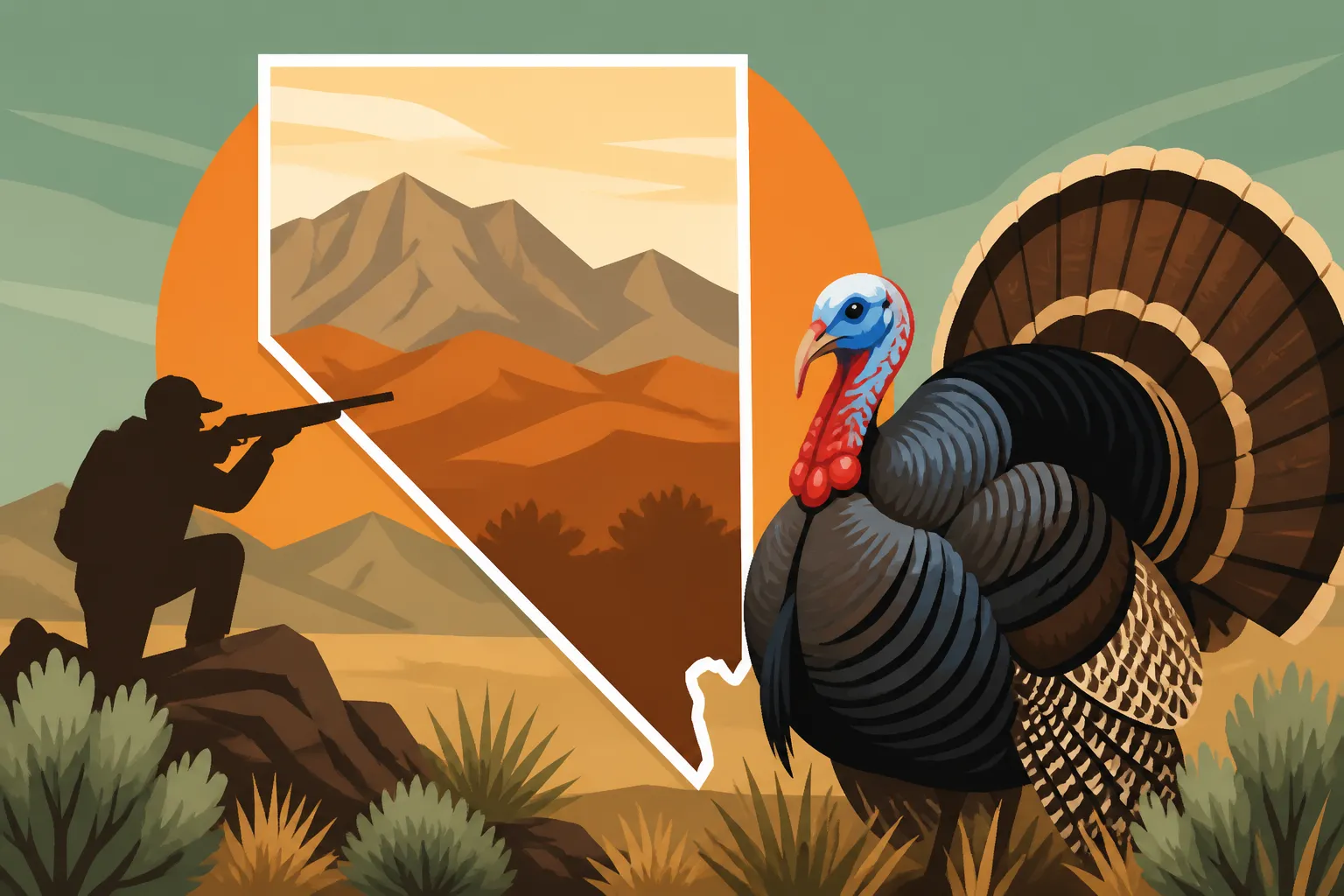
Nevada Turkey Hunting Units
Trying to figure out where turkeys even exist in Nevada can feel like a real wild goose chase, especially if you're used to states where gobblers are practically tripping over each other. Many hunters assume Nevada is all sagebrush and desert, and while that's largely true, there are pockets of prime habitat for wild turkeys that offer incredible, albeit challenging, hunting opportunities. This guide will walk you through the units where you actually have a shot at a Nevada gobbler, what to expect from these unique hunts, and how to increase your odds of success.
Understanding Nevada's Unique Turkey Landscape
When you think of Nevada, images of vast open basins, towering mountain ranges, and endless sagebrush typically come to mind. And you wouldn't be wrong; much of the state fits that description. However, scattered across this arid landscape are vital riparian corridors—rivers and streams lined with cottonwoods, willows, and other deciduous trees—that create the perfect conditions for wild turkeys to thrive. These aren't the dense hardwood forests of the Midwest or the pine plantations of the South; Nevada's turkey habitat is distinct and requires a different approach.
The Sparse but Mighty Rio Grande
Nevada's turkey population primarily consists of Rio Grande turkeys, which were introduced decades ago to these specific riparian environments. Unlike their Eastern or Merriam's cousins, these birds are adapted to more open country and can often be found scratching around along riverbanks, moving between cover and more open foraging areas. Their numbers aren't massive, and they're definitely not in every patch of suitable habitat, but where they do exist, they can offer a genuinely rewarding hunt. It’s a testament to their adaptability that they've made a home in such an unexpected place.
Hunting these birds means understanding their preference for these linear habitats. They don't typically roam far from water and the dense cover these areas provide for roosting and security. You'll often find them working their way along a river, sometimes busting up into the surrounding agricultural fields or rangeland to feed, but always returning to the river bottom for safety and roosting. This makes finding them a bit more predictable than in larger, more uniform habitats, but it also means the huntable areas are relatively narrow.
River Corridors: Turkey Hotspots
The major river systems running through Nevada are the lifeblood for these turkeys. These aren't roaring, wide rivers like the Mississippi, but often smaller, meandering waterways that carve green ribbons through otherwise dry landscapes. The trees along these rivers—cottonwoods, specifically—are crucial for roosting. Without these tall, sturdy trees, turkeys simply wouldn't be able to establish a foothold.
These corridors provide everything a turkey needs: water, food sources like seeds, insects, and berries, and crucial cover from predators. During the spring, when Nevada's turkey seasons typically open, these areas are often the first to green up, offering fresh forage. Recognizing these green strips on a map is your first step to identifying potential turkey units. It's a classic example of how wildlife adapts to the specific conditions of their environment, creating unique hunting challenges and rewards. Reading a Nevada Hunt Unit Before You Apply is essential for understanding how these corridors are encompassed within specific units.
Key Units for Nevada Turkey Hunters
Finding a turkey unit in Nevada isn't as simple as just picking a number off a map; you really need to understand the underlying geography and habitat. The most productive units are invariably tied to the state's major river systems, which provide the consistent water and vegetation necessary for turkeys to survive and reproduce. These aren't units known for trophy elk or massive mule deer, but for the distinct opportunity to pursue a challenging game bird in a truly unique setting.
Units Along the Humboldt River
The Humboldt River system, particularly in the northern and central parts of the state, is arguably the most consistent producer of wild turkeys in Nevada. The river flows generally east to west, creating an extensive ribbon of riparian habitat through a vast sagebrush sea. Units such as Unit 061 and Unit 062 are often mentioned as prime locations. The river itself, with its mature cottonwoods and dense undergrowth, provides excellent roosting and nesting cover.
Hunting these areas often involves covering ground along the riverbanks, listening for gobblers at dawn, and setting up in strategic locations where you can intercept birds moving between roosts and feeding areas. Access can be a mix of public lands and private agricultural ground, so it's critical to know your boundaries and obtain permission where needed. The key here is patience and persistence, as gobblers in these areas can be just as cagey as any other.
Truckee and Carson River Valleys
Moving further west, the Truckee River and Carson River valleys also offer limited but viable turkey hunting. These rivers, fed by the Sierra Nevada snowpack, create rich, fertile floodplains that support significant riparian zones. Unit 194 near the Carson River and Unit 200 along the Truckee can hold huntable populations. These areas are often more developed with agriculture and residential zones, which means public access points might be fewer and farther between, and you'll need to be extra vigilant about safety zones and private property.
The hunting here can be more fragmented, with turkeys moving between small patches of cover and irrigated fields. Success often comes down to intense pre-season scouting to pinpoint exactly where birds are roosting and feeding. Don't be surprised to find turkeys in unexpected places, especially where a small creek or irrigation ditch feeds into the main river, creating micro-habitats they can exploit. Using tools like GoHunt's mapping features can be invaluable for identifying these smaller, often overlooked pockets of habitat within a larger unit.
Other Potential Riverine Areas
Beyond the main river systems, there are other, smaller drainages and creeks throughout Nevada that occasionally support turkey populations, though often in lower densities. For example, some units in eastern Nevada that include parts of the Snake Range or Schell Creek Range might have isolated pockets of turkeys along perennial streams. These are often steeper, more mountainous environments compared to the broader river valleys.
These smaller, more isolated populations can be incredibly challenging to hunt, requiring extensive scouting and a willingness to hike steep terrain. However, the reward can be a truly unique and solitary turkey hunting experience. Units like Unit 113 or Unit 114 might have these more dispersed populations, but it's crucial to consult the most recent Nevada Department of Wildlife (NDOW) regulations and harvest reports to gauge current population trends and tag availability. Don't forget that Water is the Access Problem in Southern Nevada for many species, and for turkeys, it's about the presence of consistent water and riparian vegetation.
Here’s a simplified look at some common turkey units and their associated river systems:
| Unit Number | Primary River System | General Location | Notes on Access/Habitat |
|---|---|---|---|
| Unit 061 | Humboldt River | North Central | Mixed public/private, good riparian corridors. |
| Unit 062 | Humboldt River | North Central | Similar to 061, good cottonwood roosts. |
| Unit 194 | Carson River | Western | More agricultural influence, fragmented habitat. |
| Unit 200 | Truckee River | Western | Closer to populated areas, requires careful access planning. |
| Unit 113 | Snake Range (creeks) | Eastern | Mountainous, isolated populations along creeks. |
| Unit 114 | Schell Creek (creeks) | Eastern | Similar to 113, demanding terrain. |
Strategies for Hunting Nevada Turkeys
Hunting turkeys in Nevada demands a different mindset than hunting in, say, Missouri or Alabama. The sheer vastness of the landscape and the linear nature of the turkey habitat mean your strategy has to be precise and well-executed. It's less about finding a vast forest full of birds and more about pinpointing those specific green ribbons where they thrive.
Pre-Season Scouting and E-Scouting
This is where your hunt truly begins. Given the dispersed nature of Nevada's turkey populations, relying solely on opening day luck is a recipe for disappointment. E-scouting with tools like GoHunt is incredibly effective. Start by identifying the major river systems and then zoom in on sections that show mature timber (look for those signature cottonwood tops) and a mix of open areas nearby. Look for bends in the river, agricultural fields bordering the riparian zone, and areas where public land abuts these features. These are likely roosting and feeding areas.
Once you have potential spots, if possible, do some boots-on-the-ground scouting a few weeks before the season. Listen for gobblers at dawn and dusk. Drive dirt roads that parallel the river and look for tracks, droppings, and dusting bowls. This is also your chance to assess public access points and identify any private land boundaries you'll need to respect or seek permission to cross. Understanding the specific terrain and how turkeys use it is paramount.
Calling Tactics in Open Country
Nevada's turkey habitat can be surprisingly open once you get beyond the immediate river bottom. This means your calling strategy needs to adapt. While aggressive calling can sometimes work, particularly if you've located a hot gobbler, often a more subtle approach is better. Loud, rapid calling might alert turkeys to your presence from a long distance, making them wary, especially if they've been pressured.
Start with soft yelps and clucks to gauge their interest. If a gobbler responds, listen carefully to his location and direction of travel. Use natural terrain features, like riverbanks or small rises, to break up your silhouette and give you an advantage. Calling to bring them closer, then going silent, can sometimes pique their curiosity enough to come investigating. Remember, these birds often have to travel across more open ground to reach you, so be patient and let them work. Reading Wind on a Long Sage Stalk is a skill that translates well to turkey hunting here, as sound carries far.
Decoy Use and Setup
Decoys can be incredibly effective in Nevada's turkey units, especially in the more open areas where visibility is high. A well-placed hen decoy, or even a jake and hen setup, can be irresistible to a lonely gobbler looking for company. The key is to set them up so the gobbler approaches from a direction that gives you a clear shot. Think about their likely line of travel and place your decoy where the approaching tom will have to present a good shot opportunity.
Always set up with a good backstop, like a large tree or a brush pile, to break your outline and allow you to draw or shoulder your gun undetected. In particularly open areas, a strutting gobbler decoy can be a powerful magnet, but be aware that it might also attract other hunters who mistake it for a real bird. Always prioritize safety and know what's beyond your target.
Important Considerations for Your Hunt
Beyond the tactics, understanding the administrative and logistical aspects of turkey hunting in Nevada is crucial. It's not a state with widespread turkey opportunities, so the specifics of tags, access, and preparation need careful attention.
Tag Quotas and Application Process
Turkey tags in Nevada are typically limited and often allocated through a draw system, similar to big game tags. This means you can't just walk into a sporting goods store and buy an over-the-counter tag in most units. You'll need to apply during the designated application period, which usually aligns with the big game draw in spring. It's important to keep an eye on the NDOW website for specific dates and unit quotas each year. Success in the draw can sometimes depend on the unit and the number of applicants, so researching previous draw odds can be helpful.
Be prepared for the possibility of not drawing a tag, especially if you're a nonresident. If you're serious about hunting Nevada turkeys, consistently applying each year is part of the game. Once you do draw, cherish that tag—it's a hard-earned opportunity! When Nevada Applications Open in March and The Nevada Application Deadline in May are critical dates to remember for all species, including turkeys.
Accessing Private and Public Lands
As discussed, many of Nevada's prime turkey habitats are along river systems that often flow through a mix of public and private lands. While BLM and National Forest lands offer abundant public access for other species, the narrow, linear nature of turkey habitat means you'll frequently encounter private property, especially agricultural fields and ranches. Always verify land ownership before you hunt, using detailed maps or a GPS unit with land ownership layers.
Respecting private property boundaries is paramount, and if you wish to hunt on private land, securing permission from the landowner well in advance is non-negotiable. Building relationships with landowners can unlock incredible hunting opportunities. Failing to do so can result in trespass charges and harm the reputation of all hunters. Remember, Getting Landowner Permission in Nevada is a skill in itself.
Gear and Logistics for a Nevada Turkey Hunt
A Nevada turkey hunt, even for a single day, can be physically demanding. Expect to cover significant ground, often through thick brush along river bottoms or across open, uneven terrain. Good quality boots that are comfortable for walking long distances are a must. Layered clothing is also key, as spring mornings can be chilly, but midday temperatures can climb quickly in the Nevada sun.
Bring plenty of water, as reliable water sources can be scarce away from the river itself. A good set of binoculars will help you spot birds from a distance, crucial in open country. Beyond your firearm or bow, your calls, and decoys, consider a comfortable seat cushion or small chair for long setups. Given the remote nature of some units, a reliable vehicle, spare tire, and emergency supplies are also wise precautions. Planning for Preparing Physically for Long Glassing Days will set you up for success in covering ground.
Disclaimer
This article is for general informational purposes only and does not constitute professional advice. Laws, prices and regulations vary by location and change over time. Consult a qualified professional for guidance on your specific situation.