Why Nevada Guides Rely on Optics
If you've ever spent a day chasing ghosts in the vastness of Nevada's backcountry, you know the frustration of feeling small and insignificant against an endless horizon. Hunting here isn't like sneaking through dense woods; it's a game of observation, patience, and making the impossible visible. This guide dives deep into why optics aren't just a luxury for Nevada hunting guides, but an absolute, non-negotiable necessity for success in this incredibly expansive landscape.
The Immense Scale of Nevada's Hunting Terrain
Nevada isn't known for its dense forests where you might stumble upon an animal just around the next bend. Instead, it offers a landscape of staggering scale, where an animal can be miles away and still feel like it's in your immediate vicinity. This vastness is both its allure and its greatest challenge, and it's precisely why a guide's eyes are always glued to their glass.
Miles of Sagebrush and Open Valleys
Imagine standing on a small rise, looking out over a sagebrush sea that stretches for twenty, thirty, or even fifty miles to the next mountain range. That's a typical view in much of Nevada. You can't just walk that ground and expect to find game; you'd exhaust yourself long before you covered any meaningful portion of a prime mule deer or antelope unit. This is where the power of optics truly shines. A guide can systematically break down huge swaths of country, picking apart every fold, every shadow, and every patch of cover from a single vantage point.
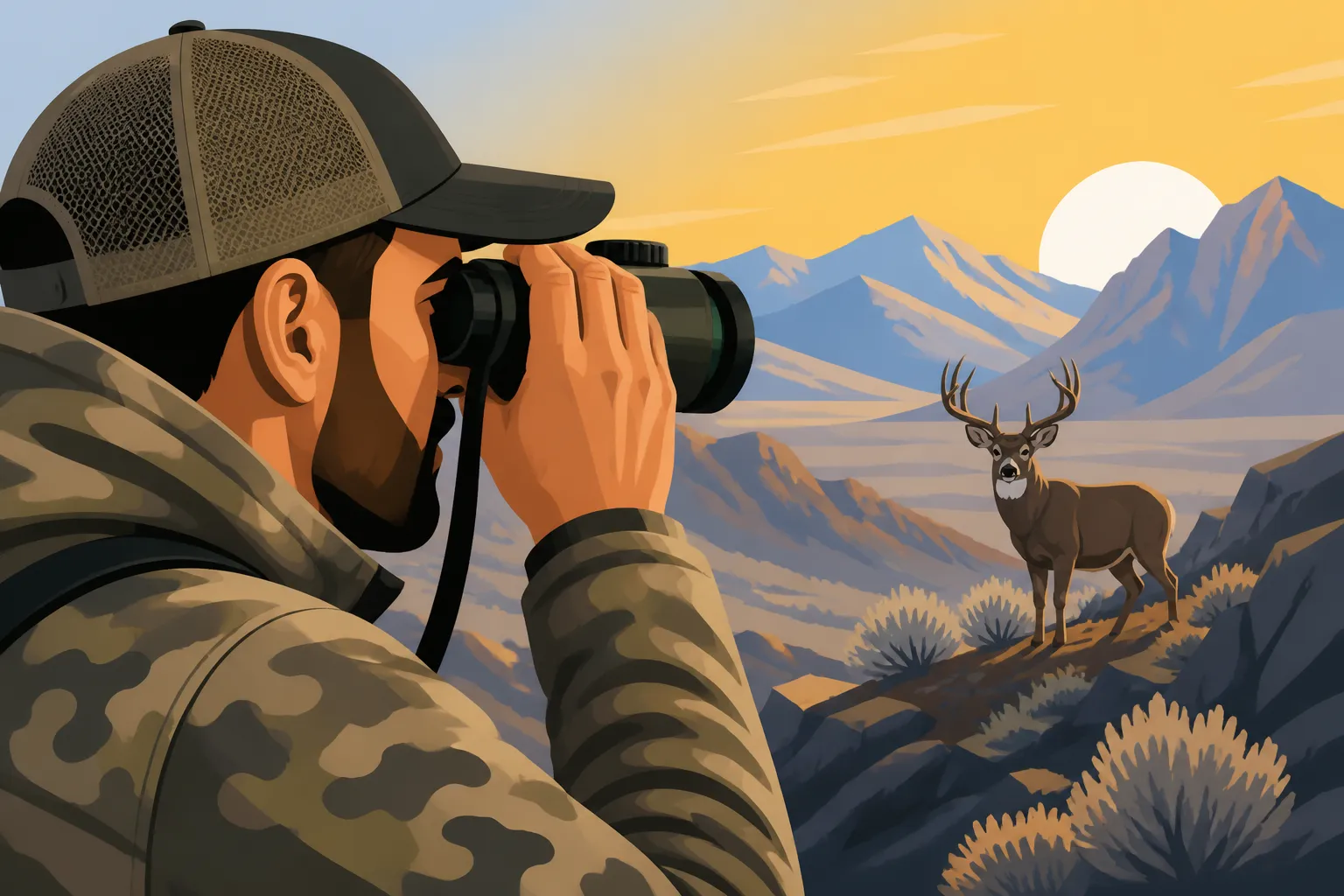
This method, often called "glassing," is less about relentless hiking and more about relentless looking. It's about letting your eyes do the walking, covering ground efficiently and identifying potential game without expending precious energy. Seasoned guides understand that the quality of your glassing session directly correlates to your success, which is why they invest heavily in top-tier binoculars and spotting scopes. They're literally magnifying their ability to hunt smart, not just hard, in a land that demands such an approach.
Rugged Mountains and Hidden Canyons
Beyond the sage flats, Nevada boasts some incredibly rugged and steep mountain ranges, often sparsely timbered with juniper or Pinyon pine, but frequently exposing vast, open rock slides, cirques, and canyons. While these areas might offer more cover than the open valleys, they still demand keen observation from a distance. An elk could be bedded in a small pocket of timber a mile away, or a bighorn sheep could be perfectly camouflaged against a rocky bluff, seemingly invisible to the naked eye.
Guides excel at understanding the terrain and knowing where animals will likely bed, feed, or travel. They know the subtle nuances of Reading a Nevada Hunt Unit Before You Apply and how to translate those features into potential game locations. But even with all that knowledge, they still rely on powerful optics to confirm what their instincts tell them. They'll spend hours meticulously scanning these broken landscapes, looking for the flick of an ear, the horizontal line of a back against a vertical slope, or the subtle glint of an antler in the morning sun. This is a game of patience, made possible only by having the right tools to extend their vision.
Efficiency and Ethical Hunting
For a professional guide, time is literally money, and client satisfaction is paramount. Optics play a critical role in maximizing the efficiency of a hunt and ensuring that every animal pursued is done so ethically, with a clear understanding of its characteristics and location.
Locating Game Quickly and Accurately
No client wants to spend their entire hunt walking aimlessly. Nevada guides use optics to rapidly locate game, minimizing wasted effort and maximizing the chances of a successful encounter. Instead of blindly hiking miles of country, a guide can set up on a high point at dawn or dusk, deploy their optics, and scour multiple drainages and slopes within minutes. If nothing is spotted, they move to the next vantage point, repeating the process until game is located. This systematic approach is the bedrock of Western hunting, especially in Nevada.
This precise location also means less disturbance to the animals. Rather than bumping them out of their beds and sending them fleeing, guides can often spot animals from a distance before they're aware of human presence. This allows for a more controlled approach and a better opportunity to execute a clean, ethical stalk. When you're trying to put a client on a specific caliber of animal, locating it first without spooking it is half the battle, and optics make that possible.
Judging Animals from Afar
One of the most critical skills a Nevada guide possesses, and one that absolutely hinges on optics, is the ability to judge an animal's size and age from a great distance. Whether it's the spread of a mule deer's antlers, the mass of an elk's rack, or the curl of a bighorn ram's horn, clients often have specific trophy goals. You can't walk up to every animal you see to check its size; that would be impossible and likely ruin the hunt.
Instead, guides use high-magnification spotting scopes to "field judge" animals that might be a mile or more away. They look for specific indicators of age and size, comparing what they see to what they know about the unit's potential and the client's expectations. This skill takes years to develop, but even the most experienced eye needs the magnification and clarity provided by premium glass. This ensures that when a stalk is initiated, it's for the right animal, preventing a disappointing surprise or an unethical shot at an undersized animal. Judging a Mule Deer Buck at Distance is a refined art, impossible without quality optics.
Planning the Stalk
Once an animal is located and judged, the real chess match begins: planning the stalk. This is another area where optics are indispensable. From their vantage point, the guide can use their binoculars and spotting scope to meticulously map out the approach route. They look for terrain features that offer cover – ridges, draws, rock outcrops, even clumps of tall sagebrush – and identify potential obstacles like fences, open flats, or unexpected changes in elevation.
They also assess wind direction and thermals, which can be notoriously tricky in Nevada's varied topography. A guide will watch the animal's behavior, its feeding patterns, and its bedded positions to anticipate its next move. All of this detailed reconnaissance is done through the glass. It allows them to formulate a precise plan, communicate it to the client, and increase the likelihood of getting within shooting range undetected. It's about Using Draws and Rims to Close Distance effectively and stealthily.
Types of Optics Essential for Nevada Guides
When you see a Nevada guide in action, you'll notice they're usually surrounded by a suite of optical tools, each serving a specific purpose. These aren't just arbitrary choices; they are calculated selections to cover every scenario the vast Nevada landscape can throw at them.
High-Powered Binoculars
The absolute workhorses of any Nevada hunt are high-powered binoculars, typically in the 10×42, 12×50, or even 15×56 configurations. These are the tools a guide spends the most time looking through, used for initial wide-area scanning and prolonged glassing sessions. They offer a balance of magnification, field of view, and light-gathering capability that makes them ideal for finding game across vast distances.
A good pair of binoculars allows for comfortable, extended viewing, which is crucial when you might be glassing for hours on end. Guides often use them mounted on tripods, even binoculars, to maintain a steady image and prevent eye fatigue. This allows them to pick apart distant hillsides for the slightest movement or shape that doesn't belong. The clarity and light transmission of quality binoculars are paramount, especially during the critical low-light hours of dawn and dusk when game is most active. Binocular Size That Survives an All-Day Session is a common discussion among experienced hunters.
Spotting Scopes for Detail
While binoculars excel at finding game, a spotting scope takes over when finer detail is required. Once a guide spots a potential animal with their binoculars, they'll swing their spotting scope onto the target. This tool, often ranging from 20-60x or even 30-70x magnification with a large objective lens, allows them to zoom in and assess the animal's characteristics with incredible precision. Is it a buck or a doe? How many points does that bull elk have? Is that bighorn ram legal? These are the questions a spotting scope answers.
Spotting scopes are almost always used with a sturdy tripod. The high magnification makes any hand tremor unbearable, rendering the image unusable. A good Tripod Setup for Glassing From a Ridge can be the difference between a successful identification and a missed opportunity. This is where a guide truly earns their keep, providing the definitive assessment of an animal's trophy potential, making sure the client is fully informed before committing to a stalk.
Rangefinders with Ballistic Capabilities
In Nevada's open country, shots can often be long, stretching hundreds of yards across valleys or up steep mountain faces. Accurate range estimation is not just important; it's absolutely critical for ethical shot placement. Modern rangefinders have become incredibly sophisticated, offering not only line-of-sight distance but also angle compensation and often, even basic ballistic solutions.
A guide uses a rangefinder constantly throughout a hunt. After locating an animal, they'll range it to determine if it's within a comfortable shooting distance for the client. During a stalk, they'll continually range landmarks along the intended path and the animal itself to update the shooting solution. For clients using modern rifles and scopes, a rangefinder with ballistic data integration can provide precise holdovers or turret adjustments, taking much of the guesswork out of a long shot. This ensures that when the moment of truth arrives, the client has the best possible chance for a clean, humane kill.
The Guide's Edge: Experience and Optics Combined
While premium optics are powerful tools, they are only as effective as the person behind them. A Nevada guide combines their intimate knowledge of the land, animal behavior, and hunting strategies with their optical array to create an unparalleled hunting advantage.
Reading the Landscape Through Glass
A great guide doesn't just look at the landscape through their optics; they read it. They understand that a certain slope might hold more feed, a particular rock outcrop offers ideal bedding cover, or a specific saddle is a common travel corridor. Their experience tells them where to look, and their optics confirm or deny their hypotheses. They know the subtle nuances that often betray an animal's presence – the slightly disturbed sage where a deer just bedded, the fresh tracks in a patch of dirt, or the sheen of wet rock indicating a hidden spring. Hunting Water in Nevada's Driest Country is a prime example where optics help pinpoint these life-sustaining spots.
For example, when looking for bighorn sheep, a guide won't just scan randomly; they'll focus on areas known for sheep, meticulously scrutinizing cliff faces and high-elevation benches where these agile animals thrive. Similarly, for Spot and Stalk Antelope on Nevada's Open Flats, they'll scan vast flatlands, anticipating where antelope might be feeding or traveling between water sources. This ability to interpret the land through the lens of experience, amplified by optics, is what separates a good guide from a great one.
Client Education and Confidence
A significant part of a guide's role is to educate their client and build confidence, especially for those new to Western hunting or the specific challenges of Nevada. Optics are central to this process. Once an animal is located, the guide will often invite the client to look through the spotting scope. This allows the client to see the animal themselves, confirm its size and location, and truly understand the plan for the stalk.
This direct observation builds excitement and reinforces trust in the guide's expertise. When the client can clearly see the animal, they feel more invested in the plan and are better able to visualize the shot. This is especially true for hunters who might be using platforms like BookYourHunt to find an outfitter, and who are eager to learn from the best. It helps calm nerves and prepare the hunter mentally for the challenging task ahead. Furthermore, if a difficult shot is required, seeing the target through the optics helps the client understand the range and trajectory considerations, enhancing their confidence in taking the shot under the guide's direction.
Table: Key Optics and Their Primary Uses for Nevada Guides
| Optic Type | Typical Magnification | Primary Use | Key Benefit for Guides |
|---|---|---|---|
| Binoculars | 10x-15x | Wide-area scanning, locating game, sustained glassing | Efficiently covers vast terrain, reduces fatigue |
| Spotting Scope | 20-70x | Detailed animal identification, trophy judging, stalk planning | Precise assessment of animal quality and location |
| Laser Rangefinder | Varies | Accurate distance measurement, ballistic data | Ensures ethical shot placement, aids client confidence |
Strategic Scouting and Brand Integration
Even before stepping foot in the field, optics play an indirect but vital role through advanced scouting methods. Many savvy hunters, and certainly guides, start their planning long before the season, often using tools like GoHunt to e-scout units and identify potential glassing knobs and areas of interest. They'll study topographical maps, satellite imagery, and historical data to pinpoint high points that offer expansive views – the very places they'll later deploy their physical optics.
This blend of digital reconnaissance and physical glassing is a hallmark of modern Western hunting. A guide might use a digital mapping platform to identify a ridge that overlooks a critical water source or a known bedding area. Then, on the ground, they'll climb to that very ridge, set up their tripod-mounted binoculars and spotting scope, and begin the meticulous process of breaking down the country. The pre-work done with digital tools simply narrows down the vastness, making the in-field optical work even more efficient and productive.
Ultimately, the Nevada guide’s reliance on optics is a testament to the unique demands of hunting in the Great Basin. It's about maximizing every minute, making ethical decisions, and leveraging technology and experience to transform the invisible into the tangible.
Disclaimer
This article is for general informational purposes only and does not constitute professional advice. Laws, prices and regulations vary by location and change over time. Consult a qualified professional for guidance on your specific situation.