Playing Thermals on a Rimrock Stalk
There’s nothing quite as frustrating as meticulously planning a stalk, getting everything just right, only to have a sudden shift in wind carry your scent directly to that big mule deer buck you’ve been chasing all morning in the Nevada rimrock. The Great Basin's broken, arid landscapes are beautiful but incredibly challenging, and understanding how thermals work is absolutely critical to closing the distance on wary big game. This guide will dive deep into deciphering these invisible air currents, helping you leverage them for successful rimrock stalks.
The Elusive Nature of Thermals in Nevada's Rugged Country
Nevada's vast, often steep, and highly varied terrain, from its deep canyons to its exposed rimrock edges, creates a unique meteorological challenge for hunters. Unlike the relatively consistent wind patterns you might find on open plains, the air movement in mountainous and rocky country is often dominated by thermals – localized air currents driven by temperature differences. These subtle shifts can make or break a stalk, and ignoring them is a surefire way to educate every animal in the unit about your presence.
How Air Movement Dictates Your Approach
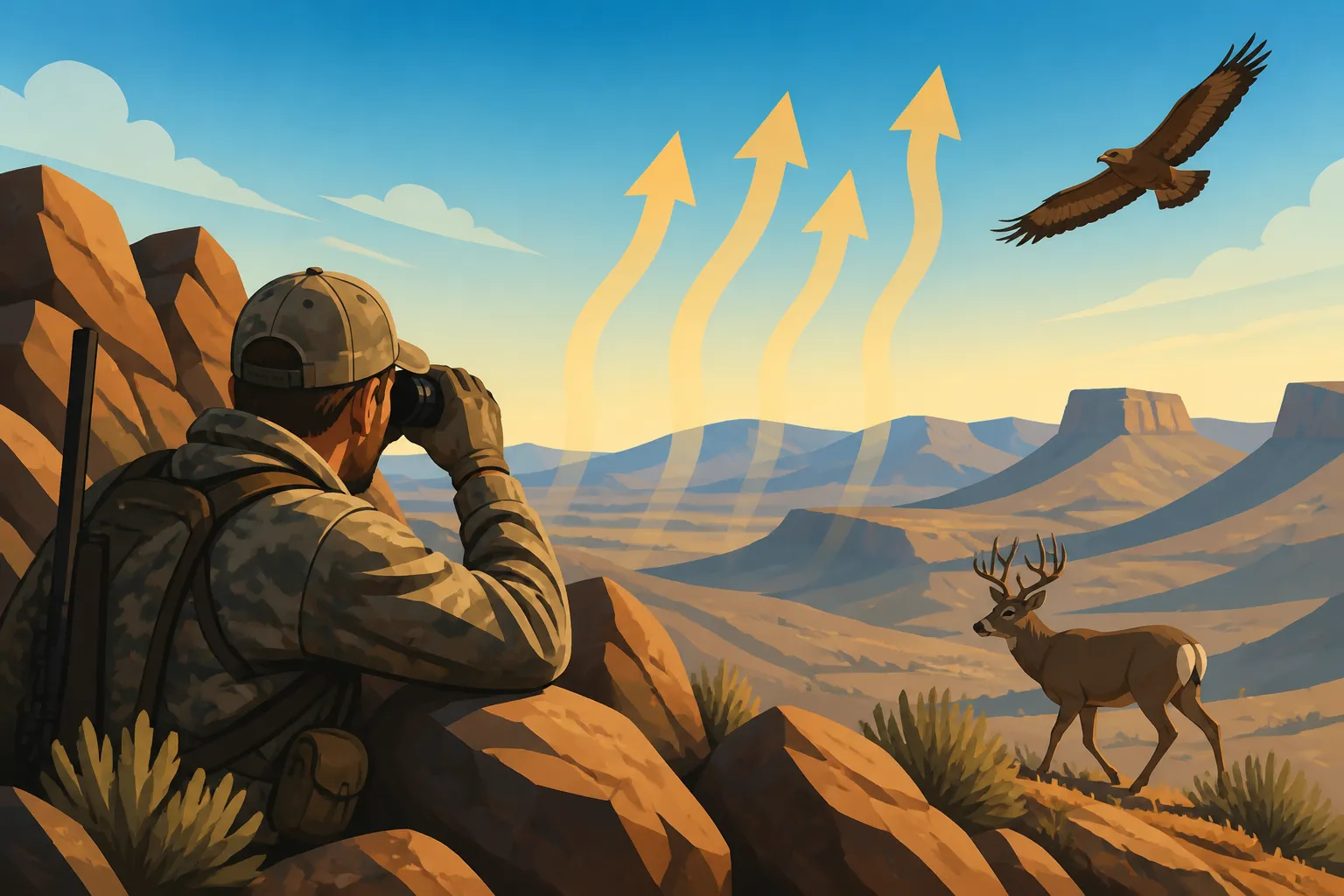
Imagine a crisp morning in the high desert. The air itself feels heavy, cool, and still down in the canyon bottoms. As the sun begins to climb and warm the exposed rocks and slopes, that cool, dense air in the shadows starts to warm up, expand, and naturally rise. This creates an upward current, often referred to as an "updraft" or "uphill thermal." Conversely, as evening approaches and the sun dips, the rocks cool down quickly, and the air above them cools and becomes denser, causing it to flow downhill into the cooler shadows and valleys. This is your "downdraft" or "downhill thermal." Understanding this fundamental principle is like having a cheat code for scent control in broken country.
Your scent, much like smoke, will travel with these air currents. If you're above an animal on a morning hunt, and the thermals are still drifting downhill, your scent will be carried directly to them. The same goes for an evening hunt if you're below an animal and the thermals are now pulling upwards. It's not just about the big, sweeping winds you feel on your face; it's about these localized, terrain-driven currents that often override the broader wind forecast. A slight shift in a canyon or a change in sun exposure can entirely redirect these thermal flows, demanding constant vigilance and adaptability from the hunter.
The Daily Thermal Rhythm in Rimrock
The rhythm of thermals in Nevada's rimrock country is predictable, though often complex due to the intricate topography. It's a dance between the sun, the terrain, and the air temperature that plays out every single day, weather permitting. Knowing this schedule can help you plan your entire hunt, from where you glass to where you initiate a stalk.
As dawn breaks and the temperatures are at their lowest, gravity pulls the densest, coolest air downhill. This means your scent, if you're above an animal, will likely drift down into the drainages and canyon bottoms. This is why a morning hunt often favors approaching from below an animal, allowing your scent to rise away from them as the sun begins to hit the slopes. By mid-morning to early afternoon, as the sun is high and intense, the thermals often become incredibly shifty and unpredictable. The ground is warming unevenly, creating chaotic swirling currents that can change direction on a dime. This is often the hardest time to successfully stalk an animal in the open rimrock.
As the sun begins its descent in the late afternoon, the exposed slopes and rocks start to cool rapidly. The air closest to the cooling ground becomes denser and begins to flow downhill. However, the warmer air from the still-sunlit higher slopes and exposed areas will continue to rise, creating a complex interplay. Generally, as the evening progresses, the dominant thermal shifts to an uphill pull, as the rising warm air from the heat stored in the rocks and ground continues to ascent. This is when approaching from above can be a significant advantage, allowing your scent to be carried upwards and away. However, it’s not always a clean transition; micro-thermals will always be a factor.
| Time of Day | Typical Thermal Direction | Stalking Advantage | Stalking Challenge |
|---|---|---|---|
| Dawn-Morning | Downhill/Falling | Approach from below, scent falls away. | Being above the animal, scent drifts down. |
| Mid-Day | Swirling/Stagnant | No consistent advantage, very unpredictable. | Scent can go any direction, very high risk. |
| Afternoon-Dusk | Uphill/Rising | Approach from above, scent rises away. | Being below the animal, scent drifts up. |
Reading the Micro-Winds: Beyond the Forecast
While checking the general wind forecast before a hunt is always a good idea, relying solely on it in Nevada's rimrock is a recipe for disappointment. The terrain itself acts as a giant baffle, funneling, redirecting, and sometimes completely reversing what the weather app tells you about the prevailing wind direction. This is where truly "reading" the micro-winds comes into play, a skill that can only be honed through observation and experience in the field.
Local Terrain's Undeniable Influence
Think about the way a river flows; it follows the path of least resistance, carving its way through the landscape. Air acts in a similar fashion. A deep, shaded canyon can hold cool air for much longer than an exposed, sun-drenched ridge just hundreds of yards away. When you combine these temperature differentials with the physical barriers of cliffs, draws, and rock formations, you get a localized wind pattern that might bear no resemblance to the broader atmospheric wind. These are the micro-thermals that can instantly bust your stalk.
For instance, a prevailing west wind might be blowing across the top of a large rimrock system. But if you're descending into a deep, north-facing drainage on the east side of that rim, the cool air pooling in that drainage could create its own localized downhill thermal, completely overriding the west wind. Or perhaps a narrow chute acts as a wind tunnel, accelerating an otherwise gentle breeze. This is why Using Draws and Rims to Close Distance is so critical, as these features not only offer cover but also predictable (or at least interpretable) thermal highways. Ignoring these local variations and trusting only your general weather report is one of the most common mistakes hunters make in this challenging environment.
Essential Tools and Their Limitations
While no tool can perfectly predict every micro-thermal, a few essentials can help you stay as scent-free as possible. First and foremost is a good wind checker. Forget licking your finger; a small squeeze bottle of unscented powder or even a handful of dried grass or milkweed seeds will give you a visual representation of the air current. Flick it into the air every few steps during a stalk, especially when you encounter changes in terrain or vegetation. You'll be amazed at how quickly the direction can shift, even subtly.
Modern hunting apps, like those offered by GoHunt, provide excellent topographical maps and often integrate real-time wind forecasts, which are invaluable for initial planning. You can see elevation changes, potential bedding areas, and often even map out a rough approach route from your couch. However, remember these apps provide a macro view of the wind. They can tell you the general direction and speed at 10,000 feet, but they can't account for the localized thermal effect of a sun-baked rock chute or a deep, shaded ravine. Use them to get an idea of the prevailing wind, but always confirm with your wind checker on the ground. For more general wind strategies, consider exploring Reading Wind on a Long Sage Stalk.
Crafting Your Stalk: Strategic Approaches to Rimrock Animals
Successfully stalking an animal in rimrock terrain is a chess match against nature, requiring meticulous planning, keen observation, and an intimate understanding of thermals. It's rarely a straight-line approach; instead, it's a series of calculated movements, pauses, and adjustments, always with the wind in mind.
Pre-Stalk Intelligence Gathering
Before you even take your first step in a stalk, you need to gather as much intelligence as possible. This means spending ample time glassing the animal from a distance. Utilizing high-powered optics like those discussed in Optics Power for Nevada's Long Sightlines is non-negotiable in this expansive country. Observe not just the animal's location, but its posture, its escape routes, and critically, how the sun is hitting the terrain around it. Are there shaded pockets where it might bed down for the mid-day heat? Are there deep draws that could act as thermal funnels?
Consider the time of day. If it's early morning, and you've spotted a buck bedded high on a rim, a direct approach from above is likely suicide. Conversely, if it's late afternoon, approaching from below might send your scent straight up to him. Having a detailed map, whether it's a paper topo or an app like GoHunt, can help you visualize elevation changes and potential routes that offer both cover and a thermal advantage. This pre-stalk assessment is where you decide if a stalk is even feasible, or if you need to wait for a better opportunity or a shift in conditions. For broader strategies on finding animals, remember to utilize methods like The Grid Glassing Method, Step by Step before committing to a stalk.
Executing the Uphill and Downhill Advantage
Once you've decided on an approach, the execution is everything. In the early morning, when thermals are typically falling, your goal is often to stay below the animal. This means if a deer is on a ridge, you'll want to move up the drainage or climb a parallel ridge below its position. Your scent will be carried downhill and away from it. However, always be mindful of micro-thermals that might be influenced by a cross-canyon or a side draw. Continuously check your wind with a powder bottle.
As the day transitions into late afternoon and evening, the thermals tend to switch and pull uphill. This is your cue to reverse your strategy. Now, you want to approach from above the animal, allowing your scent to rise with the air currents, carrying it over their heads and away. This often means climbing higher than your target, using saddles and ridgelines to stay out of sight, and then dropping down into position. Remember the importance of Using a Rim to Break Your Silhouette to remain undetected during these approaches. Regardless of the direction, slow, deliberate movement is key. For advice on movement, consider How Far to Stalk a Bedded Mule Deer.
Navigating Mid-Day Thermal Chaos
The mid-day window, especially in the intense Nevada sun, is often the most challenging time for a rimrock stalk. The ground is heating up rapidly and unevenly, creating chaotic, swirling thermals that are notoriously unpredictable. This is when the "Nevada Swirl" is at its worst – a light breeze might push your scent one way, only for a rising thermal from a hot rock face to pull it another, momentarily sending it in every direction imaginable.
Unless you have a very specific, sheltered route with consistent wind, it's often best to avoid actively stalking during this time. Instead, use this period for re-positioning to a new glassing point, taking a break, rehydrating (you'll appreciate Water You Must Carry on a Desert Day Hunt), or simply observing. If you must move, prioritize extreme caution, stay in deep shade or along contours that might offer more stable air, and check your wind every few steps. Sometimes, waiting out the chaos until the more predictable afternoon thermals set in is the wisest move, even if it means sacrificing some daylight hunting time. It's often during this period you might consider a longer glassing session, perhaps in anticipation of evening movement, a skill that requires Preparing Physically for Long Glassing Days.
Common Pitfalls and Mastering the Rimrock Stalk
Even with a solid understanding of thermals, the rimrock environment of Nevada can humble the most experienced hunter. Mastering the stalk requires not just knowledge, but an acute awareness of your surroundings and an unwavering commitment to patience.
The Peril of Underestimating Micro-Thermals
The biggest mistake a hunter can make in rimrock country is underestimating the power of micro-thermals. It’s easy to feel a steady breeze on your face and assume your scent is being carried safely away, only to be busted by a localized updraft from a sun-baked rock slab or a downdraft funneling down a shaded coulee. These aren't just minor annoyances; they are hunt-enders. A common scenario is getting a strong crosswind on a ridge, but as you drop into a small saddle or draw, the air becomes stagnant or even reverses direction due to thermal pull.
To combat this, become obsessive about your wind checker. Use it constantly, especially when transitioning between different elevation bands, entering or exiting a drainage, or moving from sun to shade. Look for visual cues in the environment: shimmering heat off rocks, dust devils, or even the way sparse vegetation is moving. Trust your wind checker over your gut feeling, especially in critical moments. Remember that while tools like GoHunt can offer great insights into topography, the ground-level reality of air movement is dynamic and demands your constant attention.
Patience and Positioning as Your Allies
In a world that often prizes speed, successful rimrock stalking demands the opposite: patience. Rushing a stalk to beat a thermal shift or to get a shot before an animal moves is often what leads to failure. Take your time. Observe. Test the wind repeatedly. If the conditions aren't right, pull back and re-evaluate, even if it means abandoning the stalk for now. A successful hunt isn't just about taking the shot; it's about making the right decisions to get into a position to take that shot ethicaly.
Your position relative to the animal, the sun, and the prevailing thermals is everything. Never expose yourself on a skylined ridge, and always try to use the terrain to your advantage for cover. Whether it's the rough, sharp volcanic rock that demands Choosing Boots for Sharp Volcanic Rock or the steep, broken ledges, the landscape is both your challenge and your camouflage. If you find yourself in a tricky spot with swirling winds, sometimes the best move is to freeze, wait for a more stable thermal pattern, or even back out entirely. The mountains of Nevada will always be there, and another opportunity will likely present itself if you remain patient and strategic.
Disclaimer
The information provided in this guide is for general educational purposes only and is not a substitute for official hunting regulations. Always consult the most current Nevada Department of Wildlife (NDOW) regulations before any hunting activity. Hunting is an inherently risky activity; prioritize safety, respect wildlife, and adhere to all local, state, and federal laws.