Cell Coverage Across Nevada Hunt Units
It's a familiar punch in the gut for any hunter venturing into Nevada's vast backcountry: you drive for hours, get deep into your chosen unit, and then watch those precious cell bars disappear, leaving you completely disconnected. That feeling of isolation, while sometimes part of the appeal, can also bring a lot of anxiety, especially when you need to check in with family, coordinate with hunting partners, or heaven forbid, face an emergency. This guide will walk you through the realities of cell coverage across Nevada's hunting units and offer practical strategies for staying safe and connected, even when your phone is just a fancy paperweight.
The Harsh Reality of Cell Coverage in Nevada's Backcountry
Let's be brutally honest: reliable cell coverage is a luxury, not a guarantee, in most of Nevada's prime hunting country. This isn't like hunting in a state where you're always within a stone's throw of a town or a major highway. Nevada is defined by its vast, open spaces and dramatic, often uninhabited mountain ranges. Expecting consistent service out here is like expecting to find a five-star restaurant in the middle of the Black Rock Desert – it's just not how things work.
Why Phone Service Disappears Out Here
There are a few key reasons why your phone often goes silent the deeper you venture into a Nevada hunt unit. First, the sheer scale of the state means that population centers are few and far between, and cell tower infrastructure follows population. There's simply no economic incentive for carriers to build and maintain towers in areas where only a handful of ranchers, prospectors, or hunters might pass through each week. You might get a faint signal near a major highway that skirts the edge of a unit, but once you drop into a canyon or climb behind a ridge, that signal vanishes faster than a spooked mule deer buck.
Second, the topography of the Great Basin plays a huge role. Nevada is literally a "basin and range" state, characterized by long, north-south running mountain ranges separated by wide, flat valleys. These ranges, while beautiful, are natural barriers for cell signals. A tower might be miles away, but if there are two or three mountain ridges between you and it, your phone isn't going to pick up a thing. Even within a valley, local rises and dips in the terrain can create dead zones, turning what looks like flat, open country on a map into a communication black hole. Knowing Elevation Bands Worth Understanding in Nevada can help you predict where pockets of signal might exist or where it's almost certainly absent.
Understanding Carrier Limitations
It's also important to remember that not all cell carriers are created equal when it comes to rural coverage. While all major carriers (think Verizon, AT&T, T-Mobile) have their strengths, you'll find that one might have a slight edge in certain areas of Nevada over another. However, that "edge" often means the difference between one bar and no bars – it rarely means full, reliable service in truly remote areas. You might be shocked to find that even what seems like a bustling area on the map, perhaps a small town on the edge of a sprawling unit, still has only one or two carriers providing decent service, if any. Many hunters who frequent the same remote units eventually figure out which carrier, if any, offers the best chance of a signal, but even then, it's a gamble.
Strategies for Staying Connected (or Wisely Disconnected)
Given the reality of spotty to non-existent cell service, a smart hunter plans for disconnection rather than relying on their phone. This means having alternative communication methods and a solid plan for what to do when your phone has no service.
Researching Coverage Before You Go
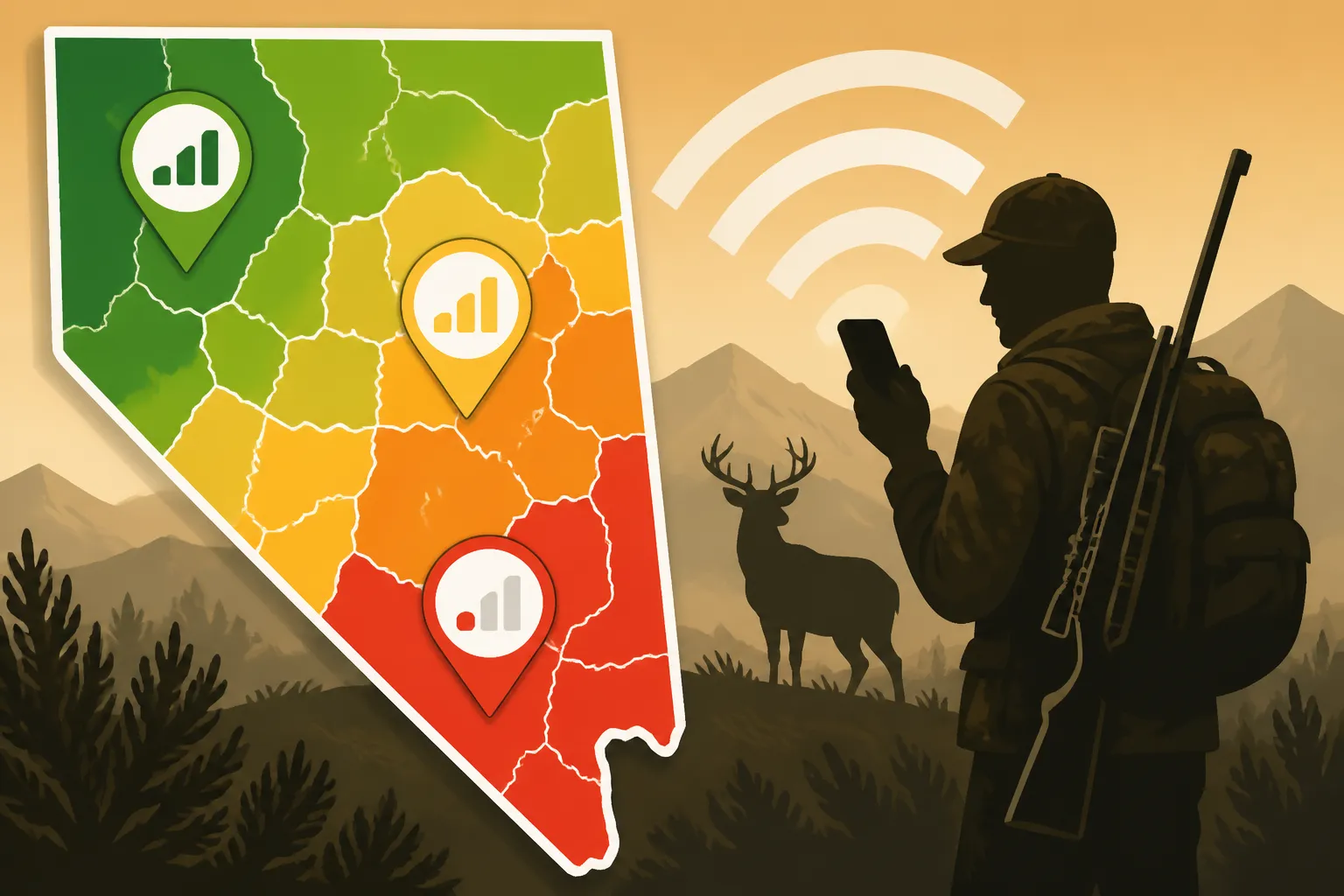
Before you even leave your driveway, you can do some preliminary research. Most major carriers provide coverage maps on their websites. While these maps can be helpful, take them with a grain of salt, especially in Nevada. They often represent ideal conditions and don't always account for localized terrain obstructions. What looks like "fair" coverage on a map might translate to zero bars once you're on the ground.
A better approach is to use mapping applications designed for hunters, like onX Hunt. These apps often include user-generated "heatmaps" of cell service, or at least show where others have reported getting a signal. While still not foolproof, they can give you a more realistic picture than a carrier's official map. Plus, even if you lose service, these apps allow you to download maps for offline use, ensuring you always know where you are and how to navigate, which is far more critical than making a phone call when you're miles from the nearest road. Similarly, platforms like GoHunt offer detailed unit information and draw odds; while they don't map cell coverage directly, the remoteness of the units they profile should inherently signal that traditional cell service will be sparse at best. E-scouting a Nevada unit before the season is always a good idea, and part of that should involve looking at the access roads and potential camping spots in relation to any known towers, even if it's a long shot.
Communication Plans with Your Hunting Party and Home Base
One of the simplest yet most effective strategies is to have a robust communication plan that doesn't rely on cell service. If you're hunting with a partner or a group, establish clear check-in times and rendezvous points. You might decide to meet at a specific landmark every evening at dusk, or agree that if separated, everyone returns to the main camp by a certain time. Two-way radio use between hunting partners can be invaluable for short-range communication in the field, especially when working through thick brush or across drainages where visual contact is lost. These radios are line-of-sight, but their range often exceeds what you'll get from a cell phone in rugged terrain.
Equally important is a plan for communicating with someone back home. Before you leave, provide a detailed itinerary to a trusted friend or family member, including your hunting unit number, planned dates, expected return time, and a "trigger" for when they should initiate a search if they don't hear from you. For example, "If you haven't heard from me by 8 PM on Sunday, contact the local sheriff's office." This gives them concrete information and a clear course of action if something goes wrong.
Tools to Supplement or Replace Cell Service
Since cell service is so unreliable, smart hunters often carry backup communication devices. These tools can be lifesavers, allowing you to send messages or even make emergency calls when your phone is completely dead.
Satellite Messengers and Phones
Satellite messengers are game-changers for remote hunting. Devices like Garmin inReach or Zoleo allow you to send and receive text messages and, most critically, trigger an SOS signal that connects you directly to emergency services, no matter how far out you are. They operate on global satellite networks, meaning as long as you have a clear view of the sky, you can communicate. This capability provides incredible peace of mind, knowing that if a serious accident or medical emergency occurs, you can get help. I always recommend carrying one, especially when heading into vast, roadless country. You can learn more about Satellite Messenger Use in Remote Country to understand how these devices work and which might be best for your needs.
Satellite phones, while more expensive and often bulkier, offer full voice communication anywhere in the world. They're typically overkill for most casual hunting trips but are invaluable for extended expeditions into truly extreme wilderness where reliable, two-way voice communication is paramount.
Two-Way Radios for Group Communication
For communicating with your hunting partners within a few miles, two-way radios (FRS/GMRS or even licensed amateur radio) are an excellent choice. They don't rely on cell towers, and a good set with fresh batteries can keep your group coordinated. This is especially useful in broken terrain where partners might spread out to glass different ridges or work separate draws. Imagine you're trying to communicate a buck's movement to a partner perched on a distant ridge – a radio is much more effective than yelling or trying to send a text that may never go through. Just be mindful of their limitations; they work best with line-of-sight and can be affected by dense timber or deep canyons.
Personal Locator Beacons (PLBs)
A Personal Locator Beacon (PLB) is a last-resort emergency device. Unlike satellite messengers, PLBs typically only transmit an SOS signal and do not allow for two-way communication. They're designed to be activated in life-threatening situations to alert search and rescue with your exact GPS coordinates. While they don't offer the communication flexibility of a satellite messenger, their simplicity, reliability, and usually longer battery life can be a strong argument for carrying one as a dedicated emergency device.
Here's a quick comparison of popular communication options for Nevada's remote hunting areas:
| Device Type | Primary Function | Pros | Cons | Cost (Device) | Cost (Subscription) | Reliability in Remote NV |
|---|---|---|---|---|---|---|
| Cell Phone | Calls, Texts, Internet | Multi-purpose, familiar, cheap to operate (if service) | Highly unreliable in remote areas, terrain-dependent | Included | Existing plan | Low to None |
| Satellite Messenger | Two-way texts, SOS, GPS tracking | Reliable global communication, emergency SOS | Requires subscription, limited communication | Moderate | Required | High |
| Satellite Phone | Voice calls, texts | Full voice communication globally | Very expensive, bulky, often complex to use | High | Required | High |
| Two-Way Radio | Short-range voice calls (group) | No subscription, instant group comms, robust | Limited range, line-of-sight dependent | Low to Moderate | None | Medium (short-range) |
| Personal Locator Beacon (PLB) | Emergency SOS only | Very reliable emergency signal, long battery | No two-way communication, single-purpose | Moderate | None (registration) | Very High |
Planning Your Communication Strategy Before You Go
A successful hunting trip, especially in Nevada, hinges on thorough preparation, and that absolutely includes your communication strategy. Don't leave it to chance.
Downloading Offline Maps
This is non-negotiable. Even if you think you might have cell service, download offline maps of your entire hunt unit onto your phone or GPS device. Apps like onX Hunt make this incredibly easy, and it ensures that you always have access to crucial topographical information, land ownership boundaries, and your current location, even with zero signal. Many a hunter has found themselves turned around because they relied solely on streaming maps that suddenly stopped working when the bars disappeared. Always have Reading a BLM Surface Management Map and topographical features in mind when you're preparing.
Battery Management and Charging
No matter what devices you bring, they're useless without power. Invest in high-capacity portable power banks to recharge your phone, satellite messenger, or other USB-powered devices. Consider solar chargers for extended trips, though their effectiveness can vary. Always start with all your devices fully charged, and practice good battery management in the field: turn off Wi-Fi, Bluetooth, and cellular data if you don't have service. Put your phone in airplane mode to conserve battery life if you're not actively using it, especially if you expect to be out for several days. Remember, the vehicle battery can be a lifeline for charging, but don't run it down too low trying to charge everything! Knowing Vehicle Prep for Remote Nevada Roads is crucial for maintaining your power source.
Emergency Protocols and Contact Information
Beyond having an itinerary with someone at home, carry physical copies of important phone numbers and emergency contacts. If your phone runs out of battery or breaks, you won't be able to access digital contacts. A small, waterproof note card with contact information, your hunting license details, and any medical information can be invaluable. Discuss potential emergency scenarios with your hunting partners before you're in the field. What if someone gets injured? What's the plan if someone gets lost? Who carries the first aid kit? Who has the satellite messenger? These conversations are vital and reduce panic if the worst happens.
Knowing Your Exit Routes and Nearest Services
Even with a satellite messenger, knowing your surroundings and having an exit plan is critical. Study your maps to identify primary and secondary egress routes from your hunting area. Know the location of the nearest towns, gas stations, hospitals, and any potential points of contact. Nevada's services are often few and far between, and How Far Apart Nevada Fuel Stops Are can be a major consideration when planning how far you venture. It's not just about getting help to you, but sometimes about getting yourself to help. Understanding the nuances of Remote Road Conditions Across Nevada is also vital, as what looks like a good road on a map can quickly become impassable.
By embracing the reality of limited cell coverage in Nevada and proactively planning for it, you can ensure a safer, more enjoyable, and ultimately more successful hunting experience. The wild places of Nevada demand respect and preparation, and communication is a cornerstone of that readiness.
Disclaimer
This article is for general informational purposes only and does not constitute professional advice. Laws, prices and regulations vary by location and change over time. Consult a qualified professional for guidance on your specific situation.