Vehicle Prep for Remote Nevada Roads
Heading out into Nevada's vast, wild landscapes for a hunt is an incredible experience, but it comes with a harsh reality: those remote roads can turn a dream trip into a nightmare if you're not prepared. Getting stuck miles from anywhere with no cell service is a terrifying prospect many hunters have faced. This guide will walk you through everything you need to know about readying your vehicle to conquer Nevada's unforgiving backcountry, ensuring your adventure is memorable for all the right reasons.
Understanding Nevada's Remote Road Challenges
The sheer scale of Nevada's public lands means that getting to prime hunting spots often involves navigating miles of unpaved, rarely maintained roads. These aren't your typical forest service roads; they can be brutal, isolated, and utterly relentless, constantly testing the limits of your vehicle and your resolve. Many hunters underestimate the punishment these roads dish out, leading to breakdowns and dangerous situations.
The Brutality of Unmaintained Tracks
Nevada's backcountry roads are a mixed bag of challenges. You'll encounter everything from bone-jarring washboards that threaten to rattle your fillings out, to sharp, volcanic rock fields that can shred tires in an instant. Then there are the deep, soft sand sections, particularly in the lower elevations, ready to swallow two-wheel drive vehicles whole and even give 4x4s a workout. After a storm, dry washes can become impassable muddy quagmires, or even raging rivers. It's a constant battle against terrain that rarely sees a grader or any consistent maintenance. These aren't roads designed for comfort or speed; they're merely paths of least resistance across some of the most rugged country in the lower 48.
Navigating these tracks often requires a specific driving style. You can't just power through everything. Speed on washboards will quickly loosen bolts and damage suspension components. Too much throttle in sand will dig you deeper. Over-reliance on momentum through rocky sections can lead to expensive undercarriage damage. Every mile demands your full attention, and a casual approach is a recipe for disaster. The cumulative effect of these conditions, especially over dozens or hundreds of miles, puts immense strain on every part of your vehicle, from the frame to the smallest electrical connection.
Distance Between Services
One of the most profound challenges of hunting in Nevada is the sheer isolation. Small towns, gas stations, and repair shops are often hundreds of miles apart. If your vehicle breaks down, you're not just stranded; you're often in a literal wilderness, hours from any assistance. Cell service is virtually nonexistent in much of the backcountry, making even calling for help a monumental task. This isn't like breaking down on an interstate where a tow truck might be 30 minutes away; it could be a multi-day ordeal to get rescued.
This vastness means that every piece of your Vehicle Recovery Gear for Nevada Roads needs to be carefully chosen and maintained. You must be entirely self-sufficient, capable of handling minor repairs and, if necessary, basic self-recovery. The cost of a tow in these remote areas can be astronomical, easily running into thousands of dollars, not to mention the potential loss of your hunting opportunity. Understanding Fuel and Service Distances in Nevada and planning your route accordingly, including where you'll refuel and resupply, is critical for survival.
Unpredictable Weather and Terrain
Nevada's weather can be as extreme and unpredictable as its terrain. Summer and early fall hunts can see daytime temperatures well over 100 degrees Fahrenheit, putting immense stress on engines and tires, and demanding you carry substantial Water You Must Carry on a Desert Day Hunt. These high temperatures also contribute to dry, dusty conditions that can choke air filters and wear down components more quickly. Dust can also severely reduce visibility on dirt roads, making driving hazardous.
Conversely, late fall and winter hunts can bring sudden, heavy snowfall, especially in the higher elevations. A road that was dry and passable in the morning can become completely snowed in by afternoon, trapping you for days. Flash floods, even from distant storms, can turn dry washes into torrents, washing out roads and creating impassable canyons. It's not uncommon for hunters to get stuck due to weather changes, sometimes requiring costly rescue operations. Always check the forecast for your specific hunt unit, and have contingency plans for rapid changes in conditions.
Essential Vehicle Upgrades and Maintenance
Before you even think about pointing your rig toward a remote Nevada hunt unit, your vehicle needs to be in peak condition and potentially upgraded to handle the abuse. This isn't about looking cool; it's about reliability and safety when you're far from civilization. Skipping these steps is a gamble with high stakes.
Tire Selection and Management
Your tires are arguably the single most important component on your vehicle for Nevada's remote roads. Stock highway tires are simply not sufficient. You need tough, durable tires that can withstand sharp rocks and provide traction in loose dirt and sand. An E-rated (10-ply equivalent) all-terrain (AT) or mud-terrain (MT) tire is highly recommended for its increased puncture resistance and sidewall strength. Brands like BFGoodrich KO2s, Falken Wildpeak AT3Ws, or Toyo Open Country AT III are popular choices among serious off-road hunters for good reason. Remember, a cheap tire can easily cost you a hunt, or worse, your safety.
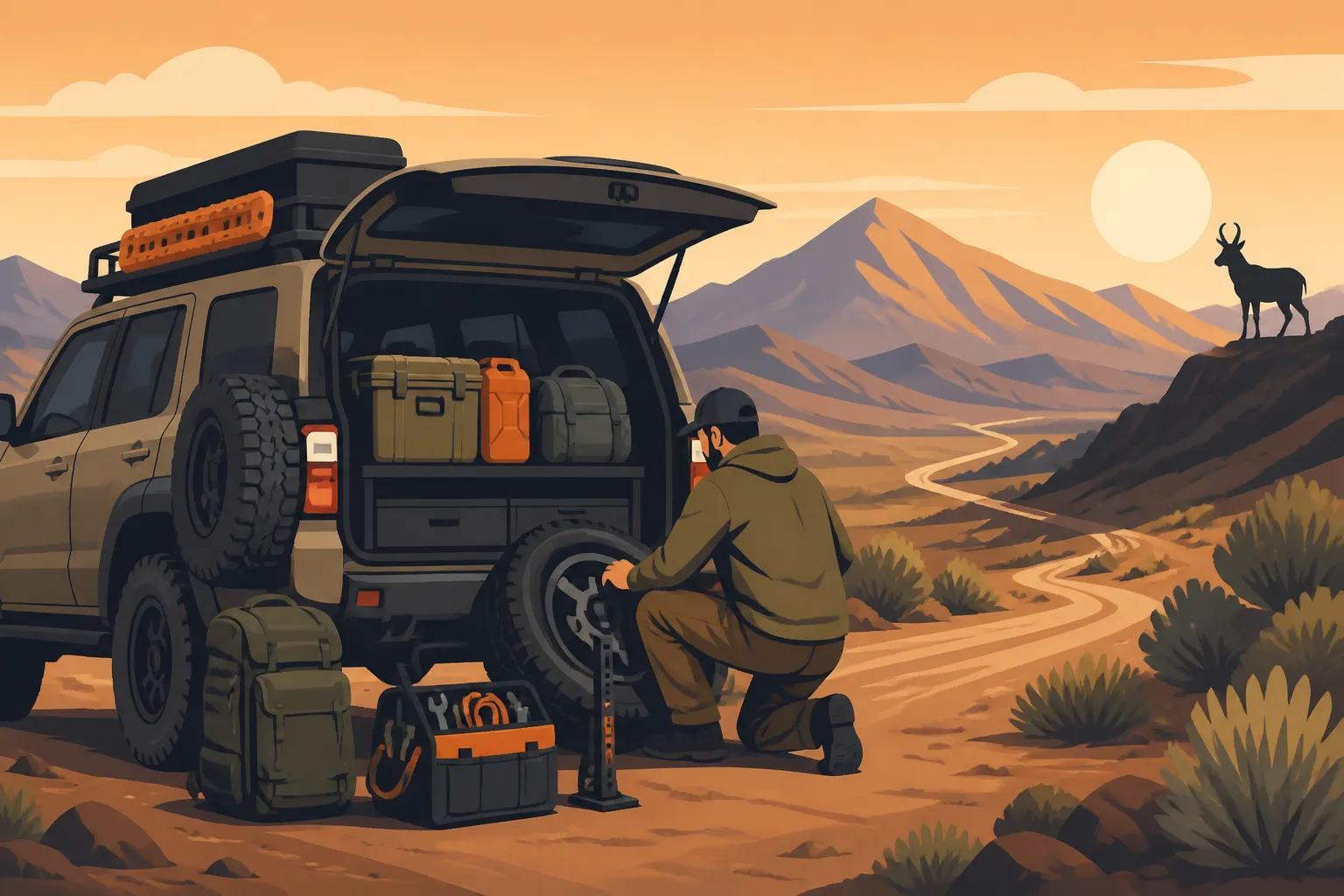
Proper tire management goes beyond just choosing the right rubber. Always carry a full-size spare tire, not a donut, and ensure it's in good condition and properly inflated. Two spares aren't a bad idea for extended trips deep into the backcountry. A high-quality tire repair kit, a robust air compressor, and a tire pressure gauge are non-negotiable. Airing down your tires to 18-25 psi on rough roads dramatically improves ride comfort, increases traction, and reduces the risk of punctures, as the tire can flex over obstacles rather than fighting them. Just remember to air back up when you hit pavement. Neglecting these details is one of the quickest ways to find yourself stranded, battling a flat tire on What Nevada Backroads Do to a Tire.
Suspension and Underbody Protection
The constant jarring and uneven terrain will test your suspension system to its limits. Stock suspension components are often designed for highway comfort, not repeated heavy impacts. Upgrading to heavy-duty shocks and springs, or even a modest lift kit, can significantly improve your vehicle's capability and longevity. A lift provides more ground clearance, reducing the risk of bottoming out, and often allows for larger, more robust tires. However, don't overdo it; a modest 2-3 inch lift is usually plenty for most hunting scenarios.
Underbody protection is equally vital. Skid plates for your engine, transmission, transfer case, and fuel tank act as a crucial barrier against sharp rocks and debris. Differential covers are also a smart addition. These pieces of armor can prevent catastrophic damage that would otherwise leave you immobile. Think of them as cheap insurance against expensive repairs. You might not need rock sliders unless you plan serious rock crawling, but protecting your vitals is a must when you're traversing miles of unforgiving terrain.
Engine and Drivetrain Reliability
Before any major trip, a thorough inspection of your engine and drivetrain is paramount. Change your oil, check all fluid levels (coolant, brake fluid, power steering, differential, and transfer case), and ensure they are topped off and fresh. Inspect belts and hoses for any signs of wear or cracking, as a broken belt or burst hose can quickly overheat your engine. A fresh air filter is also essential, especially given the dusty conditions in Nevada.
Consider adding a differential breather extension kit. Stock breathers are often low, allowing water and mud to enter your differential housings if you cross a deep puddle or stream. Extending these breathers up into the engine bay or higher in the chassis prevents water contamination, which can quickly destroy expensive gears. If your vehicle has a heavy electrical load from accessories (fridge, lights, etc.), ensure your battery and charging system are robust enough to handle it. A dual battery setup is a great investment for remote camping. These small investments in preventative maintenance and smart upgrades pay huge dividends when you're hundreds of miles from the nearest mechanic.
On-the-Road Essentials: Gear for Self-Reliance
Even the most meticulously prepared vehicle can encounter an unforeseen problem. Being self-reliant means having the right gear to get yourself out of a bind, or at least to communicate your predicament. In Nevada's remote corners, your gear is your lifeline.
Recovery Gear You Can't Afford to Skip
Getting stuck is a matter of "when," not "if," in the Nevada backcountry. A good set of recovery gear is non-negotiable. This includes:
- Winch: If you're serious about remote travel, a winch is a significant investment but can be a lifesaver. Ensure it's properly mounted and rated for your vehicle's weight.
- Recovery Strap/Kinetic Rope: A heavy-duty kinetic recovery rope is excellent for safely pulling out a stuck vehicle, offering stretch and stored energy. Static recovery straps are useful for winching.
- Shovel: A quality, full-sized shovel is invaluable for digging out tires, clearing small obstructions, or building a path.
- Traction Boards: Products like Maxtrax or other recovery boards can provide critical traction in sand, snow, or mud, allowing you to drive out of a sticky situation without needing another vehicle.
- Hi-Lift Jack (or similar): While tricky to use, a Hi-Lift jack can lift a vehicle far higher than a factory jack, useful for changing tires on uneven ground or lifting a vehicle out of a rut.
- Basic Tool Kit: Pliers, wrenches, screwdrivers, zip ties, duct tape, electrical tape, and a multi-meter can help with minor roadside repairs. Don't forget a tire plug kit.
Always know how to use your recovery gear safely and effectively before you head out. A botched recovery can be more dangerous than being stuck. Make sure to pack all your Vehicle Recovery Gear for Nevada Roads in an easily accessible location.
Communication and Navigation Tools
In areas where Cell Coverage Across Nevada Hunt Units is sparse to non-existent, relying on your smartphone is foolish. You need dedicated communication and navigation solutions:
- Satellite Messenger/Communicator: Devices like the Garmin InReach or Zoleo are essential. They allow you to send texts via satellite, share your location, and, crucially, activate an SOS button in an emergency. This is often the only way to call for help from deep within the Great Basin. Investing in Satellite Messenger Use in Remote Country is not optional for safe backcountry travel.
- Two-Way Radios (VHF/UHF): For communicating with hunting partners in a convoy or within a few miles, good quality two-way radios (like a Baofeng UV-5R or Midland GMRS) are indispensable. Remember, these have limited range but are fantastic for group coordination.
- Paper Maps and Compass: Technology can fail. Always carry detailed topographical maps (USGS or forest service maps are great) of your hunt unit and a reliable compass. Know how to use them.
- GPS Device/Mapping App: While satellite messengers can navigate, a dedicated handheld GPS unit or a robust smartphone app like OnX Hunt, Gaia GPS, or even a platform like GoHunt with downloaded offline maps is excellent for tracking your location, marking waypoints, and staying on course. Before you even turn the key, diving into detailed maps, perhaps through a service like GoHunt, can reveal crucial insights into access and terrain.
Fuel, Water, and Emergency Supplies
The vast distances and lack of services demand you bring ample provisions:
- Extra Fuel: Running out of gas miles from a station is a common scenario. Always carry extra fuel in approved, securely mounted fuel cans (like RotopaX or Jerry cans). Calculate your vehicle's realistic fuel economy on dirt roads and add a significant buffer. Understanding Carrying Extra Fuel on a Nevada Hunt is critical for preventing a truly miserable experience.
- Abundant Water: This cannot be stressed enough. Carry far more water than you think you'll need for drinking, cooking, and emergency vehicle cooling. A general rule for emergencies is at least one gallon per person per day, plus extra. In hot August conditions, you'll need even more.
- Food: Non-perishable, calorie-dense food for at least a few extra days beyond your planned trip.
- First Aid Kit: A comprehensive first aid kit is vital. Consider taking a wilderness first aid course.
- Emergency Shelter/Sleeping Bag: If you get stranded overnight, you'll want protection from the elements. A space blanket or a small sleeping bag can be a literal lifesaver.
- Fire Starter: Matches, lighter, ferro rod.
- Headlamp/Flashlight: With extra batteries.
- Trash Bags: Pack out everything you pack in!
- Basic Repair Kit: Jumper cables, spare fuses, hose clamps, electrical wire, and a small amount of engine oil, brake fluid, and coolant.
Pre-Trip Checks and Best Practices
Getting your vehicle ready isn't just about loading gear; it's about a systematic approach to preparation and understanding how to operate safely in challenging conditions. Don't leave anything to chance.
A Thorough Pre-Departure Checklist
Before every significant hunt, perform a detailed inspection of your vehicle. This goes beyond a quick glance at the tires. Use a checklist to ensure nothing is overlooked.
| Component | Check/Action | Notes |
|---|---|---|
| Tires | Pressure (including spare), Tread Depth, Sidewall Condition, Lug Nuts Tightness | Rotate if needed; inspect for cuts/bulges. |
| Fluids | Engine Oil, Coolant, Brake Fluid, Power Steering, Washer Fluid, Differential, Transfer Case | Top off or change as needed; inspect for leaks. |
| Belts & Hoses | Condition (cracks, fraying), Tension | Carry spares if prone to issues. |
| Battery | Charge, Terminal Cleanliness, Connections Secure | Load test if questionable; consider dual battery for accessories. |
| Brakes | Pad Thickness, Rotor Condition, Fluid Level | Listen for unusual noises; check for spongy pedal. |
| Lights | Headlights (High/Low), Taillights, Brake Lights, Turn Signals, Hazard Lights | All functional, clean lenses. |
| Wipers | Blade Condition, Washer Fluid Function | Clear visibility is paramount. |
| Filters | Engine Air Filter, Cabin Air Filter (if applicable) | Replace if dirty, especially in dusty environments. |
| Suspension/Steering | Shocks, Springs, Bushings, Tie Rods, Ball Joints, CV Boots | Inspect for leaks, excessive play, tears. |
| Underbody | Skid Plates Secure, Exhaust System Intact | Check for loose bolts, dents. |
| Tools & Recovery Gear | All items present, functional, and accessible | Confirm jack, wrench, strap, shovel, compressor. |
| Emergency Supplies | First Aid, Water, Food, Fire Starter, Communication Devices | Confirm satellite device subscription is active. |
This kind of rigorous inspection helps catch small problems before they become major headaches on the trail.
Driving Techniques for Rough Terrain
Driving on Remote Road Conditions Across Nevada requires a different mindset and skillset than highway driving.
- Slow Down: This is the golden rule. Excess speed is the enemy of vehicle longevity and safety on rough roads. It increases the risk of punctures, suspension damage, and loss of control.
- Choose Your Line: Look ahead and pick the smoothest path through rocky sections or washouts. Don't just follow the ruts if they're too deep or will high-center your vehicle.
- Air Down: As mentioned, airing down your tires significantly improves ride quality and traction, and reduces the chance of flats. Don't forget to air back up when you return to paved roads.
- Engage 4WD Early: If the terrain looks challenging, engage your 4-wheel drive before you get stuck. It's much easier to prevent getting bogged down than to recover once you are.
- Maintain Momentum (When Appropriate): In sand or soft dirt, steady, moderate momentum can carry you through where hesitation might get you stuck. However, this is a delicate balance; too much speed can lead to loss of control.
- Descent Control: Use low range and engine braking when descending steep, rocky hills to maintain control and avoid overheating your brakes.
Practicing these techniques in a safe, controlled environment before your hunt can make a huge difference in your confidence and capability.
The "Buddy System" and Trip Planning
Going into the truly remote parts of Nevada alone is incredibly risky. The "buddy system" — traveling with another vehicle — provides an invaluable layer of safety. If one vehicle breaks down, the other can provide assistance or go for help. However, if a solo trip is unavoidable, meticulous planning and communication are even more critical.
Before you even leave home, thoroughly E-Scouting a Nevada Unit Before the Season will give you a leg up. Share your detailed travel itinerary, including your exact route, planned camping spots, and estimated return time, with a trusted person who is not on the hunt with you. Check in with them regularly via your satellite messenger. If you fail to check in by a pre-arranged time, they should know to initiate emergency protocols. Always respect Motorized Travel Rules on Public Land, especially in Wilderness Study Areas, to avoid fines and damage to the environment. Being prepared isn't just about your vehicle; it's about a holistic approach to safety and self-reliance in Nevada's vast and beautiful, but often unforgiving, backcountry.
Disclaimer
The information provided in this article is for general guidance only and does not constitute professional advice. Hunting in remote areas carries inherent risks. Always consult official Nevada Department of Wildlife regulations, landowner guidelines, and local weather forecasts before any trip. Ensure you have adequate training, equipment, and insurance for your chosen activities. The author and publisher are not responsible for any accidents, injuries, or damages that may occur from following the advice contained herein.