Sabot Bullets in a Muzzleloader
The world of muzzleloader hunting can feel like a labyrinth of rules and equipment choices, and nowhere is that more true than when it comes to ammunition. Many hunters, eager to maximize their muzzleloader's performance, look at modern projectile options like sabot bullets, only to be met with confusion about what's actually legal in Nevada. It's a frustrating situation when you want to be prepared but the regulations seem to contradict the latest gear. This guide aims to clear up that confusion, diving deep into what sabots are and, more importantly, whether they meet Nevada's unique and often stringent requirements for muzzleloader hunting.
Understanding Muzzleloader Projectile Types
Before we can even begin to talk about sabots in Nevada, it's vital to understand the different types of projectiles available for muzzleloaders. This isn't just about what's on the shelf; it’s about the fundamental design and how it interacts with your firearm. The choices you make here significantly impact everything from loading ease to downrange accuracy.
Traditional Muzzleloader Projectiles
Historically, muzzleloaders relied on two primary types of projectiles: the patched round ball and the solid lead conical bullet. These designs are steeped in tradition and still hold their own, especially for hunters who appreciate the classic muzzleloading experience or operate under strict regulations.
The patched round ball is exactly what it sounds like: a spherical lead ball, typically smaller than the bore diameter, wrapped in a lubricated cloth patch. The patch serves to create a tight seal against the rifling, ensuring gas pressure propels the ball efficiently and imparts spin for stability. These are often the most economical choice and, in a well-tuned rifle with a slow twist rate, can be incredibly accurate at shorter distances. However, their spherical shape leads to poor aerodynamics. They lose velocity rapidly and have a significant arc to their trajectory, making precise range estimation and close shots critical.
Conical bullets, such as Minie balls or Maxi-Balls, represent an evolution. These are solid lead projectiles, often with a hollow base (like the Minie ball) designed to expand under powder pressure, engaging the rifling directly without a patch. They are typically closer to bore diameter. Conicals are more aerodynamic than round balls, retaining energy better and offering a flatter trajectory, extending the effective range somewhat. They hit harder and tend to penetrate more deeply, making them a popular choice for big game. While easier to load than patched round balls for some, they can still be challenging in a heavily fouled barrel after multiple shots. For hunters aiming to keep their setup simple and traditional, these remain solid performers, especially when hunting during seasons like the Muzzleloader Deer Runs One Week in Select Nevada Units.
The Concept of Sabot Bullets
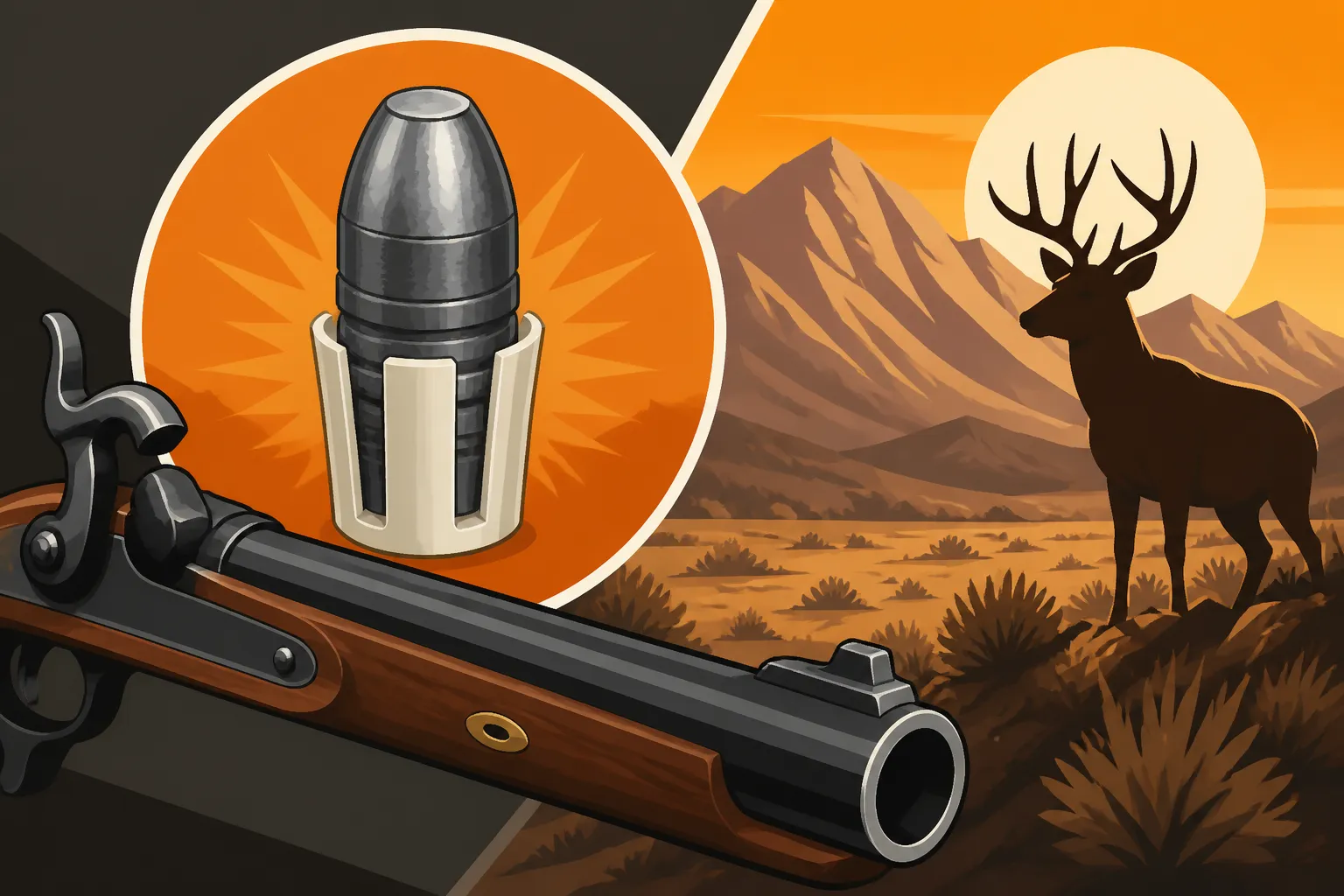
Now, let's talk about sabots. The word "sabot" itself comes from French, meaning "shoe," and that's precisely what it does: it acts as a shoe for a projectile. In muzzleloading, a sabot is typically a plastic sleeve or cup that encases a smaller-diameter bullet, allowing that bullet to be fired through a larger bore. For instance, a common setup involves a .45 caliber rifle bullet loaded inside a plastic sabot designed to fit a .50 caliber muzzleloader barrel.
The appeal of sabots is undeniable. They allow muzzleloaders to use modern, high-performance rifle bullets – often jacketed, aerodynamically efficient, and designed for controlled expansion – at significantly higher velocities and with much greater accuracy than traditional lead projectiles. This combination of speed, trajectory, and terminal performance makes saboted bullets incredibly effective for ethical long-range shooting. They flatten trajectories, reduce wind drift, and deliver devastating energy on target, making them a favorite in states with less restrictive muzzleloader regulations where scopes are also permitted. For many, the idea of using a sabot transforms a traditional muzzleloader into something akin to a single-shot rifle, greatly extending its effective range and reliability.
Nevada's Specific Muzzleloader Ammunition Regulations
Here's where the rubber meets the road, or more accurately, where Nevada's regulations draw a very clear line in the sand. While the general concept of sabots is appealing for performance, the legal reality in Nevada is far more restrictive than in many other states. It's crucial for any hunter participating in a muzzleloader hunt in Nevada to understand these specific rules.
The "Single, Non-Jacketed, All-Lead" Rule
The Nevada Department of Wildlife (NDOW) regulations for muzzleloader projectiles are quite specific and often catch hunters by surprise, especially those accustomed to more liberal rules elsewhere. According to the current NDOW Big Game Seasons and Application Guide, "Projectiles must be a single, non-jacketed, all-lead bullet or a lead bullet with a plastic tip of .45 caliber or larger, which is loaded from the muzzle."
Let's break down exactly what this means:
- "Single projectile": This simply means you can't load multiple projectiles, like buckshot, into your muzzleloader for big game. One bullet at a time.
- "Non-jacketed": This is perhaps the most significant restriction for sabot users. Most modern rifle bullets designed for use with sabots are jacketed. That means they have a copper or gilding metal jacket surrounding a lead core. Nevada explicitly prohibits these. The intent is to keep muzzleloader hunting distinctly separate from centerfire rifle hunting, maintaining a more traditional approach.
- "All-lead bullet or a lead bullet with a plastic tip": This reinforces the "non-jacketed" rule. It means the vast majority of the projectile must be lead. The allowance for a "plastic tip" does open the door for certain modern, all-lead or mostly-lead bullets that have a polymer tip for improved ballistics and expansion (e.g., some PowerBelt or Hornady Bore Driver designs). However, it does not allow for a copper jacket. All-copper bullets, while lead-free, would also typically fall outside the "all-lead" or "lead bullet with a plastic tip" definition.
- ".45 caliber or larger": This refers to the actual diameter of the bullet itself, not the bore diameter of the muzzleloader you're firing it from. So, if you're using a .50 caliber muzzleloader, you cannot use a sabot to fire a .40 caliber or .429 caliber bullet, even if the sabot makes it fit the .50 caliber bore. The projectile itself must be .45 caliber or greater.
When you combine "non-jacketed" and "all-lead or lead with a plastic tip" with the ".45 caliber or larger" rule, it effectively eliminates most common saboted rifle bullets from legal use in Nevada. If you're pondering Muzzleloader Caliber Minimums for Elk, remember this rule applies universally to big game.
No Scopes Allowed for Nevada Muzzleloaders
As if the projectile restrictions weren't enough, Nevada adds another layer of specificity that dramatically impacts muzzleloader hunting: optics. The NDOW regulations state unequivocally, "Muzzleloaders must be equipped with open sights or peep sights only. Scopes of any type, including fiber optic, are prohibited."
This is a monumental rule that sets Nevada apart from many other states that allow scopes on muzzleloaders. What does this mean in practice?
- Limited Effective Range: Even with the most aerodynamically efficient and accurate lead bullet that is legal in Nevada, the absence of a scope severely limits a hunter's ethical shooting distance. Hitting an animal reliably and ethically beyond 100-150 yards with open sights requires exceptional skill, practice, and ideal conditions. This negates much of the potential long-range advantage that a modern sabot-style bullet might offer in other jurisdictions.
- Emphasis on Traditional Skills: This regulation truly pushes hunters back towards traditional muzzleloading skills, where stalking, reading terrain, and judging distance with accuracy become paramount.
- Reduces "Sabot" Appeal: Even if a highly specific, all-lead, non-jacketed, .45 caliber or larger bullet could be legally used with a plastic base (often mistakenly referred to as a sabot-like system), the inability to use a magnified optic removes much of the incentive for such a high-performance setup. If you're interested in whether Can You Use a Scope on a Muzzleloader, the answer in Nevada for big game is a resounding no.
These two regulations together make Nevada's muzzleloader seasons truly unique, favoring traditional methods and close-range encounters over the modern, long-range capabilities seen elsewhere.
The Reality of Using Sabots (or Similar) in Nevada
Given Nevada's strict regulations, the discussion around "sabot bullets" in a muzzleloader shifts from how to use them to whether they are even legal. For the vast majority of commercially available saboted rifle bullets, the answer is a clear no. However, some newer all-lead or primarily-lead projectiles feature plastic components that can cause confusion.
Identifying Legal Projectiles that Resemble Sabots
Let's be absolutely clear: a true sabot, designed to hold a smaller-diameter, typically jacketed rifle bullet (like a .40 caliber Hornady SST in a .50 caliber sabot), is not legal for big game muzzleloader hunting in Nevada due to the "non-jacketed" and ".45 caliber or larger" rules for the projectile itself.
However, the market does offer some projectiles that might look like they have sabot-like components, but are actually designed to meet more restrictive regulations. These typically involve:
- All-lead bullets with plastic bases or skirts: Some manufacturers produce all-lead projectiles that use a plastic cup or base as part of their design to improve gas seal and accuracy. If the bullet itself is entirely lead (or lead with a plastic tip) and is .45 caliber or larger, this type of projectile could potentially be legal. Examples might include some versions of PowerBelt Aerolite or certain specific designs by other brands. These are not truly "sabots" in the traditional sense of holding a smaller, separate bullet, but rather a monolithic lead projectile with an integrated plastic component for better barrel fit.
- Lead-with-plastic-tip bullets: As mentioned, NDOW allows "a lead bullet with a plastic tip." This means bullets like the Hornady Bore Driver FTX (which features a lead core, copper jacket base, and plastic tip) might be problematic due to the copper jacket on the base, even if the tip is plastic and the main body is lead. This is where it gets incredibly nuanced, and it’s always best to contact NDOW directly for clarification on specific models you are considering. The "all-lead" phrasing is very powerful and generally excludes copper-jacketed bases.
The key takeaway here is that hunters must scrutinize the exact construction of any projectile they consider. Is the bullet entirely lead (or lead with a plastic tip) and .45 caliber or larger? If it has a copper jacket anywhere, or if the actual projectile diameter is less than .45 caliber, it is likely illegal. It’s not enough for the package to say “muzzleloader”; it must meet Nevada's specific requirements. Resources like GoHunt can help you plan the rest of your hunt, but when it comes to ammunition legality, the NDOW rulebook is your absolute source of truth.
Impact on Muzzleloader Hunting Strategy in Nevada
Since the long-range advantages often associated with sabots and scopes are largely unavailable to Nevada muzzleloader hunters, the strategy shifts significantly. Instead of relying on technology to extend your reach, you must lean into traditional hunting skills.
- Closer Encounters: The primary goal for a Nevada muzzleloader hunter is to get within 100-150 yards, often much closer for a high-confidence shot with open sights. This demands superior stealth, tracking, and understanding of game movement.
- Projectile Choice Matters (Within Limits): Within the legal framework, choosing the most accurate and ballistically efficient all-lead or lead-with-plastic-tip .45 caliber or larger projectile for your specific muzzleloader is paramount. Experiment with different weights and brands to find what shoots best out of your barrel with open sights.
- Focus on Fundamentals: Instead of worrying about advanced ballistic calculators for extreme distances, focus on consistent loading, sight picture, and trigger control at your ethical range. Practice frequently with the exact load you plan to hunt with. When you're Sighting In After a Long Drive to Camp, remember it's all about repeatable precision with those open sights.
- Scouting is Crucial: Understanding the terrain, game trails, feeding areas, and water sources becomes even more critical. Muzzleloader seasons in Nevada often occur in specific, short windows, making detailed pre-season scouting vital. You can use tools like GoHunt's mapping features for E-Scouting a Nevada Unit Before the Season, but the on-the-ground work will make all the difference for closing the distance.
The short muzzleloader season windows, such as the limited Which Nevada Units Run a Muzzleloader Deer Hunt, mean every detail of your preparation counts.
Maximizing Your Muzzleloader Hunt Under Nevada Rules
Hunting with a muzzleloader in Nevada, under its specific and traditional rules, can be an incredibly rewarding experience. It pushes you to hone skills that might gather dust in other contexts. Instead of lamenting the restrictions, embrace them as part of the challenge and unique allure of Nevada's muzzleloader seasons.
Practice and Ethical Shot Placement
Since you won't be relying on the enhanced ballistics of most saboted bullets or the precision of a scope, consistent and diligent practice becomes your most powerful tool.
- Master Your Open Sights: Spend significant time at the range with your chosen legal projectile and your muzzleloader's open or peep sights. Practice at various distances—25, 50, 75, and 100 yards. Understand how your bullet drops and drifts at each distance. There's no ranging reticle, no ballistic turret; it's all about your eye, your practice, and knowing your equipment.
- Consistent Loading: Muzzleloaders are inherently sensitive to loading variations. Develop a consistent routine for seating your bullet. Ensure the same amount of pressure is applied each time. This consistency is vital for accuracy, especially when you're limited to open sights.
- Know Your Ethical Range: Be brutally honest with yourself about your effective range with open sights. For most hunters, this will be between 75-125 yards, sometimes a bit more with ample practice and ideal conditions. Do not take shots beyond this range. An ethical shot is one you can confidently make into a vital area, ensuring a quick and humane harvest.
- Shot Placement is Key: Practice aiming for the vital zones of the big game you're pursuing – typically the lung/heart area. With muzzleloader velocities, particularly with traditional lead projectiles, precise shot placement is even more crucial for effective energy transfer and quick incapacitation.
Scouting and Approaching Game
With your ethical shooting distance constrained by open sights and traditional projectiles, the art of the stalk and thorough scouting take center stage. This is where you outsmart the animal, not out-shoot it at long range.
- Intensive Pre-Season Scouting: Before the season even begins, use every tool at your disposal. Online mapping applications, like those available through GoHunt, are invaluable for E-Scouting a Nevada Unit Before the Season. Look for areas with dense cover, prominent game trails, known bedding and feeding zones, and critically, water sources. In Nevada's arid environment, knowing how to find and approach game around Hunting Water in Nevada's Driest Country is a game-changer.
- Terrain as Your Ally: Nevada's basin and range topography, with its countless draws, ridges, and sagebrush pockets, offers endless opportunities for concealment. Learn to use these features to your advantage. Whether you're Reading Wind on a Long Sage Stalk or using Terrain That Hides an Approach in Open Country, mastering the art of the approach is essential. Your goal is to get within that 100-yard window without alerting the animal.
- Patience and Persistence: Muzzleloader hunting often involves more patience. You might need to wait for an animal to move into a favorable position, or spend hours slowly stalking over broken ground. This isn't a long-range glassing game where you can pick apart a hillside from a mile away and then shoot. It's about being in the right place at the right time, having earned that proximity. This physical and mental preparation is akin to Preparing Physically for Long Glassing Days, even if the end game is a closer shot.
- Leverage Season Timing: Nevada's muzzleloader seasons can offer unique opportunities. Often, these seasons fall during times when animals are still in summer patterns or before heavy hunting pressure from rifle seasons begins. Understanding these timings can give you an edge in locating undisturbed game.
Ultimately, muzzleloader hunting in Nevada is a test of traditional hunting acumen. It’s a chance to slow down, get closer to the land, and truly earn your animal. Forget about the long-range sabot magic and embrace the challenge of a true hunter.
Muzzleloader Projectile Comparison Table
To help clarify the differences and legality, here's a quick comparison of common muzzleloader projectile types, with specific notes for Nevada hunters.
| Projectile Type | Description | Typical Advantages | Typical Disadvantages | Nevada Big Game Legality (General Interpretation) |
|---|---|---|---|---|
| Patched Round Ball | Spherical lead ball wrapped in a lubricated cloth patch, loaded from the muzzle. | Economical, easy to load, often accurate in traditional slow-twist barrels at short range. | Poor aerodynamics, rapid velocity loss, limited energy transfer at longer distances, requires careful patch-fitting. | Legal (if .45 cal or larger): Meets "single, non-jacketed, all-lead" requirement. |
| Solid Lead Conical Bullet | Solid lead bullet (e.g., Minie Ball, Maxi-Ball) designed to engage rifling directly, loaded from the muzzle. | Better aerodynamics and energy retention than round balls, harder hitting, good for hunting, decent accuracy. | Can be harder to load in fouled barrels, more expensive than round balls, still limited ballistic performance compared to modern bullets. | Legal (if .45 cal or larger): Meets "single, non-jacketed, all-lead" requirement. |
| Saboted Rifle Bullet (Standard) | A smaller diameter, typically jacketed, modern rifle bullet (e.g., .40 cal) encased in a plastic sabot for a larger bore (e.g., .50 cal). | High velocity, flat trajectory, excellent accuracy, superior bullet performance (expansion/penetration) at longer range. | Difficult to load in fouled barrels, expensive, plastic residue in barrel, often requires faster twist rates. | Likely ILLEGAL: Typically features a jacketed bullet (violates "non-jacketed"), and/or the actual projectile is smaller than .45 caliber (violates ".45 caliber or larger"). Nevada's regulations are very clear on these points. |
| Lead/Plastic-Tipped Muzzleloader Bullet | An all-lead or predominantly lead projectile with a plastic tip for improved ballistics, sometimes with a plastic base/skirt. Examples: PowerBelt Aerolite, some Hornady Bore Driver models. | Improved ballistics (flatter trajectory, better energy retention) over traditional conicals, easier loading due to reduced bearing surface. | May not achieve the extreme ranges of true saboted rifle bullets, can be expensive, specific to bore size. | Potentially Legal (with strict interpretation): If the bullet itself is single, non-jacketed, all-lead or lead with a plastic tip, and is .45 caliber or larger. Crucially, any copper jacketing, even just at the base, would likely render it illegal. Always verify with NDOW for specific products. |
Disclaimer
The information provided in this guide is for general informational purposes only and is based on publicly available regulations at the time of writing. Hunting regulations, including those pertaining to muzzleloader ammunition, can change frequently. It is the sole responsibility of every hunter to consult the most current Nevada Department of Wildlife (NDOW) Big Game Seasons and Application Guide or contact NDOW directly to ensure full compliance with all applicable laws and regulations before hunting. Failure to do so may result in legal penalties.