Two-Way Radio Use Between Hunting Partners
It's incredibly frustrating to be out in the vast, open country of Nevada, miles from pavement, and realize your cell phone is just an expensive paperweight. When you're trying to coordinate with a hunting partner, or worse, facing an unexpected emergency, a lack of reliable communication can turn a great day afield into a serious problem. This guide will walk you through the essential role two-way radios play for hunting partners in Nevada, covering legality, choosing the right gear, and maximizing their performance in the field.
The Challenge of Communication in Nevada's Big Country
Nevada isn't just big; it's empty. And that emptiness, while beautiful and wild, creates significant challenges when you need to stay in touch with your hunting partners. The terrain itself, the sheer distances, and the lack of infrastructure all conspire against reliable communication methods that work flawlessly closer to town.
Why Cell Service is a Mirage
Let's be honest, we've all been there. You pull up a map on your phone, see a promising ridge line, and head out with a buddy, assuming you'll just text or call if you split up. Then, as soon as you're a mile off the main dirt road, the bars vanish. Poof. Gone. This isn't just an inconvenience; it's a genuine safety concern. The vastness of Nevada's public lands, particularly the sprawling BLM ground and remote national forests, means that cell towers are few and far between. Even when you think you have a signal on a high point, it often drops to a single, unreliable bar or disappears entirely as you descend into a draw or move behind a mountain.
This isn't a knock on your cell provider; it's simply the reality of trying to cover millions of acres of rugged, uninhabited terrain. While you might get lucky near a small town or along a major interstate, venture into the heart of a hunting unit like 071, 102, or the remote country around the Jarbidge Wilderness, and you'll quickly realize that line-of-sight is king, and cell towers are rarely in your line of sight. Relying on a cell phone for critical communication with your hunting partner out here is a gamble you really shouldn't take.
Staying Connected for Safety and Strategy
Beyond the sheer frustration of a dead zone, effective communication is paramount for both safety and successful hunting strategy in Nevada. Imagine one partner sprains an ankle miles from the truck, or worse, encounters dangerous wildlife. Without a reliable way to call for help, a minor incident can quickly escalate into a life-threatening situation. The peace of mind that comes from knowing you can reach your partner instantly, even if you're out of sight, is invaluable. This is why many hunters also carry a satellite communicator, such as a Garmin inReach or Zoleo, especially if they plan to be alone for extended periods or truly deep in the backcountry where even two-way radios might struggle over extreme distances. For more on this, check out our guide on Satellite Messenger Use in Remote Country.
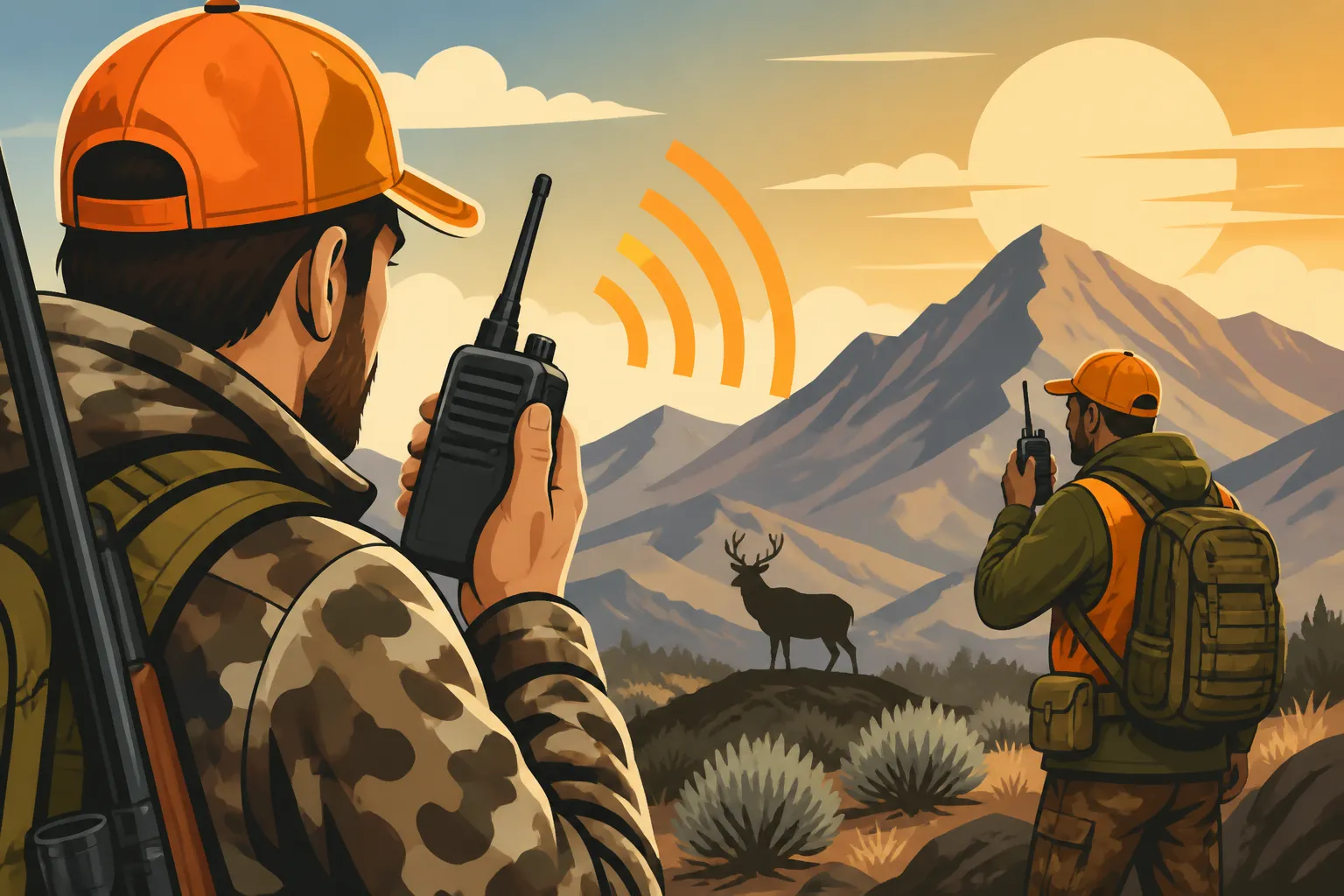
From a hunting perspective, two-way radios are game-changers. Think about coordinating a stalk on a bedded mule deer. One partner might be Glassing Grids Across a Nevada Basin from a high vantage point, spotting a buck, while the other is trying to How Far to Stalk a Bedded Mule Deer through a draw. Being able to communicate in real-time about the buck's movements, wind shifts, or optimal approach routes is critical. It allows you to synchronize your movements, share crucial observations, and even direct your partner to an animal they haven't seen yet. This coordinated effort can be the difference between filling a tag and going home empty-handed.
Understanding Two-Way Radio Legality and Regulations
Before you grab a pair of radios and head for the hills, it's wise to understand the rules of the game. While two-way radios are an invaluable tool for direct communication between hunting partners on the ground, there are specific regulations in Nevada that you need to be aware of, particularly regarding their use in relation to spotting and taking game.
Nevada's Stance on Radio Use
Generally speaking, using two-way radios for direct voice communication between hunting partners on the ground in Nevada is perfectly legal. The Nevada Department of Wildlife (NDOW) regulations primarily focus on prohibiting the use of electronic devices to spot or locate game animals from aircraft or to transmit information for the purpose of taking game animals by a person not physically present at the location of the animal. This means you can't have a buddy flying overhead in a plane, spotting an elk, and then radioing you its exact coordinates to go shoot it. Nor can you have someone miles away with a high-powered spotting scope on a different mountain radioing you play-by-play on an animal you're trying to sneak up on, effectively "hounding" it with electronics.
The distinction is important: communicating with your hunting partner about your location, their location, observations about terrain, or even the general direction an animal was headed when you saw it, is generally considered acceptable. The key is that the communication is between hunters actively involved in the hunt on the ground, and not being used to gain an unfair advantage through prohibited electronic spotting methods. Always check the current NDOW hunting regulations booklet for the most up-to-date and specific wording, as rules can change. When reading the regulations, look for sections pertaining to "illegal devices" or "methods of take" that specifically address electronic communication.
Channel Etiquette and Interference
Once you're legally squared away, the next step is responsible use. The airwaves aren't just for you and your buddy. Many two-way radios, particularly the popular FRS (Family Radio Service) and GMRS (General Mobile Radio Service) models, share common frequencies. This means you might accidentally tune into another hunting party, or worse, an emergency channel.
Good radio etiquette means being mindful of others. When you're out there, try to select less congested channels. Most radios offer "privacy codes" or "sub-channels" (CTCSS/DCS tones) which, while not truly private, filter out conversations from other users not using the same code. This helps reduce unwanted chatter, allowing you and your partner to hear each other clearly. Always keep your conversations clear, concise, and to the point. Long, rambling discussions tie up the channel and drain batteries unnecessarily. Furthermore, avoid using emergency channels unless it's a genuine emergency. These channels are often monitored and should be kept clear for genuine distress calls. Remember, the goal is effective communication with your partner, not broadcasting your every thought to the entire unit.
Choosing the Right Two-Way Radio for Nevada Hunting
Navigating the options for two-way radios can feel a bit overwhelming with all the acronyms and specs thrown around. But for hunting in Nevada, understanding the core differences between FRS and GMRS, and knowing which features genuinely matter, can make all the difference in your communication success.
FRS vs. GMRS: What Hunters Need to Know
The two most common types of consumer-grade two-way radios you'll encounter are FRS (Family Radio Service) and GMRS (General Mobile Radio Service). Both operate on UHF frequencies, which are good for penetrating light cover and buildings but are ultimately limited by line-of-sight.
-
FRS Radios: These are the most common, license-free radios you'll find at any sporting goods store or even a big box retailer. They typically offer 22 channels and low power output (usually 0.5 to 2 watts). FRS radios are excellent for close-quarters communication, say, between two hunters working a small timber patch or within a mile or two in relatively open terrain with good line-of-sight. They're affordable and easy to use, making them a great entry point. However, their lower power means their range in rugged Nevada country will be significantly less than advertised, often limited to a mile or two even under ideal conditions.
-
GMRS Radios: These are a step up. GMRS radios typically transmit at higher power levels (up to 5 watts, and even more on some mobile units or repeaters) and can utilize a broader set of channels, including repeater channels (though repeaters are less common for casual hunting use). The catch? To operate a GMRS radio legally, you need a license from the FCC. Don't let that scare you off – it's a relatively inexpensive, 10-year license that covers your entire family, and it doesn't require a test. For hunters ranging across Nevada's expansive basins and mountain ranges, the increased power of GMRS radios translates to significantly better range and reliability, especially when you need to talk to a partner across a valley or over a ridge. Many of the more robust, hunting-specific radio models available today are GMRS-capable, offering a clear advantage for Glassing Nevada's Basin and Range for Mule Deer where distances are measured in miles, not yards.
When considering which to buy, think about the typical distances you'll be apart. If you're always within shouting distance or a short walk, FRS might suffice. If you regularly split up to cover different ridges, coordinate a push, or if safety is a higher priority due to extreme terrain, investing in GMRS and getting the license is highly recommended. Many outdoor gear review sites, like those you might find on GoHunt, often provide detailed comparisons and field tests of various FRS and GMRS models, which can be a valuable resource.
Key Features for Rugged Western Hunting
Beyond FRS vs. GMRS, specific features become crucial for the demanding environment of Nevada hunting:
- Real-World Range: Manufacturers love to advertise "up to 35 miles!" but that's typically under perfect, line-of-sight conditions over water. In Nevada's mountains and sagebrush, expect a fraction of that. Look for radios with higher power output (for GMRS) and, crucially, a removable antenna on GMRS models, which allows for upgrades to longer, more efficient antennas.
- Battery Life: Multi-day hunts mean you need batteries that last. Look for radios with excellent battery life, preferably with rechargeable lithium-ion packs, but also the ability to run on standard AA/AAA batteries in a pinch. Carrying spare battery packs or a portable power bank is non-negotiable. For discussions on how to prepare for long excursions, consider reading about Water You Must Carry on a Desert Day Hunt or Preparing Physically for Long Glassing Days.
- Durability and Weather Resistance: Your radio will get dropped, bumped, and exposed to dust, rain, and snow. Look for rugged construction and an IP rating (e.g., IP67) for water and dust resistance. You don't want your communication device failing just because you set it down in the dirt or got caught in a sudden rain shower.
- VOX (Voice-Activated Transmission): This feature allows you to transmit by speaking, without pressing a button, which is incredibly useful when you're hands-free, holding optics, or scrambling up a steep incline.
- NOAA Weather Alerts: Many radios include this feature, which can be a lifesaver for unexpected storms or high winds, allowing you to seek shelter or adjust your plans.
- Privacy Codes (CTCSS/DCS): As mentioned, these help filter out other users on the same channel, keeping your conversations clearer.
- User-Friendly Interface: When your hands are cold or you're wearing gloves, simple, intuitive controls are essential.
Satellite Communicators vs. Radios
While two-way radios are excellent for short to medium-range communication between partners, it's vital to distinguish them from satellite communicators. Radios rely on terrestrial radio waves and are limited by terrain and distance. Satellite communicators, like the popular Garmin inReach or Zoleo devices, use satellite networks to send and receive messages, track your location, and most importantly, send SOS signals anywhere in the world, even without cell service.
When to use which:
- Two-Way Radios: Ideal for real-time, frequent voice communication within your hunting group over a few hundred yards to several miles. They're quick, don't require subscription fees (beyond a GMRS license), and are perfect for coordinating immediate actions like a stalk, a drive, or simply checking in on each other throughout the day.
- Satellite Communicators: Best for emergency situations, long-distance text communication (when out of radio range), detailed mapping and tracking, or when hunting solo and needing a reliable way to contact the outside world. They require a monthly or annual subscription but provide a critical safety net that radios cannot.
Many savvy Nevada hunters carry both: a GMRS radio for everyday group communication and a satellite communicator for emergencies or when venturing far afield. Your decision on which unit to choose should factor in the Cell Coverage Across Nevada Hunt Units you anticipate, and the specific Choosing a Unit by Terrain Difficulty you plan to hunt.
Maximizing Your Radio's Performance in the Field
Getting the right radio is only half the battle. Knowing how to use it effectively in Nevada's unique environment, and understanding its limitations, is key to maximizing its performance and ensuring reliable communication with your hunting partners.
Terrain and Line-of-Sight
The single biggest factor dictating your radio's range and reliability in Nevada is terrain. Unlike flatter states, Nevada is dominated by the Basin and Range topography: long, north-south running mountain ranges separated by wide, flat valleys. This means that even a small ridge or a slight dip in elevation can completely block a radio signal, which relies heavily on line-of-sight.
- The Line-of-Sight Rule: If you can't see your partner, chances are your radio signal can't either. Radio waves travel in a relatively straight line. A mountain, even a small hill, effectively creates a radio shadow. This is why a radio that works perfectly in a wide-open valley might be useless once one of you drops into a canyon or moves behind a peak. When you're trying to communicate with a partner who might be Using Draws and Rims to Close Distance on an animal, remember that those same draws and rims can easily impede your signal.
- Strategies for Success:
- Gain Elevation: Whenever possible, try to move to higher ground before transmitting. Even a few extra feet of elevation can significantly extend your range by clearing obstacles.
- Relay Messages: If you have more than two people, or if there's a third person positioned strategically on a high point between two distant hunters, they can act as a relay, receiving a message from one and re-transmitting it to the other.
- Pre-Plan Communication Points: Before splitting up, identify key geographical features (e.g., "Meet me at the north saddle of that prominent peak" or "I'll be on that bench overlooking the spring") where you anticipate better radio reception.
- Consider Repeaters (GMRS): In some areas, there might be GMRS repeaters that can dramatically extend range. This requires a GMRS license and a radio capable of using repeaters, but it's an advanced option for truly vast areas.
Understanding how terrain impacts your signal is crucial, especially when you're trying to coordinate intricate moves like Two-Hunter Calling Setups That Actually Work where precise timing and communication are everything.
Antenna, Power, and Battery Management
Beyond terrain, how you manage your radio's internal components and power can heavily influence its performance.
- Antenna: For most FRS radios, the antenna is fixed. For GMRS radios, especially higher-end models, you might have the option to upgrade the antenna. A longer, more efficient aftermarket antenna (from reputable brands like Nagoya or Smiley Antenna) can significantly boost your signal strength and reception, effectively extending your range. Just make sure the antenna is compatible with your radio's connector type.
- Power Settings: Most GMRS radios allow you to select high, medium, or low power output.
- High Power: Use this for transmitting over long distances or through challenging terrain. It offers the best chance of getting through but drains your battery fastest.
- Low Power: Use this for close-range communication (within a mile or two) to conserve battery life. It's often sufficient and can keep your radio running for days longer.
- Battery Management: Batteries are the lifeblood of your radio.
- Carry Spares: Always pack extra battery packs or a compatible set of AA/AAA batteries. For longer trips, a small solar charger or a power bank (like those you use for phones) can top off your rechargeable packs.
- Conserve Power: Beyond using low power settings, avoid unnecessary chatter. Turn off features like NOAA weather alerts if you don't need them constantly. In very cold weather, keep batteries insulated close to your body, as cold significantly reduces battery performance.
- Pre-Charge: Always start your hunt with fully charged batteries. Simple, but often overlooked in the excitement of opening day.
Communication Protocols and Practice
Finally, even the best gear needs skilled operators. Establishing clear communication protocols with your partner and practicing them before the hunt will ensure you make the most of your radios.
- Clear and Concise Messages: Radio communication isn't a phone call. Keep messages brief and to the point. State your call sign (if you use one), your partner's call sign, and then your message. "Whiskey Tango, this is Papa Bear, I've got two deer moving into the timber draw below your position, copy?"
- Establish a Check-In Schedule: Agree on specific times to check in, especially if you plan to be separated for extended periods. For example, "Check in at 10 AM, 1 PM, and 4 PM." This provides a safety net if someone goes silent.
- Use Call Signs or Names: Especially if there's a chance of other hunters on the same channel, using unique names or call signs helps avoid confusion.
- Practice Before the Hunt: Don't wait until opening morning to figure out how your radios work. Go out with your partner, split up, and practice communicating over varied terrain. Test the limits of your radios in conditions similar to what you'll encounter during the hunt. This helps you understand real-world range, clarify any unclear features, and get comfortable with the communication flow. This preparation is just as important as sighting in your rifle or practicing your glassing routine like The Grid Glassing Method, Step by Step.
By understanding the terrain, managing your equipment, and practicing effective communication, your two-way radios will become an indispensable tool for safe and successful hunting across Nevada's incredible landscapes.
| Feature | FRS (Family Radio Service) | GMRS (General Mobile Radio Service) |
|---|---|---|
| License Required | No | Yes (FCC license, covers family for 10 years, no test) |
| Power Output | Low (0.5 – 2 watts typically) | Higher (up to 5 watts handheld, more for mobile/repeaters) |
| Range | Shorter (1-2 miles realistic in varied terrain) | Longer (2-5+ miles realistic in varied terrain, much more with line-of-sight) |
| Channels | 22 shared channels | 22 shared FRS/GMRS channels + 8 dedicated GMRS repeater channels |
| Antenna | Fixed, non-removable | Often removable/upgradable on higher-end models |
| Cost | Generally less expensive | Generally more expensive, plus license fee |
| Ideal Use | Close-range communication, small groups, casual use | Extended range, rugged terrain, serious hunting/outdoor activities |
Disclaimer
The information provided in this guide is for general informational purposes only and does not constitute legal advice. Hunting regulations, including those pertaining to electronic devices, can change. Always consult the most current Nevada Department of Wildlife (NDOW) regulations before engaging in any hunting activities. It is the hunter's responsibility to understand and comply with all applicable laws and regulations.