Rocky Mountain Goats in Nevada Ranges
Dreaming of chasing a white ghost across Nevada's highest peaks? For many hunters, drawing a Rocky Mountain goat tag in the Silver State feels like winning the lottery, and for good reason—these tags are incredibly rare, hard-earned, and represent an unparalleled physical and mental challenge. This comprehensive guide will walk you through everything you need to know about pursuing these majestic animals, from understanding their limited presence in Nevada's rugged ranges to the demanding preparation required for a truly once-in-a-lifetime hunt.
The Elusive Rocky Mountain Goat in Nevada
Nevada might be known for its vast deserts and sagebrush flats, but tucked away in its highest, most remote mountain ranges, a small, resilient population of Rocky Mountain goats thrives. These animals are a true testament to the state's diverse, often surprising, wild landscapes.
A Brief History of Nevada's Goats
Unlike mule deer or elk, which have deep historical roots across much of Nevada, Rocky Mountain goats are not native to the state. Their presence here is a result of strategic reintroduction efforts by the Nevada Department of Wildlife (NDOW). Starting primarily in the 1960s and extending into the 1970s, goats were transplanted from healthy populations in states like Idaho and Montana into suitable high-alpine habitats in Nevada. The hope was to establish a self-sustaining population that would eventually offer limited hunting opportunities.
These initial transplant efforts were often arduous, involving capturing goats in their home ranges and transporting them to release sites in Nevada's most formidable mountain environments. The animals faced the immediate challenge of adapting to new terrain, finding forage, and establishing new social structures. It's a testament to their incredible resilience that these initial groups not only survived but began to reproduce, slowly but surely establishing a foothold in some of the most unforgiving landscapes the state has to offer.
Current Population and Distribution
Today, Nevada's Rocky Mountain goat population remains relatively small compared to other big game species, and their distribution is quite specific. They are predominantly found in the state's highest and most rugged mountain ranges in eastern Nevada, particularly the Ruby Mountains, the Schell Creek Range, and parts of the Snake Range near the Utah border. These are not easy places to access, often requiring significant backcountry travel, which further protects these animals from human disturbance outside of hunting season.
NDOW conducts periodic aerial surveys to estimate population numbers, but counting animals that inhabit such vertical, remote terrain is always a challenge. While exact figures fluctuate, the overall population is in the low hundreds, making it one of the rarest big game species to pursue in the state. Each unit where goats reside has a very conservative tag quota, often only one or two tags per year, underscoring the precious nature of these animals and the hunts they provide. When you see a goat in Nevada, you're looking at a conservation success story.
Why the Numbers Are So Small
Several factors contribute to the limited size and slow growth of Nevada's Rocky Mountain goat populations. First and foremost is habitat. Goats require very specific, high-elevation, cliff-dominated terrain that provides both forage and critical escape cover from predators. Such habitat is not widespread in Nevada, which is largely dominated by lower-elevation sagebrush and pinyon-juniper zones. The few mountain ranges that offer suitable goat habitat are isolated, limiting natural expansion.
Furthermore, goats reproduce slowly, typically having only one kid per year, and those kids face high mortality rates in the harsh alpine environment. Competition with other high-country ungulates, such as bighorn sheep and mule deer, for forage can also play a role, especially in years of drought. The extreme weather conditions characteristic of Nevada's high mountains, including heavy snowfall and severe winter storms, can significantly impact survival rates. Disease outbreaks, while rare, can also be devastating to small, isolated populations. All these elements combined mean that every goat in Nevada is a valuable part of a fragile population, and managing them for sustainable hunting is a delicate balance.
Drawing That Once-in-a-Lifetime Tag
For most hunters, the journey to a Nevada mountain goat hunt begins and often ends in the draw. With such limited tags available, success is rare, but the dream keeps thousands applying year after year.
Understanding Nevada's Mountain Goat Draw Odds
Let's be blunt: the draw odds for a Nevada Rocky Mountain goat tag are astronomically low. We're talking about single-digit percentages, often less than one percent, even for applicants with many bonus points. Nevada uses a squared bonus point system, which means your accumulated points are squared, and that total is added to your application number for more chances in the drawing. So, if you have four points, you actually get sixteen chances plus your current year's application, adding up to seventeen chances. This system theoretically favors those who have been putting in for many years, but with so few tags, it's still largely a lottery. You can delve deeper into how this works by reading about how "Nevada Squares Your Bonus Points Into Draw Chances".
Many dedicated hunters apply for decades before ever seeing success, if they ever do. It's a testament to the allure of these incredible animals and the experience they represent. To stay informed on the current odds and application trends, resources like GoHunt offer detailed draw statistics and unit analysis, which can be invaluable for strategizing your application. However, even with the best data, persistence is truly the name of the game for a Nevada goat tag.
Applying Strategically: Units and Choices
When it comes to applying for a Nevada mountain goat tag, strategic unit selection is crucial, even if the options are limited. NDOW typically offers tags in only a handful of specific units that harbor established goat populations. These units are usually in the Ruby Mountains, Schell Creek Range, and the Snake Range. Researching these units involves looking at past harvest success, population trends, and drawing statistics. While draw odds are low across the board, sometimes one unit might offer a slightly better chance due to lower applicant numbers or a slight increase in tag allocation.
It's vital to meticulously research the unit boundaries and habitat before applying. Understanding "Reading a Nevada Hunt Unit Before You Apply" will help you decipher the regulations and geographic specifics. Most applicants will list multiple choices, but the reality is that nearly all goat tags are drawn as a first choice. Your second and third choices are long shots at best, but it doesn't hurt to list them, perhaps for less popular units or those with even lower success rates. The goal is to maximize any small edge you can get in a draw with such incredibly tight margins.
The Cost of a Nevada Goat Tag
Drawing a Nevada mountain goat tag is just the first hurdle; the financial investment is significant, especially for nonresidents. The application fees themselves can add up if you're applying for multiple species, but the real cost comes when you actually draw the tag.
For nonresidents, the Nevada combination license is required before you can even apply for any big game species, and that's a notable expense on its own. If you are lucky enough to draw, the Rocky Mountain goat tag itself carries a substantial fee. To give you a clear picture, you can review the specific breakdown of costs by checking "Nevada Nonresident Tag Pricing by Species". This is truly an investment in a once-in-a-lifetime experience, and it's essential to be prepared for the financial commitment that accompanies such a coveted tag. Between application fees, the combination license, and the tag itself, you're looking at a considerable sum before you even factor in travel, gear, or potential guide services.
Habitat and Locating Nevada's Mountain Goats
Mountain goats are creatures of the extreme, living their lives in environments that most other large mammals shy away from. Locating them in Nevada's vast, vertical wilderness is a serious undertaking.
Identifying Goats in Their High-Altitude Domains
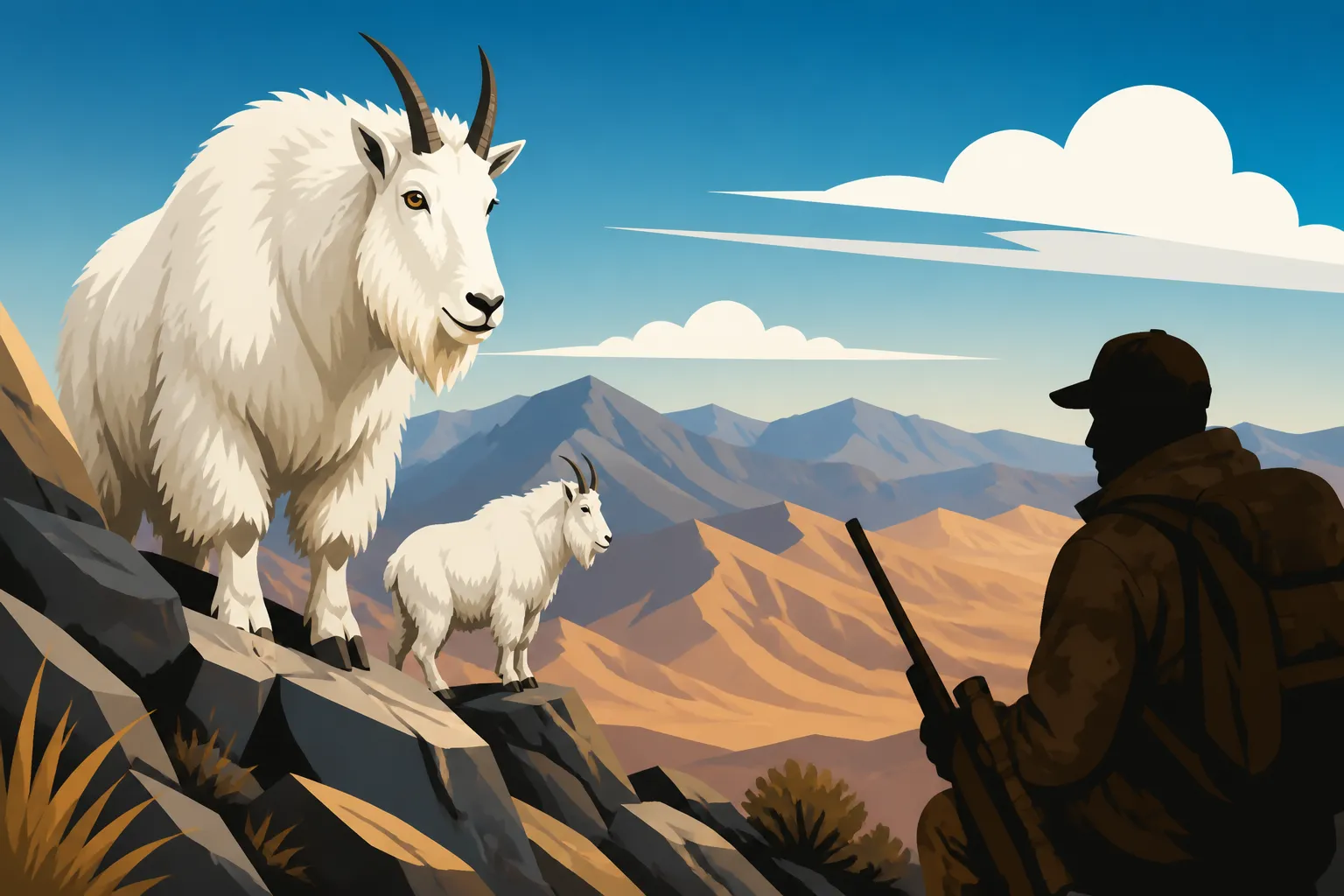
Rocky Mountain goats are perfectly adapted to their high-altitude, rugged environments. They prefer steep, rocky terrain, often above timberline, characterized by cliffs, ledges, and alpine meadows. Their white coats provide excellent camouflage against snowfields and light-colored rock faces, especially during the early or late seasons when snow is present. This natural camouflage makes spotting them incredibly difficult, even for experienced hunters.
You'll typically find them navigating seemingly impossible slopes, using their cloven hooves and specialized pads for traction. They might be feeding on sparse alpine vegetation, bedded down on a precarious ledge, or slowly traversing a sheer rock wall. Understanding this specific habitat preference is paramount to locating them. Don't expect to find them in rolling hills or dense timber; their world is one of vertical rock and thin air.
Key Mountain Ranges for Goat Encounters
While Nevada has many mountain ranges, only a select few offer the extreme, high-elevation habitat that Rocky Mountain goats require. The Ruby Mountains in northeastern Nevada are arguably the most well-known stronghold. With their dramatic, glacially carved peaks, deep cirques, and abundant high-alpine basins, the Rubies provide ideal goat country. Hunting here often involves traversing vast, open areas at high elevation and navigating challenging rock slides.
Another significant area is the Schell Creek Range in eastern Nevada, part of the larger Great Basin ecosystem. This range, like the Rubies, boasts significant elevations and steep, broken terrain. Further south, the Snake Range, home to Great Basin National Park, also supports a small goat population. While hunting is prohibited within the national park boundaries, goats can be found in suitable habitat outside its borders. Knowing these specific areas is critical for pre-scouting and understanding the challenges of your potential hunting grounds. For instance, understanding "Access Into the Snake Range" can give you a head start on planning your approach to some of these remote areas.
The Role of E-Scouting and Optics
Given the extreme and remote nature of goat habitat, meticulous e-scouting is non-negotiable. Before you ever set foot in the field, you should spend countless hours studying satellite imagery and topographic maps. Platforms like GoHunt, onX Hunt, or BaseMap allow you to identify potential goat holding areas, escape routes, water sources, and possible approach routes. Look for steep, north-facing slopes with jagged cliff bands, isolated pockets of high-altitude forage, and any features that break up the terrain offering goats sanctuary. This kind of detailed virtual reconnaissance is the bedrock of a successful hunt, helping you eliminate unproductive ground and focus your limited time in areas with the highest potential. For a deeper dive into this, check out our guide on "E-Scouting a Nevada Unit Before the Season".
Once you're in the field, high-quality optics are your best friend. A good spotting scope (20-60x or higher) and powerful binoculars (10×42 or 15×56) are absolutely essential. You'll spend an incredible amount of time glassing, systematically picking apart every rock face, every patch of snow, and every small basin. The ability to distinguish a white goat from a white rock at extreme distances is a learned skill that comes only with practice and top-tier glass. Think of your optics as an extension of your eyes, allowing you to effectively cover miles of vertical terrain without expending unnecessary energy.
The Physical and Mental Demands of a Goat Hunt
Hunting Rocky Mountain goats is not for the faint of heart. It is, by almost any measure, one of the most physically demanding big game hunts available, pushing hunters to their absolute limits.
Unmatched Physical Preparation
Drawing a mountain goat tag is just the beginning; the real work starts with your physical preparation. This is not a hunt where you can "get in shape on the mountain." You need to arrive in peak physical condition, capable of sustained climbs with heavy packs in thin air. Training should focus heavily on cardiovascular endurance, strength training (especially legs and core), and carrying weight. Incorporate activities like stair climbing, hiking with a weighted pack, and trail running into your routine. The elevation gain on a goat hunt can be extreme, often involving thousands of feet of climbing each day.
Many successful goat hunters describe their preparation as similar to training for a marathon, but with the added challenge of navigating treacherous, uneven terrain. The thin air at 10,000 to 12,000 feet (and higher) will test your lungs, and inadequate conditioning can lead to altitude sickness, fatigue, and even serious injury. This demanding aspect is something we emphasize in our article, "Preparing Physically for Long Glassing Days", which is critical for any high-country hunt. Neglecting this part of the hunt preparation is a recipe for misery and potential failure.
Gear Essentials for Extreme Terrain
Your gear list for a Nevada mountain goat hunt will look more like an expedition packing list than a typical big game hunt. Every item must be carefully considered for its weight, durability, and functionality in extreme conditions.
- Boots: This is perhaps the most critical piece of gear. You need stiff, durable mountaineering boots with excellent ankle support and a stiff sole for kicking steps into snow and edging on rock. Lightweight hiking boots won't cut it. Read our insights on "Choosing Boots for Sharp Volcanic Rock" for more specific advice.
- Layering System: Temperatures can swing wildly, from freezing nights to warm midday sun, often with high winds. A versatile layering system, including base layers, mid-layers (fleece, puffy), and a bombproof waterproof/breathable shell, is essential. Check out "Layering for Basin and Range Temperature Swings" for comprehensive advice.
- Pack: A comfortable, high-capacity backpacking pack (60-80 liters) is needed to carry all your gear, plus potentially heavy meat and a cape.
- Navigation: GPS device, satellite messenger (Garmin inReach or Zoleo), map, and compass are all non-negotiable. Cell service is nonexistent in these remote areas.
- Shelter: A lightweight, four-season tent or bivy system capable of withstanding high winds and snow.
- Other Essentials: Water filtration system, headlamp, first-aid kit, trekking poles, ice axe (depending on conditions), and potentially crampons.
Field Dressing and Meat Care in the High Country
Successfully harvesting a goat is only half the battle; getting it off the mountain is the other. Field dressing a goat, often on a steep, unstable slope, presents unique challenges. Safety is paramount—you do not want to lose an animal, or yourself, down a cliff. Carefully assess the terrain before you begin.
Meat care is also critical. While high-altitude temperatures are often cool, proper ventilation and cooling of the carcass are still important, especially if you have a long pack out. The white hair of a goat is incredibly dense and insulative, so skinning the animal promptly is key to allowing the meat to cool. You'll likely be deboning the meat to reduce weight for the pack out. This isn't a job for one person; a hunting partner or guide is invaluable for both safety and logistics. For more detailed advice on handling game in remote, challenging environments, refer to "Packing an Animal Out of Roadless Country". It's a grueling task, but the effort ensures that the precious meat is preserved.
Hunting Strategies and Ethical Considerations
A Nevada mountain goat hunt is a masterclass in patience, planning, and precision. The terrain, the animal's natural defenses, and the sheer effort involved demand nothing less than your absolute best.
Spot-and-Stalk in a Vertical World
The spot-and-stalk method is king when hunting mountain goats. You'll spend most of your time behind your optics, systematically glassing every inch of the high country. Starting from a vantage point, often a high ridge or peak, use your binoculars and spotting scope to methodically grid the terrain. This is a practice we highlight in "Glassing Grids Across a Nevada Basin", adapted for vertical ground. Goats often appear as small white specks, sometimes only discernible by their movement or position on an unlikely ledge.
Once a goat is spotted, the stalk begins. This is where the physical demands truly hit. Navigating treacherous cliffs, scree slopes, and boulder fields while maintaining silence and staying out of sight requires extreme caution and skill. You'll need to use every fold, every rock, and every patch of scrub to your advantage to close the distance. Wind direction is critical and can be unpredictable in mountain terrain, swirling with thermals rising in the morning and falling in the evening. Patience is your greatest virtue; a single misstep can send rocks tumbling, alerting the goat and ruining the hunt.
Shot Placement and Recovery Challenges
Goats are incredibly tough animals, built to withstand harsh conditions. Their thick hide and bone structure mean that precise shot placement is absolutely vital. A poorly placed shot can result in a wounded animal disappearing into impossible terrain, a scenario every hunter dreads. Aim for the vitals, understanding the goat's anatomy, and be prepared for a follow-up shot if necessary.
Recovery after the shot is another massive challenge. Goats often fall on steep, unstable slopes or ledges that are difficult, if not dangerous, to access. Before taking a shot, always consider the recovery angle and what might happen if the animal rolls. It's often better to pass on a shot that puts the animal in an unrecoverable position, even if it's a good goat. Having a detailed recovery plan with your hunting partner or guide, including ropes and safety equipment, is essential. There's no shame in calling off a shot that could lead to an unrecoverable animal; ethical hunting demands that you do everything possible to retrieve your game.
The Role of a Guide for a Goat Hunt
Given the extreme challenges of hunting Rocky Mountain goats in Nevada, many successful tag holders opt to hire a professional guide. A reputable guide brings invaluable experience, intimate knowledge of the terrain, and an understanding of goat behavior in specific units. They can significantly increase your odds of success, not just in locating a goat, but in safely executing a difficult stalk and recovery.
However, guide services for mountain goats are among the most expensive big game hunts, reflecting the intensity of the work and the specialized skills required. It's crucial to understand "What a Guided Mountain Goat Hunt Costs" and to carefully vet any potential outfitter. Always ask for references, inquire about their success rates in your specific unit, and clarify what is included in the price. Read our guide on "Vetting a Nevada Outfitter Before You Send a Deposit" to ensure you make an informed decision. For many, a guide isn't just a luxury but a necessary component to maximize the potential of such a rare and demanding tag.
| Factor | Rocky Mountain Goat Hunt in Nevada | Typical Nevada Mule Deer Hunt |
|---|---|---|
| Draw Odds | Extremely low (often <1%), decades to draw | Low to moderate, varies significantly by unit and weapon type |
| Habitat | High-alpine, steep cliffs, rocky, above timberline | Varied: sagebrush, pinyon-juniper, mountain fronts, high country |
| Physical Demand | Extremely high, mountaineering-level fitness required | High, but typically less extreme than goat hunting |
| Gear Specialization | Very specialized: mountaineering boots, technical layering, ice axe/crampons possible | Standard hunting gear, good hiking boots, layering |
| Hunting Strategy | Intensive spot-and-stalk, often in precarious positions | Spot-and-stalk, still-hunting, glassing vast basins |
| Tag Cost (Non-res.) | Very high (often $2000+) | Moderate to high (e.g., ~$400 for deer tag + license) |
| Guide Necessity | Highly recommended due to terrain and animal behavior | Optional, many successful DIY hunts |
Disclaimer
Please note: Hunting regulations, season dates, and tag fees are subject to change annually. Always consult the most current Nevada Department of Wildlife (NDOW) regulations before planning any hunt.