Carrying Extra Fuel on a Nevada Hunt
Out in Nevada's vast, wild landscapes, running out of fuel isn't just an inconvenience – it can quickly turn into a serious situation, leaving you stranded miles from the nearest town, cell service, and any help. The sheer emptiness of much of the Silver State's backcountry means gas stations are few and far between, and the roads themselves can devour fuel faster than you'd expect. This guide is all about equipping you with the knowledge and practical strategies to ensure you always have enough gas in the tank to get where you're going and, more importantly, to get back safely.
The Reality of Nevada's Remote Backcountry
If you've spent any time driving through the heart of Nevada, you know it's a place defined by its immense scale. Vast sagebrush basins stretch for what feels like forever, broken only by towering, rugged mountain ranges. It's truly breathtaking, but it's also a landscape that demands respect, especially when it comes to logistical planning.
Miles Between Services
The biggest shock for many first-time Nevada hunters is just how far apart services, especially fuel stations, can be. You might drive for an hour or two, or even longer, without seeing another car, let alone a gas pump. Towns are often tiny, offering a single pump that might be closed on weekends or holidays, or have limited hours. It's not uncommon to fill up in a place like Winnemucca or Elko and know that your next reliable fuel stop is hundreds of miles away in another state, or a much larger city like Reno or Las Vegas.
This isn't like hunting in more populated states where you can always find a small town with a gas station every 30-40 miles. Here, those distances are magnified. You could easily be 80-100 miles from the nearest pavement, and then another 50 miles to a town with fuel. This vastness means every gallon counts. Neglecting to top off your tank when you have the chance is a mistake many hunters only make once. Knowing How Far Apart Nevada Fuel Stops Are is critical for any extended trip.
Unpredictable Terrain and Road Conditions
It's easy to look at a map and calculate your vehicle's mileage based on highway driving, but that's a dangerous assumption to make in Nevada's hunt units. The roads you'll be traveling are rarely paved. We're talking about graded dirt roads, faint two-tracks, and sometimes no discernible road at all as you push deeper into the backcountry. These conditions dramatically impact your fuel consumption.
Think about it: you're likely in a 4×4 truck or SUV, possibly loaded down with gear, a roof rack, and maybe even larger, heavier tires. When you engage four-wheel drive to navigate washouts, steep climbs, or deep sand, your fuel economy plummets. Driving slowly over washboard roads, constantly shifting gears, or idling for extended periods while glassing for deer or elk also burns through fuel much faster than cruising at 60 mph on the interstate. The constant stopping, starting, and crawling over What Nevada Backroads Do to a Tire means your engine is working harder and less efficiently. You might see your usual 20 MPG drop to 10-12 MPG, or even less, when you're truly off the beaten path. This isn't just about getting stuck; it's about the increased demand on your vehicle's engine that directly translates to higher fuel burn.
Planning Your Fuel Strategy Before You Go
Before your tires even hit the dusty Nevada roads, a solid fuel strategy should be one of the top items on your preparation checklist. This isn't an afterthought; it's foundational to a successful and safe hunt.
Mapping Fuel Stops and Distances
Your e-scouting doesn't just involve finding potential hunting spots or water sources; it absolutely must include mapping your entire route, identifying every single potential fuel stop, and noting the distances between them. Don't just assume a town has fuel. Use up-to-date mapping software like GoHunt or other reliable platforms that show gas station locations. Better yet, call ahead to verify hours of operation, especially in smaller, remote communities. Many of these small stations operate on limited schedules, might be closed for lunch, or even for days at a time. The last thing you want is to roll into a tiny town on fumes, only to find the one pump is closed.
Think about the farthest points you plan to drive within your hunt unit, and then trace your path back to the nearest reliable fuel source. Consider side trips for scouting, retrieving game, or simply exploring a new ridge. Add those miles to your calculations. When you're E-Scouting a Nevada Unit Before the Season, be sure to layer in fuel station locations and check recent satellite imagery for signs of closed businesses. A good rule of thumb is to never let your main tank drop below half if you're venturing more than an hour or two off pavement.
Calculating Your Vehicle's True Range
Most modern vehicles display an estimated "distance to empty" or "range," but take that number with a huge grain of salt when you're hunting in Nevada. Those estimates are usually based on recent average fuel economy, which, as we discussed, will be far different from your actual consumption on rough dirt roads.
To get a more realistic understanding of your range, you need to factor in your specific hunting conditions. If you typically get 18 MPG on the highway, assume that number will drop significantly — perhaps to 12-14 MPG — once you hit the dirt, especially if you're loaded down, running larger tires, or frequently engaging 4WD. A simple formula is to take your tank size, multiply it by your estimated backcountry MPG, and then subtract a generous safety buffer, say 25-30%. This buffer accounts for unexpected detours, extra idling, or just plain miscalculation. It's the equivalent of having an emergency fund, but for your fuel tank.
Here's a quick reference for common factors that impact your true range:
| Factor | Impact on Fuel Economy (Approx.) | Notes |
|---|---|---|
| Highway Driving | Baseline | Your vehicle's advertised MPG (often optimistic). |
| Dirt Roads (Washboard/Gravel) | -10% to -20% | Constant acceleration/deceleration, lower speeds. |
| Rough Two-Tracks/Off-Road | -20% to -40% | 4WD engagement, slow speeds, obstacles, steep grades. |
| Heavy Loads (Gear, Passengers) | -5% to -15% | More weight means engine works harder. |
| Roof Rack/Cargo Box | -5% to -10% | Increased aerodynamic drag. |
| Larger/Aggressive Tires | -5% to -15% | More rolling resistance, heavier. |
| Cold Weather Idling | -5% to -10% (when stationary) | Engine takes longer to warm up, runs rich. |
| High Elevation | -5% to -10% | Thinner air means less efficient engine combustion. |
Always be conservative in your estimates. It’s far better to have too much fuel than not enough, especially in a state where a breakdown could mean a very long walk to find help.
Safe and Effective Ways to Carry Extra Fuel
Once you've accepted that your main tank simply won't cut it for a remote Nevada hunt, the next step is deciding how to safely and effectively transport that precious extra fuel. There are a few tried-and-true methods, each with its own benefits and considerations.
Portable Fuel Cans: Jerry Cans and Rotopax
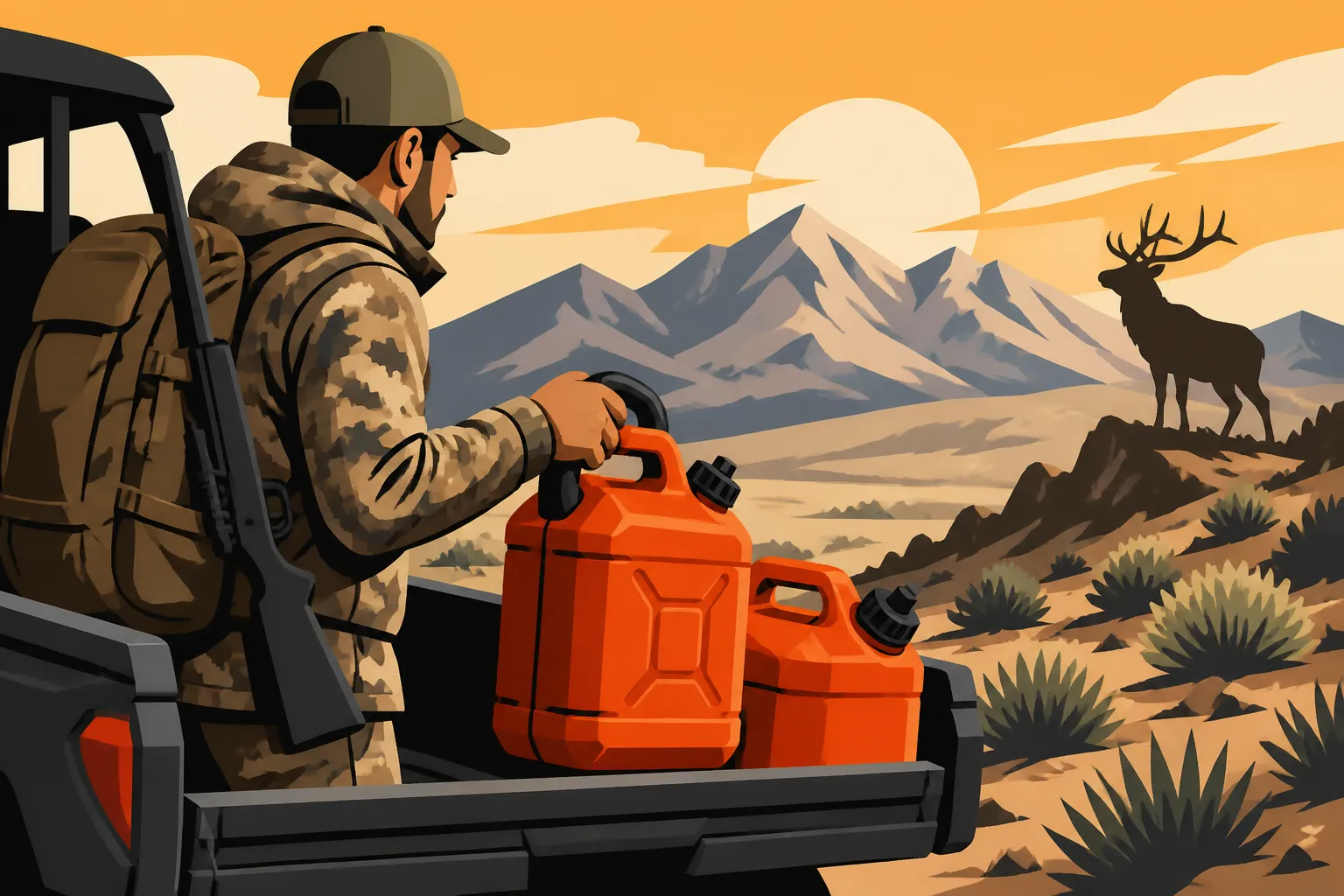
For most hunters, portable fuel cans are the go-to solution. The two most popular styles are traditional metal Jerry cans and the more modern plastic Rotopax containers.
-
Jerry Cans: These classic metal cans (often 5-gallon capacity) are robust, relatively inexpensive, and designed to withstand abuse. They've been a staple for military and off-road enthusiasts for decades.
- Pros: Durable, classic look, readily available.
- Cons: Can be heavy when full, prone to rust if not cared for, fumes can be an issue if carried inside a vehicle. They also often require an aftermarket spout to be truly spill-free, as the new "CARB compliant" spouts can be frustratingly slow and leak-prone.
- Safety Tip: Always transport Jerry cans outside the passenger compartment. A roof rack, trailer, or external bumper mount is ideal. Ensure they are secured tightly to prevent bouncing or tipping, which can cause leaks or damage. Keep a high-quality, spill-proof pour spout handy.
-
Rotopax Cans: These rugged, rotationally-molded plastic containers are designed specifically for off-road vehicle mounting. They come in various sizes (1, 2, 3, 4 gallons) and colors, and their unique stackable design allows for versatile mounting options. GoHunt users often rave about their modularity and secure mounting systems.
- Pros: Extremely durable, UV-resistant, leak-proof when properly sealed, low profile, and can be easily mounted on ATVs, UTVs, roof racks, or spare tire carriers. Their proprietary mounting system is incredibly secure.
- Cons: More expensive per gallon than Jerry cans, require specific mounting hardware, and can be slower to empty due to their design.
- Safety Tip: Always use the appropriate Rotopax mount, ensuring the fuel pack is tightly secured. Venting them periodically, especially with temperature changes, is crucial to prevent pressure buildup. Keep them out of direct sunlight as much as possible to minimize expansion.
No matter which type of portable can you choose, remember that proper maintenance is key. Inspect seals regularly, and replace them if they show signs of wear.
Vehicle-Mounted Fuel Tanks and Auxiliary Systems
For the most serious overlanders or those who spend weeks at a time in the deepest backcountry, a more permanent solution might be an auxiliary fuel tank. These systems are typically installed underneath the vehicle, often replacing the spare tire, or custom-fabricated to fit existing space.
- Pros: Greatly extended range, secure and out of the way, often plumbed directly into the vehicle's fuel system (though some are manual transfer). Frees up roof rack or cargo space.
- Cons: Significant upfront cost for the tank and professional installation, adds considerable weight, may require modifying exhaust or suspension, and can impact departure angles if poorly placed.
- Considerations: This is a major modification, so research thoroughly and consult with experienced off-road shops. Ensure the system is compatible with your vehicle and meets all safety and regulatory standards. While not something the average hunter needs, it's a testament to the distances involved in Nevada.
Essential Safety Precautions for Fuel Transport
Carrying extra fuel is inherently risky if not done correctly. Safety should always be your top priority.
- Ventilation is Key: Fuel fumes are explosive. Never carry fuel cans inside the passenger compartment of your vehicle without extreme ventilation. If you absolutely must, ensure windows are open, and even then, limit the time. Exhaust fans or roof vents can help in enclosed campers.
- Secure All Cans: A loosely secured fuel can can bounce, rub, and eventually leak. Use high-quality straps, cargo nets, or dedicated mounting systems to ensure cans are locked down tight. Imagine your truck rolling over on a rough trail – you want those cans to stay put.
- Fire Extinguisher: Always carry at least one, preferably two, easily accessible fire extinguishers (ABC type) in your vehicle. One inside the cab, one mounted externally or near your fuel cans.
- Spill Kit: A small spill kit with absorbent pads, gloves, and a sealed bag for contaminated materials can be a lifesaver in case of a minor leak or spill.
- Avoid Overfilling: Leave a little headspace in your fuel cans for expansion, especially in hot weather or at higher altitudes. Overfilling can lead to pressure buildup and leaks.
- No Smoking/Open Flames: This should be obvious, but always be mindful of open flames, sparks, and smoking when handling fuel.
- Grounding: When refueling from a portable can, it's good practice to ground the can to your vehicle to prevent static discharge. While less common with modern plastic cans, it's a simple safety measure.
How Much Extra Fuel Do You Really Need?
This is the million-dollar question, and the answer, unfortunately, is "it depends." However, we can break it down to give you a solid framework for making your decision.
Assessing Your Unit and Trip Duration
The amount of extra fuel you need is directly proportional to the size of your hunt unit, the quality of its road network, and the duration of your trip.
- Unit Size: Some Nevada units are massive, covering thousands of square miles. If you're hunting one of these, especially for a species like elk or mule deer where you might be chasing them across different drainages, you'll be covering a lot of ground. Conversely, a smaller unit, or one with more limited access, might require less roaming. The guide to Why Unit Size Changes How You Hunt offers good perspective here.
- Road Network: Is your unit crisscrossed with passable dirt roads, or are you looking at faint two-tracks and long stretches of off-road travel? Units with extensive Remote Road Conditions Across Nevada mean more slow-speed, high-fuel-consumption driving. If you anticipate heavy 4×4 use, plan accordingly.
- Trip Duration: A 3-day weekend hunt will require less fuel than a 7-10 day hunt. Factor in not just the days you're actively hunting, but also travel days to and from the unit, and any potential scouting trips you plan once you arrive.
- Base Camp vs. Mobile Camp: If you're setting up a base camp and making day trips from there, you might need less extra fuel at any one time, as you can return to your stash. If you're constantly moving your camp, you'll need to carry all your fuel with you. Even if you're Camping Legally on Nevada BLM Ground at a static location, having enough fuel for the entire trip, plus a buffer, is wise.
As a general guideline, for a typical 5-7 day hunt deep in a Nevada unit, many hunters opt for an additional 10-15 gallons of fuel. This usually translates to two 5-gallon Jerry cans or three to four 3-gallon Rotopax. This provides a significant extension to your range, often adding another 100-200 miles of backcountry driving, which can be the difference between getting home and getting stranded.
Contingency Planning for the Unexpected
Even the best-laid plans go awry, especially in the backcountry. Your extra fuel supply should always include a contingency.
- Getting Stuck: If you get stuck in sand, mud, or a wash, your engine might idle for long periods while you work to recover your vehicle. Running a winch also consumes fuel. Having extra fuel means you won't drain your main tank during a recovery effort.
- Extended Scouting: You might find a promising area further than anticipated and want to spend extra time scouting it out. Fuel allows for that flexibility.
- Helping a Fellow Hunter: You might encounter another hunter in distress who has run out of fuel. Being able to offer assistance is part of the hunting community ethos.
- Unforeseen Detours: A washed-out road, a gate closure, or an unexpected private land boundary might force a long detour, burning through precious fuel.
- Peace of Mind: Honestly, the biggest benefit of carrying extra fuel is the peace of mind it provides. Knowing you have a reserve allows you to focus on the hunt, not constantly watching your fuel gauge. This peace of mind is just as important as Preparing Physically for Long Glassing Days, allowing you to keep your focus on the task at hand.
Always err on the side of caution. An extra 5 gallons of fuel is cheap insurance compared to the cost, time, and potential danger of being stranded in the middle of nowhere.
Legalities and Best Practices
While there aren't typically specific state or federal regulations that dictate how much personal fuel you can carry in your private vehicle for recreational use, it's always smart to be aware of general best practices and legalities that govern fuel transport and environmental responsibility.
Understanding Regulations for Fuel Transport
For personal use, you generally won't encounter strict limits on the number of portable fuel cans you can carry, as long as they are properly secured and transported safely. However, if you were transporting fuel for commercial purposes or in extremely large quantities, different regulations would apply. The key takeaway here is that safety is paramount. Any incident involving improperly stored or transported fuel could lead to legal issues, not to mention personal injury or property damage. Ensure your containers are approved for fuel storage (like UN-rated Jerry cans or EPA/CARB-compliant Rotopax), and always follow manufacturer instructions for use and storage. While you're preparing your vehicle, remember to check all aspects of your Vehicle Prep for Remote Nevada Roads to ensure it's in top condition for the journey.
Environmental Responsibility
As hunters and outdoors enthusiasts, we have a responsibility to protect the environment we enjoy. This extends to how we handle fuel.
- Prevent Spills: Always take precautions to prevent fuel spills, whether you're filling cans at the gas station or transferring fuel in the field. Use funnels, take your time, and be aware of your surroundings.
- Clean Up Any Spills: If a spill does occur, clean it up immediately and thoroughly. Use absorbent materials (which should be part of your spill kit) and dispose of them properly, usually by packing them out and placing them in a sealed container for later disposal at an approved facility. Never leave contaminated materials in the backcountry.
- Proper Disposal of Empty Cans: Once a fuel can is truly empty, you have a couple of options. You can continue to use it, or if it's damaged or old, dispose of it responsibly. Many recycling centers accept metal or plastic fuel cans, but it's best to check with your local waste management facility for specific guidelines. Never abandon fuel cans in the wilderness.
- Leave No Trace: Adhering to Leave No Trace principles means packing out everything you pack in, and that absolutely includes fuel containers, even if they're empty. Our goal is to leave the land better than we found it.
Remember, every decision you make regarding fuel on your Nevada hunt impacts not just your safety and success, but also the pristine environments we are privileged to explore. Plan wisely, carry safely, and respect the wild country.
Disclaimer
Please note that hunting regulations and conditions can change. Always consult the most current Nevada Department of Wildlife (NDOW) regulations and local land management agency rules before planning any hunt. This guide is for informational purposes and should not be considered legal advice. Safety in the field is your responsibility.