Fuel and Service Distances in Nevada
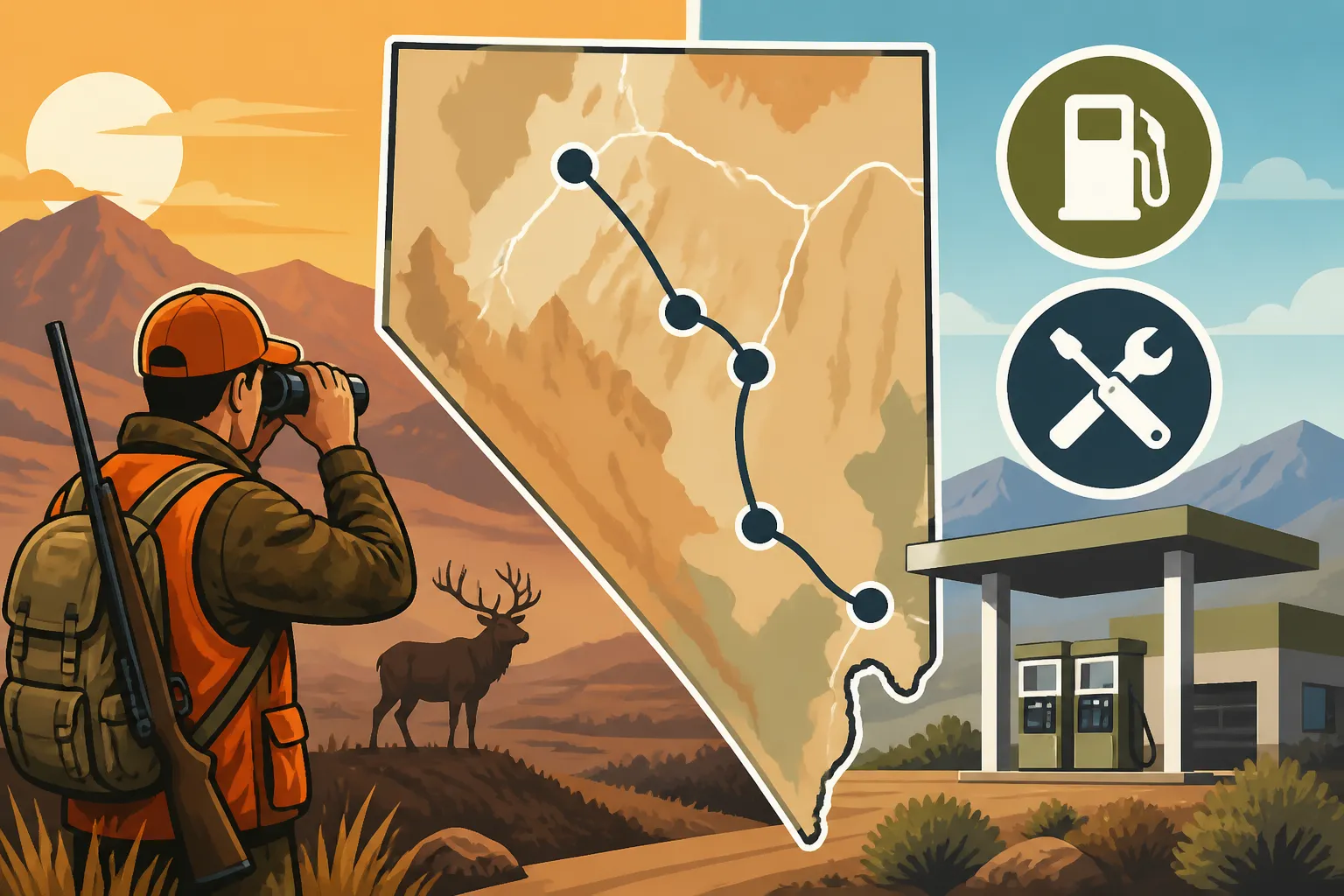
It's easy to look at a map of Nevada and see what appear to be short distances between towns or access points, only to find yourself hours from pavement, watching the fuel gauge drop faster than expected. The vastness of the Great Basin isn't just about mileage; it's about the quality of those miles, the remoteness of the terrain, and the sheer emptiness that can make a breakdown a serious, even dangerous, situation. This guide is here to walk you through the realities of planning for fuel, services, and emergencies when you're hunting the Silver State, so you can focus on the hunt itself, not on whether you'll make it back to civilization.
The Vastness of Nevada: More Than Just Distances
Nevada is truly a land of extremes, and its scale often catches hunters off guard. While the population centers are few and far between, the distances between them are often covered by long, lonely stretches of highway. But the real challenge begins when you leave that pavement and head deep into the backcountry. The landscape itself conspires to make every mile count, and every drop of fuel a precious commodity.
The Reality of Great Basin Travel
Imagine pulling up your favorite mapping app and seeing a route that's only 40 miles long. In many parts of the country, that's a quick 45-minute drive. In rural Nevada, especially when you're venturing off maintained roads, that 40 miles could easily take three, four, or even five hours. You're often traversing faint two-tracks that wind through sagebrush, climb over rocky passes, and navigate washes. These aren't roads built for speed; they're routes that demand patience and a slow, deliberate pace.
This isn't just an inconvenience; it's a critical factor in fuel consumption. Driving slowly in four-wheel drive, especially low-range, burns significantly more fuel than cruising on the highway. Add to that the constant shifting, the occasional need to clear a path, or even just idling for a few hours while glassing a distant ridge, and your vehicle's MPG plummets. It's a fundamental truth of Nevada's Roads Are Long and Its Services Are Far Apart. You could spend an entire day traveling less than 100 miles, and that fuel gauge will reflect every single slow, grinding mile. The sheer isolation can also play tricks on your mind; seeing no other vehicles for hours on end can make you second-guess every decision, especially when your fuel starts to run low.
Why Every Drop Counts
In the remote corners of Nevada, running out of fuel isn't just a minor inconvenience that leads to a quick walk to the nearest gas station. It can quickly escalate into a survival situation. Many of Nevada's hunting units are vast, sprawling across hundreds of square miles with minimal human presence. If you run out of gas ten miles down a dirt road, you might be facing a 20-mile round trip on foot just to reach a paved road, let alone a gas station that might still be 50 miles further down the highway.
Factors like extreme temperatures, whether blistering summer heat or freezing winter nights, further amplify the danger. You might need your engine to run for warmth or air conditioning if you're stuck, but that eats into your remaining fuel. Planning for a successful hunt means meticulously planning your fuel, understanding that every single drop counts, and always assuming that help, if it comes at all, will be hours away. This foresight is just as important as Preparing Physically for Long Glassing Days or knowing your rifle's zero.
Mapping Your Route: Anticipating the Gaps
The key to navigating Nevada's vastness successfully lies in proactive planning. You can't just wing it and hope for the best. Modern technology has provided hunters with incredible tools, but they only work if you know how to use them effectively to anticipate the inevitable service gaps that define so much of Nevada's public land.
Utilizing Digital Tools for Planning
Gone are the days of relying solely on paper maps, although those are still incredibly valuable as a backup. Today, digital mapping applications are indispensable for planning a Nevada hunt. Tools like onX Hunt and GoHunt allow you to scrutinize your chosen unit from the comfort of your home. You can identify not just game habitat and topographical features, but also land ownership, potential water sources, and, critically, the location of towns, even small ones, that might offer services.
Before you ever put the truck in gear, use these apps to measure the exact distance from your last known reliable fuel station to your intended hunting area and back. Then, add a significant buffer for scouting, chasing game, and unexpected detours. Pay attention to the types of roads shown – a solid line on a digital map can hide a treacherous, fuel-guzzling two-track in real life. Mark potential fuel stops along your entire route, including your intended hunting unit and potential exit strategies. This kind of E-Scouting a Nevada Unit Before the Season is not just about finding deer; it's about ensuring your logistical survival. Think of your vehicle like your bow: you wouldn't go into the field without knowing your Rifle Zero Distance for Long Sage Shots, so don't hit the road without knowing your vehicle's range.
Reading a Nevada Unit Map Beyond the Roads
A map, whether digital or paper, tells you where the roads are, but it doesn't always tell you what they're like. When you're Reading a Nevada Hunt Unit Before You Apply, go beyond just identifying obvious access points. Look for the faint, dashed lines that indicate primitive roads or trails. These often lead to deeper penetration into prime hunting areas but come with a significant cost in terms of time and fuel.
Consider the terrain itself. Are you crossing vast, flat playas where roads are mere suggestions and prone to washouts, or are you navigating steep, rocky canyons where progress will be agonizingly slow? Each type of terrain has its own impact on your vehicle's performance and fuel economy. Small towns that appear on a map might consist of nothing more than a few houses and an abandoned general store. Always research the actual services available in these tiny communities before banking on them for fuel or repairs. Don't be afraid to call ahead to small-town gas stations or mechanic shops to confirm their hours and services, especially during off-peak seasons or on weekends.
Fueling Up: Strategy for the Far Reaches
Given Nevada's immense distances and sparse services, carrying extra fuel isn't an option for serious hunters; it's a necessity. This isn't just about topping off your tank; it's about strategic planning and safe execution.
The Case for Auxiliary Fuel Tanks and Cans
Let's be blunt: if you're planning an extended hunt deep into Nevada's backcountry, your vehicle's factory fuel tank is rarely enough. The solution usually comes in two forms: auxiliary fuel tanks or portable fuel cans (often called jerry cans). Auxiliary tanks are usually aftermarket additions, permanently mounted under the truck bed or in another suitable location, offering significant additional capacity and the convenience of being plumbed directly into your fuel system. They're a bigger investment but offer seamless integration.
Portable fuel cans are the more common and accessible option. Brands like RotopaX, or traditional military-style metal jerry cans, are popular choices. When using these, it's absolutely critical to consider safety. Fuel should never be stored inside the passenger compartment of your vehicle due to fumes and extreme fire risk. Mount them securely on an exterior rack, bumper, or bed. Ensure they are properly vented to prevent pressure buildup, especially with Nevada's temperature swings. Always carry at least 5-10 gallons extra, and often more for multi-day excursions or if you plan to cover serious ground off-road. Even a seemingly minor issue like a slow tire leak can turn into a major fuel issue if you have to drive significantly slower to air up and get to the nearest town. Carrying Extra Fuel on a Nevada Hunt is about preparedness, not paranoia.
Identifying Last-Chance Fuel Stops
It’s easy to get tunnel vision when you’re excited about a hunt, but you absolutely must train yourself to look for "last-chance" fuel stops. These are the small towns, often just a speck on the map, that represent your final opportunity to top off before heading into truly remote country. Towns like Denio, Jarbidge, Montello, or Lund, while small, can be lifelines. However, always verify their operating hours and fuel availability. Some might close early, or not be open on Sundays, leaving you stranded if you didn't plan ahead.
Develop a habit: every time you pass a gas station, even if your tank is only half full, consider topping it off. That seemingly unnecessary five gallons could be the difference between making it to your destination and being stuck. Think about the long valleys you'll cross, like the Smoke Creek Desert, Big Smoky Valley, or Diamond Valley. These are massive geographical features with little to no services. A full tank and a couple of jerry cans are your insurance policy against becoming another statistic in the vastness of Nevada.
Vehicle Preparedness: Beyond Just a Full Tank
A full tank is a great start, but it's only one piece of the puzzle. Nevada's backcountry roads are notoriously brutal, and mechanical failures, especially tire issues, are incredibly common. Being prepared means your vehicle needs to be in top shape and equipped for self-sufficiency.
Tire Wisdom for Nevada's Backroads
If there's one thing Nevada's sharp volcanic rock, basalt, and loose shale will teach you, it's respect for your tires. These roads are not kind, and punctures are a rite of passage for many hunters here. You absolutely need appropriate tires for the job. Highway-rated passenger tires simply won't cut it. Invest in good quality, all-terrain (AT) tires with a strong sidewall and a higher load rating. Ensure they are properly inflated for the load you're carrying and consider airing down slightly on extremely rough roads for better traction and ride quality, just remember to air back up for pavement.
More importantly, you need a full-size spare tire – not a donut. A small spare won't get you far, if anywhere, on a rocky dirt road. Make sure that spare is in good condition and properly inflated. Beyond the spare, carry a comprehensive tire repair kit. This should include plugs, patches, and a portable air compressor capable of reinflating a large tire. Knowing how to use these tools is just as important as having them. Practice changing a tire at home in comfortable conditions, so you're not trying to figure it out for the first time on a dark, cold, windy night in the middle of nowhere. This is part of understanding What Nevada Backroads Do to a Tire.
Essential Emergency and Recovery Gear
Beyond fuel and proper tires, a well-stocked recovery kit is non-negotiable. You’re often many hours from any form of professional help, and cellular service is nonexistent in vast areas. Here’s a basic list of what should be in your vehicle:
| Item | Why You Need It in Nevada | Notes/Tips |
|---|---|---|
| Extra Fuel (5-10 gal) | Sparse stations, rough roads consume more fuel | RotopaX or metal jerry cans; secure outside vehicle, vent periodically. |
| Full-Size Spare Tire | Sharp rocks, long distances to tire repair | Check air pressure regularly; practice changing a tire. |
| Tire Repair Kit | Plugs, patch kit, portable air compressor for slow leaks | Don't forget a pressure gauge. |
| High-Lift Jack | Standard jacks often too short for lifted vehicles or soft ground | Know how to use it safely; can be dangerous if not used correctly. |
| Shovel | Digging out stuck tires, clearing obstacles | Collapsible, sturdy shovel is best. |
| Traction Boards | Getting unstuck from sand, mud, snow | Brands like Maxtrax or similar; can double as leveling blocks. |
| Tow Strap/Rope | Recovering a stuck vehicle (yours or someone else's) | Ensure it's rated for your vehicle weight; no metal hooks. |
| Basic Tool Kit | Tighten loose bolts, minor repairs | Include wrenches, sockets, pliers, screwdrivers, zip ties, duct tape. |
| Jumper Cables | Dead battery, helping others | Heavy gauge cables; know how to properly jump-start. |
| Satellite Messenger | Emergency communication, check-ins outside cell service | Garmin inReach, Zoleo; test before you go; share plan with family. |
| First-Aid Kit | Accidents are always possible, far from medical help | Comprehensive kit for trauma, cuts, burns, snake bites. |
| Gallons of Water | Hydration is critical in the desert; for radiator if needed | Minimum 1-2 gallons/person/day, plus emergency reserve. |
| Non-Perishable Food | Unexpected delays can extend your trip | High-energy bars, MREs, jerky. |
| Warm Layers/Blankets | Desert nights get cold, even after hot days | Emergency blanket, sleeping bag, extra clothing. |
This list isn't exhaustive, but it covers the most critical items for Vehicle Recovery Gear for Nevada Roads. Always ensure your equipment is in working order and you know how to use it. That high-lift jack, for instance, can be incredibly useful but also dangerous if used improperly.
Emergency Services: When Help is Hours Away
It’s a common misconception that since most people have cell phones, help is always just a call away. In Nevada’s hunting country, that couldn’t be further from the truth. Understanding the limitations of modern communication and having redundant systems in place is paramount for your safety.
Understanding Cell Coverage Blackouts
Let me say it clearly: you will lose cell service. Expect it. Embrace it. Plan for it. Nevada's vast, rugged terrain, characterized by deep valleys, steep mountain ranges, and immense open spaces, creates colossal communication dead zones. Even if you're standing on a ridge overlooking a vast basin, the nearest cell tower might be 50 miles away, blocked by a mountain range, or simply nonexistent.
Relying on your cell phone for emergencies is a gamble you cannot afford to take. While apps like onX Hunt can function offline once maps are downloaded, the communication aspect of your phone will fail in these remote areas. Many hunters have found themselves in a bind, with a broken-down truck or an injured partner, only to realize their smartphone is nothing more than an expensive paperweight for communication. Never assume you'll have a signal, even if you had one in a similar spot last year. Cell Coverage Across Nevada Hunt Units is notoriously spotty and unreliable.
Satellite Communication: Your Lifeline
Because cell service is so unreliable, satellite communication devices are not a luxury; they are an essential piece of safety equipment for any serious Nevada hunter. These devices operate independently of cell towers, communicating directly with satellites orbiting the Earth.
You essentially have two main categories:
- Personal Locator Beacons (PLBs): These are one-way devices. In a dire, life-threatening emergency, you press a button, and it sends a distress signal with your GPS coordinates to a rescue coordination center. They are designed for true emergencies where you need immediate professional help.
- Satellite Messengers: Devices like the Garmin inReach or Zoleo offer two-way communication. You can send custom text messages to family and friends, update them on your location, and, crucially, activate an SOS function that connects you directly to a 24/7 emergency response center. This allows for communication with rescuers, providing vital details about your situation.
Before your hunt, ensure your device is charged, has an active subscription, and you know how to use it. Share your itinerary and expected check-in times with a trusted contact, and demonstrate how you'll use your satellite messenger to communicate. This way, if you miss a check-in, they know to initiate contact or, if necessary, activate the emergency services. This peace of mind, knowing you have a way to reach out even in the most remote areas, is invaluable. Learning about Satellite Messenger Use in Remote Country could literally save your life.
Water and Provisions: Sustenance in Solitude
Beyond fuel and mechanical preparedness, your own physical sustenance is crucial. Nevada's dry, often harsh environment means you need to be especially diligent about carrying enough water and food, even for what seems like a short trip.
Hydration is Non-Negotiable
Nevada is, after all, a desert state, and the dry air, combined with physical exertion, can lead to rapid dehydration. Even during cooler seasons, you're constantly losing moisture. If your vehicle breaks down, or you get turned around on a stalk, the amount of water you carry becomes critically important.
Always carry significantly more water than you think you'll need. A good rule of thumb is at least one to two gallons of water per person, per day, minimum, with an additional reserve for emergencies. This reserve isn't just for drinking; it could be needed for a radiator, washing a wound, or even cleaning game meat in a pinch. Don't rely on finding natural water sources, as many springs shown on maps might be dry, seasonal, or otherwise unsuitable for drinking. Water You Must Carry on a Desert Day Hunt is a lesson learned the hard way by many. During a late season hunt, water will also be needed for cooling down a harvested animal before packing it out.
Planning for Extended Stays
Even the most meticulous plans can go awry. A simple day hunt can quickly turn into an unexpected overnight stay, or even several days, if you have a serious vehicle breakdown, get lost, or encounter unforeseen weather. Preparing for this possibility is a sign of a responsible hunter.
Always pack extra non-perishable, high-energy food. Granola bars, jerky, nuts, dried fruit, and MREs (Meals Ready to Eat) are excellent choices. These items don't take up much space and can provide crucial calories and energy when you need them most. In addition to food, pack basic survival gear: an emergency blanket, a sleeping bag rated for colder temperatures (even if it's warm during the day, desert nights can be frigid), a tarp or bivy sack for shelter, and a reliable light source with extra batteries. These items aren't just for comfort; they're for survival, allowing you to endure an unexpected night or two in the wilderness, keeping you safer while you wait for help or work on a solution. This preparedness goes hand-in-hand with managing the heat if you're stranded during Heat Management on an August Archery Hunt.
Disclaimer
This article is for general informational purposes only and does not constitute professional advice. Laws, prices and regulations vary by location and change over time. Consult a qualified professional for guidance on your specific situation.