Reading Antelope Body Language on a Stalk
There's nothing quite like the sight of a magnificent Nevada pronghorn buck, horns glinting in the morning sun, that stops your heart for a moment. But that moment of awe often quickly turns to exasperation when your carefully planned stalk falls apart because the antelope suddenly knew you were there. It's frustrating, feeling like they have a sixth sense for danger, isn't it? This guide is going to peel back the layers of pronghorn behavior, helping you decipher their subtle body language so you can become a more effective and successful stalker in Nevada's vast, open country.
The Pronghorn's Superpowers: Why They're So Hard to Read
Let's be honest, pronghorn are built for survival in wide-open spaces, and that means they possess an incredible suite of senses that make them notoriously difficult to approach. It’s not just luck when they bust you; it's their finely tuned biology at work. Understanding these "superpowers" is the first step in learning to read their intent.
Unrivaled Vision and Awareness
Think about those huge, dark eyes. A pronghorn's eyes are actually disproportionately large for their head, giving them an almost 300-degree field of view without even turning their head. This means they can literally see nearly all around them, all the time. They're not just looking; they're actively scanning, processing every shimmer of heat off the sagebrush, every distant movement that you might mistake for a rock or a shadow. They can pick out a hunter from miles away, especially if you're silhouetted on a ridge or moving too quickly.
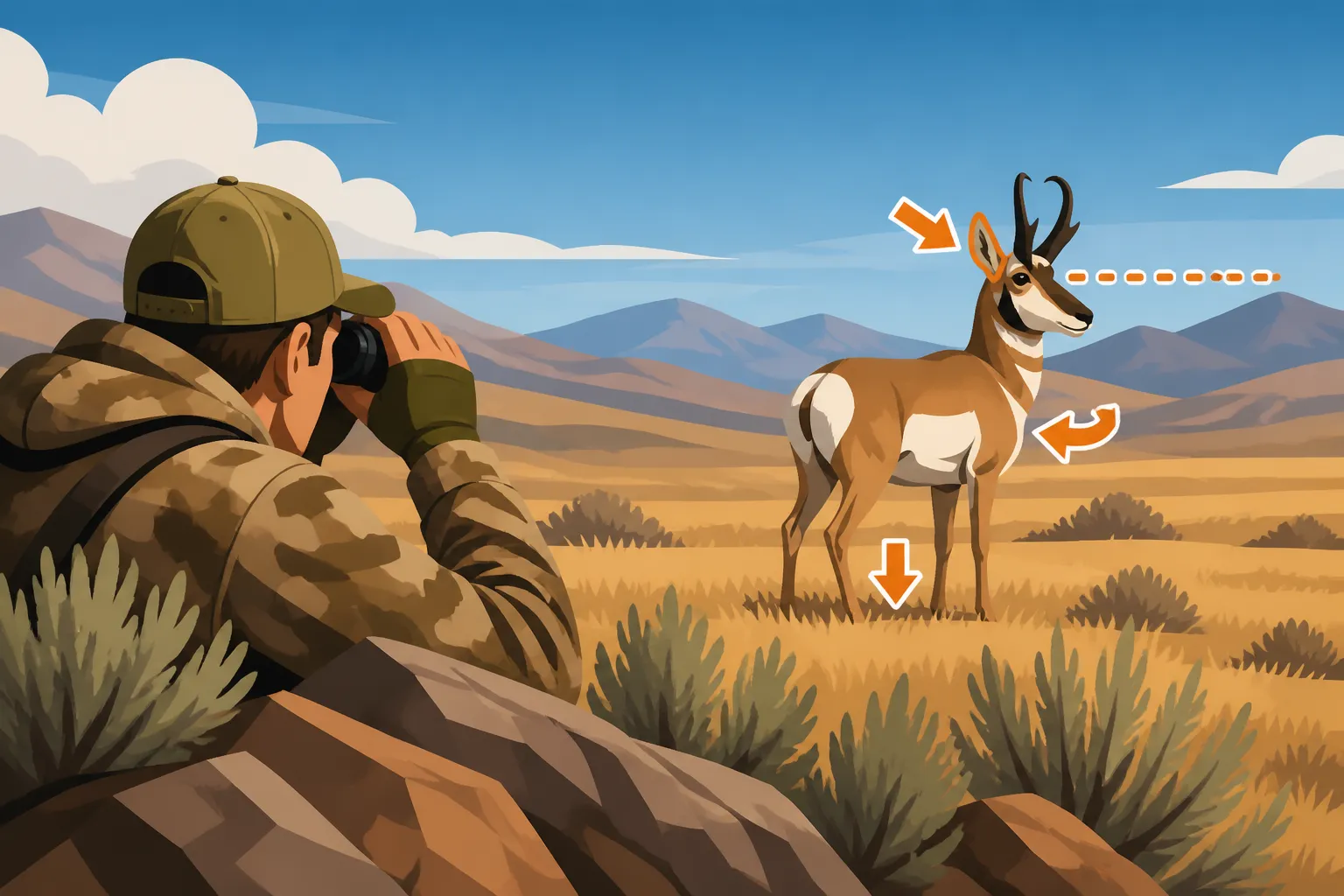
This incredible vision means that even the most subtle changes in their posture or gaze are vital clues. A slight turn of the head, an ear swiveling back and forth like a radar dish, or a sustained stare into a particular patch of country – these are not random acts. They are direct indicators that something has caught their attention, and they are trying to identify it. Ignoring these early cues is a surefire way to blow your stalk before it even gets close. They might seem relaxed, but their eyes are always working, always collecting information.
Group Dynamics and Collective Vigilance
While a solo pronghorn is certainly a challenge, a group of them multiplies the difficulty exponentially. A herd functions as a living, breathing alarm system. Imagine trying to sneak past ten sets of those incredible eyes, ten sets of radar-dish ears, and ten sensitive noses all working in concert. It’s almost impossible. Each animal contributes to the collective vigilance, and the moment one animal detects something amiss, it communicates that unease to the rest of the herd.
This collective awareness means that even if you manage to avoid the gaze of one animal, another might pick you up. The challenge isn't just to hide from a single buck; it's to hide from the entire network. Often, you'll see one animal lift its head, then another, then another, until the whole group is staring in your direction. It's a chain reaction, and once it starts, your window of opportunity shrinks dramatically. This is why when you're glassing a basin for a good buck, it's not just about finding the biggest horns; it's about assessing the entire group's position and the landscape between you and them.
Their Natural Habitat and Escape Routes
Nevada's sage flats and wide-open valleys are quintessential pronghorn country. It's a landscape that perfectly suits their primary defense mechanism: speed. When there's little to no dense cover, they don't rely on hiding; they rely on detecting danger early and simply outrunning it. This is why stalks often feel so frustrating – you might find a slight dip or a small wash, only to realize it doesn't offer enough sustained cover to get within range.
They inherently understand their terrain. They know the slight rises, the subtle draws, and the patches of thicker sage that can offer a fleeting moment of concealment. When they feel threatened, they don't just bolt aimlessly. They often move to higher ground, or circle downwind, trying to get a better vantage point or pick up your scent. This innate understanding of their environment means that even if you choose a seemingly perfect approach, if it doesn't align with their instincts for escape, they'll likely move long before you're in position. Knowing where they want to go when spooked can help you anticipate and potentially cut them off, or at least predict where your stalk will fail.
Decoding the Subtle Cues: From Calm to Catastrophe
Okay, so we know they're basically super-animals. Now, let's talk about how to interpret what those super-animals are telling us. Their body language, though subtle, provides a clear spectrum of information, from "all clear" to "run for your life."
Relaxed and Content Antelope Behavior
This is the sweet spot, the behavior you hope to observe when you first spot your target buck. A truly relaxed pronghorn will often have its head down, grazing leisurely, or perhaps chewing its cud if bedded. Their movements will be fluid and unhurried. You might see them stretching, perhaps pawing at the ground lightly, or even engaging in some social interactions with other pronghorn in the herd – a bit of light sparring between bucks, or playful chasing among younger animals.
If they're bedded, they'll often be oriented in a way that allows them to scan their surroundings while still conserving energy. Usually, they'll have a good view, but their overall posture will lack tension. Their ears might still twitch, but not in a sustained, focused manner. This is the ideal time to initiate your stalk, as their guard is relatively down. However, "relaxed" for a pronghorn is still more alert than most other big game animals. Always proceed with extreme caution, remembering that one sudden movement or a strong gust of wind carrying your scent can change their demeanor in an instant. This is when your careful planning, perhaps using a tool like GoHunt's satellite imagery to identify your approach, truly pays off.
The First Hint of Unease: Elevated Alertness
This is the critical stage where many stalks are won or lost. You’re moving along, thinking you're doing great, then you see it. The first subtle cue that tells you you’ve been detected or that they suspect something is wrong. The most common sign is a pronghorn's head snapping up, often directly looking in your general direction. Their ears will swivel, trying to pinpoint any sound, and their eyes will be wide, intently focused.
Their posture will shift. No longer are they relaxed; their muscles will tighten, their legs might straighten, ready to spring into action. Their body will be rigid, and their tail might begin to twitch or flick, a very subtle but distinct warning signal. Sometimes, they might even take a few tentative steps, trying to get a better angle or move to a slightly elevated position to confirm their suspicions. At this point, you might feel like their intense gaze is boring right through you, even if you think you're perfectly hidden. If you see this, you need to freeze and evaluate immediately. Pushing forward through this phase is almost guaranteed to result in a full-blown flight. Learning to read these early warnings is crucial for success on a pronghorn.
Approaching Panic: The Pre-Flight Signals
When an antelope reaches this stage, your window of opportunity is nearly slammed shut. These are the last, desperate warnings before they commit to full flight. You might see a pronghorn suddenly stamp a front foot, a clear, unmistakable alarm signal that vibrates through the ground. They might snort or blow air through their nostrils, a sharp vocal warning that alerts every other animal in the vicinity.
You'll also notice pacing or circling. They're not just looking; they're actively trying to get a better angle, to confirm the danger, to ascertain your exact location or species. They might run a short distance, stop, turn, and stare again, trying to goad you into making a movement that confirms their fear. And then there's the famous white rump patch. While it can flash as they run, it will often flare, becoming visibly wider and whiter, even before they fully commit to flight. This is the ultimate alarm signal, often meaning the entire herd is about to explode into a full-speed dash across the flats. If you see this, consider the stalk blown and gracefully retreat, or hold your position, hoping they might forget you in a few minutes (which is rare).
Stalking Strategies Based on Body Language
Knowing what these magnificent animals are communicating is only half the battle. The other half is knowing how to react. Your strategy has to be dynamic, constantly adjusting to their shifting moods and the landscape around you.
The Freeze and Evaluate Tactic
This is perhaps the single most important tactic for pronghorn hunting. The moment you see any sign of unease—a head snap, an ear flick, a tense posture—you must stop immediately. Don't take another step. Don't even breathe heavily if you can help it. Become part of the landscape. Get low, use any available cover, and remain absolutely motionless.
How long do you wait? It varies, but often it needs to be several minutes, sometimes even longer. Watch them intently. Are their heads still up? Are their ears still swiveling? Do they seem to be relaxing, perhaps dropping their heads to graze intermittently? If their vigilance decreases, you might be able to resume your stalk, but do so even more slowly and carefully than before. This waiting game is agonizing, but it often works. This is when utilizing terrain features like draws and rims becomes paramount. Knowing Using a Rim to Break Your Silhouette is not just good advice, it's essential for this kind of subtle movement. Always remember that Reading Wind on a Long Sage Stalk is also critical, as even when frozen, your scent can betray you.
Adapting Your Pace and Cover Use
Your pace should always be dictated by the pronghorn's current state of mind. When they're relaxed, you can move with a steady, albeit careful, pace. As they become more alert, your movements need to become slower, more deliberate, and less frequent. If they're on high alert, you might need to resort to crawling on your hands and knees, or even belly-crawling, inching your way forward when their heads are down or they're looking away.
Cover, even sparse cover, is your best friend in the open country of Nevada. Use every clump of sage, every minor rise, every dry wash. Don't be afraid to take a longer, circuitous route if it offers better concealment. Sometimes, the direct path is the one that gets you busted. This is where a good understanding of Terrain That Hides an Approach in Open Country comes into play. You might think a few sprigs of sagebrush aren't enough, but if you move slowly and deliberately, breaking up your silhouette against the ground, it can often be just enough. The goal is to always present the smallest, least human profile possible.
Decoys and Distraction When Appropriate
Pronghorn decoys can be incredibly effective, but they are not a magic bullet. They work best when the antelope is already looking at something, perhaps a distant hawk or another pronghorn, and you can introduce the decoy to grab their attention. It can sometimes draw a curious buck in, or at least distract the herd long enough for you to close crucial yards. Many hunters like the Montana Decoy company's options for their lightweight and realistic designs.
The key is timing. If the antelope are already agitated and looking for something, deploying a decoy might just confirm their fears and send them running. Use it as a last resort or when you have a specific tactical advantage, like a buck that's already seen something and is trying to identify it. Some savvy hunters will use a decoy to draw the buck's attention while a partner moves into position. GoHunt's field tips from experienced Nevada hunters often delve into specific decoy strategies that have proven successful in different units, offering insights beyond general advice.
Common Missteps and How to Avoid Them
Even the most experienced hunters make mistakes, especially when dealing with an animal as wary as the pronghorn. Recognizing these common pitfalls can save you a lot of heartache and wasted effort.
Underestimating Their Senses
This is, hands down, the number one reason stalks fail. You've glassed the buck from two miles away, picked your line, and you're feeling good about your approach. You think you're perfectly hidden behind a small rise, only to have the entire herd suddenly bolt. It's easy to forget just how phenomenal their vision and hearing truly are. They don't just see movement; they detect change in their environment.
This means rushing the final approach, even when you feel close, is a common error. One quick step, one misplaced foot, one rustle of clothing can be enough. Invest in top-tier optics, like a high-power spotting scope. Being able to confirm exactly where the animals are looking, and if they're still relaxed, from a long distance away, is invaluable. A clear understanding of Spotting Scope Power for Open Country will tell you why a powerful, stable optic is a must. Remember, when hunting pronghorn, it's truly a glassing game, as detailed in Why Nevada Deer Hunting Is a Glassing Game, and that applies doubly to antelope.
Ignoring Subtle Warnings
Another critical mistake is dismissing those early, subtle warnings. That head that just came up, that slight tail flick, that focused stare – these are not minor details. These are flashing red lights telling you to STOP. Too often, "trophy fever" sets in. You're so focused on closing the distance and getting a shot that you rationalize away the clear signs of unease. You tell yourself, "They're just looking at something else," or "They haven't seen me."
But pronghorn rarely give false alarms. If they're showing signs of nervousness, it's for a reason. Pushing on at this point is like driving through a red light; you're likely to crash. Instead, take a deep breath, freeze, and reassess. Wait them out. It's far better to wait and let them relax, even if it takes a long time, than to spook them and watch them disappear over the horizon at 60 miles per hour. This is where patience truly becomes a virtue, and understanding How Far to Stalk a Bedded Mule Deer offers good parallels for pronghorn.
Not Having a "Plan B"
In the vast, dynamic landscapes of Nevada, things rarely go exactly as planned. Your chosen approach might suddenly reveal an unexpected patch of open ground, or the wind might shift unpredictably. This is why you need a Plan B, and often a Plan C. When you first identify your target and assess the terrain, don't just pick one route. Look for alternative approaches, escape routes for yourself if the stalk goes sideways, and backup spots where the animals might move if spooked.
Using digital mapping tools, especially those that offer detailed satellite imagery and topographical maps, like GoHunt, allows you to visualize multiple options before you even take your first step. You can mark potential cover, assess elevation changes, and predict movement patterns. If your initial stalk blows up, instead of giving up, you can immediately pivot to a pre-planned alternative. Sometimes, repositioning means a long, arduous hike, but it beats calling it a day. Remember to always be Preparing Physically for Long Glassing Days so you have the stamina for these extended efforts.
Antelope Body Language Summary Table
To help you quickly reference these crucial cues, here’s a summary of common pronghorn behaviors and what they likely mean for your stalk:
| Behavior | Meaning | Hunter's Action |
|---|---|---|
| Head Down, Grazing Leisurely | Relaxed, feeding, unaware of immediate threat. | Initiate stalk cautiously. Maintain slow, deliberate movements. |
| Bedded, Chewing Cud | Content, resting, scanning intermittently. | Good time to stalk, but be mindful of their scanning orientation. |
| Ears Swiveling | Listening intently, pinpointing sound. | Freeze. Reduce noise. Assess wind direction. |
| Head Up, Focused Gaze | Alert, looking directly at perceived threat. | STOP IMMEDIATELY. Get low, stay still. Wait them out. |
| Tense Posture, Stiff Legs | Uneasy, preparing for potential flight. | STOP. Do not move. Any further action risks spooking. |
| Tail Twitching/Flicking | Early warning sign of nervousness. | STOP. Re-evaluate concealment. Prepare for them to run. |
| Foot Stamping | Strong alarm signal, confirming a threat. | STOP. Chances of successful stalk are very low. Consider retreat. |
| Snorting/Blowing Air | Vocal alarm, alerting entire group. | STOP. Expect immediate flight from the entire herd. |
| Pacing/Circling | Trying to get better angle, confirm danger. | STOP. You've likely been spotted. Prepare for them to run. |
| White Rump Patch Flaring | Ultimate alarm signal, imminent flight. | Stalk is blown. Do not pursue unless they are already running away. |
This table can be a quick mental checklist when you're out in the field. Understanding these signals, and knowing how to react, will dramatically increase your chances of success.
Disclaimer
Please remember that hunting regulations and practices can change. Always consult the most current Nevada Department of Wildlife (NDOW) regulations before heading into the field. This guide is for informational purposes only and does not supersede official regulations or sound hunting ethics. Stay safe and hunt responsibly.