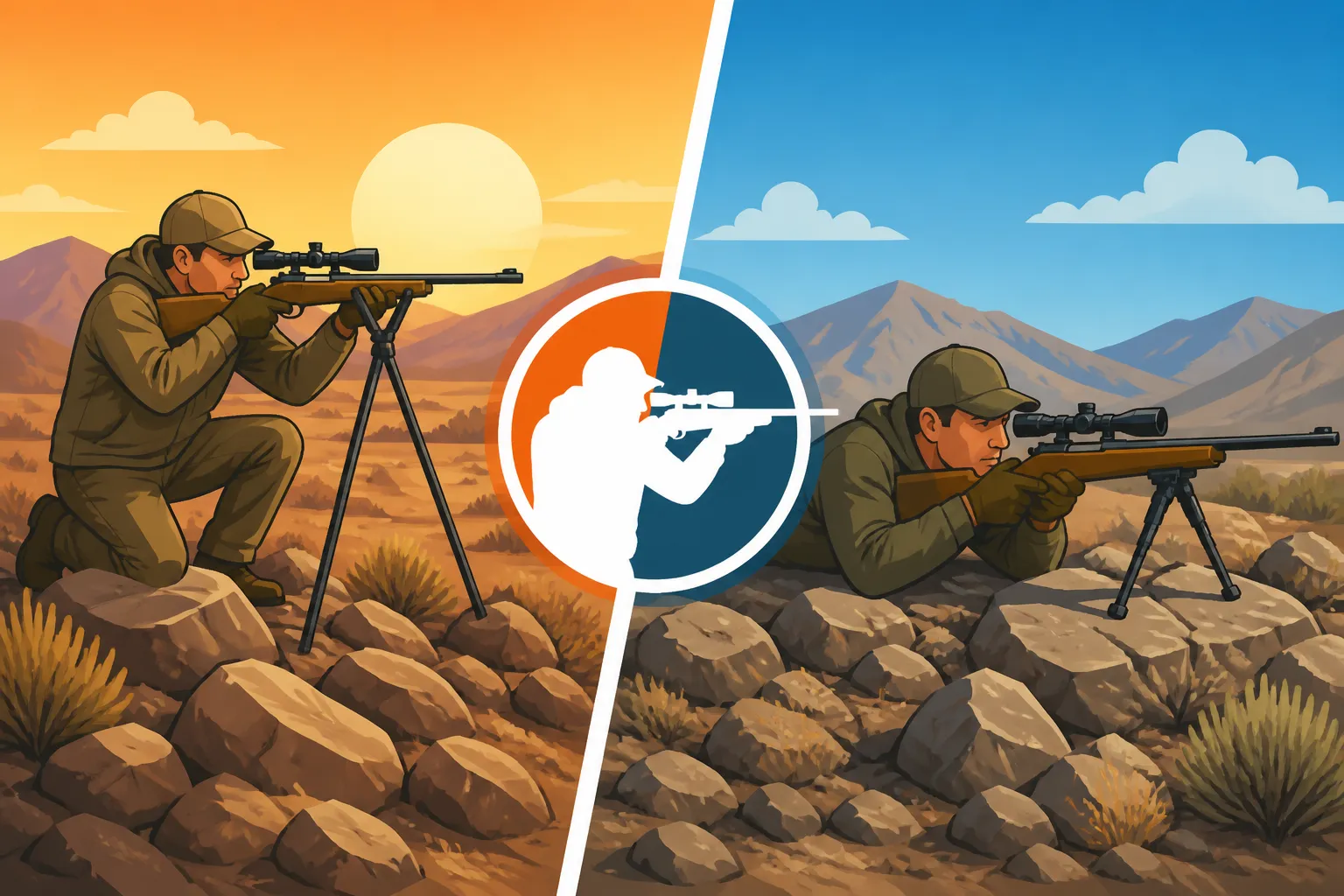
Shooting Sticks or Bipod on Rocky Ground
You’ve finally closed the distance on that mule deer across a treacherous Nevada basin, but now you're faced with a jumble of volcanic rock and uneven ground, making a stable shot nearly impossible. That moment of truth demands a solid rest, and often, what works perfectly on a flat range falls apart when the terrain fights back. This guide is all about navigating those challenging shooting positions, helping you understand the pros and cons of shooting sticks and bipods, and how to master their use on Nevada's unforgiving, rocky terrain to ensure you make the most of your shot.
The Great Debate: Sticks vs. Bipods for Nevada's Rocky Outcrops
When you're out in the vast, open spaces of Nevada, every shot is hard-earned. The ground beneath your feet is rarely cooperative, often a mix of sharp volcanic rock, loose talus, and steep, uneven slopes. Deciding between a set of shooting sticks or a bipod isn't just a matter of preference; it's about choosing the tool that will give you the most stable platform and the quickest, most adaptable setup when that hard-won animal finally presents itself. Both have their place, but understanding their strengths and weaknesses on this particular type of terrain is key to your success.
Understanding Shooting Sticks: Stability and Adaptability
Shooting sticks come in various forms, from single monopods to versatile tripods, and they are often lauded for their adaptability. A good set of sticks, especially a sturdy tripod model, can adjust to an incredible array of angles and heights, making them incredibly useful when you're shooting from a kneeling position on a steep hillside or trying to get over a ridge line from a sitting position. On rocky ground, this adaptability is a huge advantage. You can often splay the legs out unevenly, finding purchase on different rocks, or adjust one leg shorter than the others to compensate for a severe side slope.
Many hunters swear by sticks like the Primos Trigger Stick series or carbon fiber tripods from Spartan Precision Equipment because they allow for rapid height adjustments with minimal fuss. Imagine spotting a buck Using Draws and Rims to Close Distance on a distant slope, then having him appear closer than expected, moving quickly through a wash. With sticks, you can often drop from a standing to a kneeling or sitting position by simply adjusting the leg length, allowing you to react much faster than if you were trying to reposition a rifle mounted to a fixed bipod. The ability to quickly pivot and track a moving animal across broken country is another major benefit, as your rifle isn't rigidly attached to a single point. This makes them excellent for dynamic situations or when you're uncertain of the exact shot angle until the last second. They require a bit more practice to hold truly steady compared to a bipod, but that practice pays off immensely in the field.
The Bipod Advantage: Fixed Stability on Varied Surfaces
Bipods, whether permanently attached to your rifle or quickly detachable, offer a different kind of stability. They create two fixed points of contact with the ground, and when used correctly, they can provide a rock-solid platform, particularly for prone or seated shots where the ground allows for it. Brands like Harris Bipods have been a staple for decades, known for their rugged simplicity and effectiveness. Newer models, like those from Atlas Bipods, offer more articulation and adjustability, making them somewhat more versatile on uneven terrain.
On rocky ground, a bipod's strength lies in its ability to quickly deploy. If you're able to find a relatively flat spot, even a small one, a bipod can be set up in seconds, giving you a very stable shooting platform. This is especially true if you plan on shooting prone or from a low seated position predominantly. However, the fixed nature of a bipod can also be its biggest drawback on truly uneven surfaces. If you're trying to set up on two separate, sharp rocks, getting the rifle perfectly level and stable can be a frustrating exercise in futility. You might find yourself searching for flat ground while the animal walks away. Also, a rifle with a bipod attached adds weight to the front end, which can sometimes feel cumbersome when carrying it long distances or trying to balance it for offhand shots. Despite these challenges, for precision long-range shooting where you can guarantee a stable setup, a bipod is hard to beat.
Hybrid Solutions: When One Isn't Enough
Sometimes, the best approach isn't an either/or but a "both/and." Many experienced Nevada hunters will carry a bipod on their rifle and a set of shooting sticks in their pack. This provides maximum versatility. The bipod is always there for quick prone shots if the terrain allows, while the sticks are ready for those trickier standing or kneeling shots on steep hillsides or over brush.
Consider the scenario where you’ve been glassing a distant ridge using The Grid Glassing Method, Step by Step and finally spot a mature buck bedded high up. Your initial approach might put you in a position for a long shot from a prone position, where your bipod shines. But as you get closer, the terrain becomes a mess of broken shale and small junipers, forcing you into a kneeling or standing shot. This is where those sticks come out of your pack. Some bipods are even designed with quick-detach features, allowing you to remove them and use a set of sticks in their place without much hassle. This hybrid approach gives you the flexibility to adapt to whatever the rugged Nevada landscape throws at you, which, as any veteran hunter knows, is usually quite a lot. For those investing in serious equipment, looking at reliable sources like GoHunt for reviews and advice on different gear combinations can be incredibly helpful in piecing together a versatile setup that works for your hunting style.
Mastering Your Rest on Uneven Ground
Getting a stable shot on flat ground is one thing, but replicating that stability when you're perched on a volcanic outcropping or leaning into a steep, rock-strewn hillside is an entirely different beast. Nevada's topography demands a heightened level of awareness and skill when setting up your shooting rest. It's not just about deploying the tool; it's about making it part of a stable system involving your body and the terrain itself.
Proper Setup Techniques on Volcanic Rock and Talus
When deploying either sticks or a bipod on volcanic rock or loose talus, the primary goal is to find solid purchase for each leg to prevent slippage. For shooting sticks, this often means actively manipulating the legs to "hug" the contours of the rocks. Instead of just setting them down, try to wedge the feet into small crevices or against larger, immovable stones. If you have a tripod, splay the legs out wide to create a broader base, enhancing stability. Sometimes, one leg might need to be significantly shorter or longer than the others to keep the rifle level. Don't be afraid to take an extra few seconds to adjust each leg individually until it feels truly solid. A wobbly rest will lead to a missed shot, no matter how good your rifle or optic.
With a bipod, finding two relatively flat or stable points can be challenging. You might have to clear away some smaller, loose rocks. If you can only get one leg on a flat spot, try to brace the other against a larger rock or even use your own boot as a makeshift anchor. If you're shooting prone, you can often "load" the bipod by leaning into it, creating forward pressure that helps dig the feet in and reduce recoil jump. On a steep incline, this might mean positioning the rifle slightly uphill or downhill to find stability. Remember, the goal isn't just to set the rest down, but to integrate it with the ground and your body position to eliminate as much movement as possible. This kind of attention to detail is crucial when you're taking Rifle Zero Distance for Long Sage Shots where even a tiny wobble is magnified downrange.
Adjusting for Angle and Cant: Beyond Level Ground
One of the most overlooked aspects of shooting on uneven ground is compensating for angle and cant. "Cant" refers to the rifle being tilted to one side, which can cause shots to hit left or right, especially at longer distances. When you're dealing with a steep sidehill, getting your rifle level is paramount. Many bipods and shooting sticks offer some degree of cant adjustment, often through a ball joint or pivoting mechanism. Utilize this feature to ensure your reticle is perfectly vertical. If your rifle has a bubble level, use it! If not, a small external bubble level attached to your scope can be a game-changer.
When shooting up or downhill, the angle of the shot also affects the bullet's trajectory. This is where your rangefinder with angle compensation comes in handy. It provides a "shoot-to" distance that accounts for gravity's reduced effect on angled shots. Combine this with a stable rest, and you're golden. Learning to Hold for Wind Across a Wide Basin is already a challenge; adding cant to the equation makes it nearly impossible to be accurate. Always prioritize getting your rifle level to the horizon before worrying about anything else. GoHunt's wealth of resources often includes detailed articles on ballistic compensation for angle and cant, which are invaluable for hunters tackling Nevada's diverse terrain.
Integrating Natural Rests with Artificial Support
Sometimes, the best shooting position involves a blend of natural features and your artificial rest. Nevada's landscape is full of boulders, juniper trees, and rimrock ledges that can offer incredible support. Don't be afraid to use them. For instance, you might use a large boulder as a primary rest for the forearm of your rifle, and then use a monopod or bipod to support the buttstock, creating a super stable three-point contact system. Or, you might set up your bipod on the ground and then use a small rock under your rifle's buttstock to fine-tune elevation.
The key is to think creatively. A juniper bush might provide just enough cover and a stable enough branch to prop a shooting stick against, giving you an even more rigid platform. When you're Playing Thermals on a Rimrock Stalk, you might find yourself needing to shoot from a less-than-ideal angle, but using the rimrock itself as a natural rest, augmented by your bipod or sticks, can make all the difference. Always test the stability before committing to the shot. A quick wobble check can save you from a gut-wrenching miss. Look around your immediate vicinity for any natural support that can enhance the stability of your sticks or bipod, turning a marginal rest into a fantastic one.
Choosing the Right Tool for Your Nevada Hunt
The vastness and extreme conditions of Nevada mean that your gear choices have to be well-considered. A shooting rest isn't just about stability; it's about how it integrates with your overall hunting strategy, your physical capabilities, and the specific demands of the unit you're hunting. What works for a sedentary plains hunt might completely fail you in the steep, rocky ranges of eastern Nevada.
Weight, Packability, and Durability in Harsh Environments
Every ounce matters when you're humping up and down Nevada's mountains. This is especially true if you're venturing into roadless country or tackling the rugged terrain that requires you to be Preparing Physically for Long Glassing Days. A heavy, bulky shooting rest that doesn't easily attach to your pack or rifle can quickly become a burden, tempting you to leave it behind. Carbon fiber shooting sticks or lightweight aluminum bipods are often preferred for their strength-to-weight ratio.
Durability is another non-negotiable factor. The sharp volcanic rock, abrasive sand, and extreme temperature swings of Nevada will quickly expose any weaknesses in your gear. Look for rests made from robust materials with sturdy locking mechanisms that won't fail when you need them most. Cheap plastic components often don't last long out here. Imagine struggling with a flimsy bipod that won't lock into place when you finally have a shot at a trophy mule deer. It's a nightmare scenario. Investing in quality from reputable brands that can withstand the rigors of the Great Basin is always a wise decision. When looking at gear, I regularly consult sites like GoHunt, which often feature detailed reviews and durability tests, helping me make informed choices for my Nevada adventures.
Here's a quick comparison of common rest types for rocky Nevada terrain:
| Feature | Monopod | Bipod (Attached) | Tripod Shooting Sticks |
|---|---|---|---|
| Stability | Fair (requires body support) | Good to Excellent (prone/seated) | Excellent (most versatile) |
| Adaptability | High (quick height adjust) | Low (fixed to rifle, limited height) | High (uneven ground, varied heights) |
| Deployment Speed | Very Fast (single leg) | Fast (spring-loaded) | Moderate (adjusting 3 legs) |
| Weight | Light | Moderate (adds to rifle) | Moderate to Heavy (depending on model) |
| Packability | Very High (slender) | Attached (can be bulky if non-QD) | Moderate (can be bulky when folded) |
| Best Use Case | Quick standing/kneeling shots, tracking | Prone/seated shots on semi-even ground | Highly uneven ground, varied shot heights |
| Rocky Terrain Performance | Decent, but less stable | Challenging to level, limited angles | Very Good (legs conform to ground) |
Quick Deployment and Target Acquisition
Nevada big game animals, especially mule deer and antelope, rarely stand still for long. When they offer a shot, it's often fleeting. Your shooting rest needs to be quick to deploy and allow for rapid target acquisition. This is where features like quick-release legs, trigger-style adjustments, or silent deployment mechanisms become incredibly valuable. You can't afford to be fumbling with complicated knobs or struggling to extend legs when a bull elk is about to disappear into a patch of junipers.
Consider your primary hunting style. If you primarily spot and stalk, often moving quickly and needing to set up for an immediate shot, a monopod or a rapidly deployable bipod might be preferred. If you tend to find a vantage point and glass for long periods, patiently waiting for an animal to present itself, a more deliberate, highly stable tripod setup might be ideal. Practice deploying your chosen rest from various positions – standing, kneeling, sitting, and prone – until it becomes second nature. The smoother and quieter you can get into position, the better your chances of a successful shot. Having that muscle memory means you're focusing on the animal and the shot, not on your gear.
Considering Your Primary Species and Hunt Style
The type of animal you're hunting and your preferred method will heavily influence your choice of shooting rest. For instance, if you're pursuing Pronghorn Across Nevada's Open Valleys, you'll often be taking long shots across vast, relatively flat sagebrush flats, where a bipod for prone shooting is a fantastic option. The ground, while still uneven, might not be as severely broken as mountainous terrain.
However, if your tag is for mule deer in the steep, rocky draws of eastern Nevada, you might spend your days stalking through broken country, frequently needing to shoot from awkward, elevated positions over brush. Here, a versatile tripod or even sturdy shooting sticks that extend to standing height would be far more beneficial. Elk hunting, particularly during the rut, can often involve quick, close-range shots in timber or broken terrain, where a quick-deploy monopod or light bipod might be all you need to steady a standing shot. Think about the unit you're hunting, the typical terrain, and how you generally approach your hunts. Do you prefer to sit and glass, taking your time, or are you a mobile hunter always looking to close the distance? Your answer to these questions will guide you to the most effective shooting rest for your specific Nevada hunting adventures. Remember to also consider other vital gear like your Optics Power for Nevada's Long Sightlines to complement your chosen shooting rest.
Disclaimer
Hunting involves inherent risks, including injury and death. Always prioritize safety, understand and follow all Nevada Department of Wildlife (NDOW) regulations, and ensure you have proper training and experience before attempting any hunt. This guide is for informational purposes only and should not replace professional instruction or official hunting regulations.