How Elevation Shapes Nevada Hunting Seasons
One of the biggest lessons I've learned from chasing big game across Nevada's vast, wild landscapes is that elevation isn't just a number on a map; it's the invisible hand guiding everything, from where the animals live to when they're available to hunt. Many new hunters, and even some seasoned ones, overlook how dramatically elevation shapes the entire rhythm of the hunting seasons, leaving them scratching their heads when game isn't where it "should" be. This guide will help you decode this crucial element, providing a roadmap to understanding how different altitudes dictate not just when seasons fall, but how you should approach your hunt.
The Dynamic Relationship Between Elevation and Nevada's Wildlife
Nevada isn't just flat desert; it's a dramatic landscape of deep basins and soaring mountain ranges, with elevation swings that can easily exceed 10,000 feet within a single hunt unit. This incredible vertical relief creates a complex tapestry of microclimates and habitats, directly influencing where wildlife lives, what they eat, and how they move throughout the year. Understanding this fundamental relationship is key to becoming a more successful hunter in the Silver State.
How Elevation Dictates Habitat and Forage
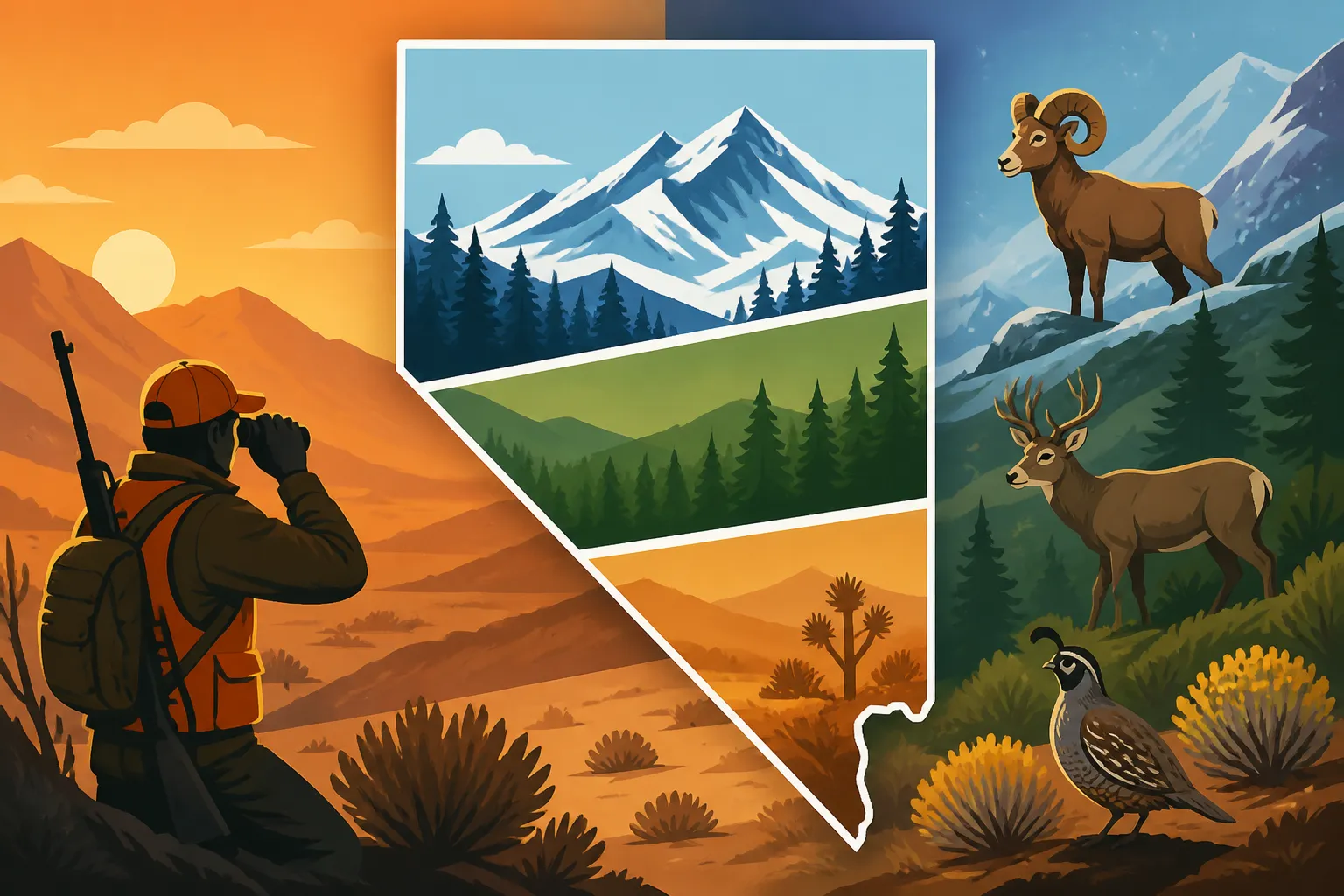
Think about a typical Nevada mountain range. At its base, you might find arid sagebrush flats and pinyon-juniper woodlands, offering browse that can withstand intense summer heat and minimal moisture. As you climb higher, the vegetation slowly changes. You'll encounter mountain mahogany, aspen groves, and perhaps even stands of conifer trees like limber pine or white fir in the highest reaches. These higher elevations generally receive more precipitation, leading to richer, more diverse forage that animals rely on, especially during the summer months when they're packing on weight.
This elevational gradient means that a mule deer buck grazing near a high-elevation alpine meadow in August is a very different animal, both physically and behaviorally, from one trying to survive the winter browsing bitterbrush in a lower-elevation canyon. Elk, too, will seek out the lush grasses and forbs found at higher altitudes during the summer, moving into dense timber pockets for security and shade. The availability and quality of food, which is directly tied to elevation, ultimately determines where these animals choose to spend their time. Hunters need to read these transitions on a map as much as they read tracks on the ground.
The Impact of Snow and Weather Patterns
It's no secret that higher elevations experience colder temperatures and significantly more snow than the valleys below. This isn't just a minor detail; it's a game-changer for Nevada hunting. A warm fall might mean deer and elk linger at high elevations well into rifle season, making them harder to locate in vast country. Conversely, an early October snowstorm can push animals off the peaks and into their lower-elevation winter ranges almost overnight, completely altering the dynamics of a hunt. This rapid migration is often what late-season hunters depend on.
The frustration of planning a high-country hunt for weeks, only to have an unexpected cold front and heavy snow make your chosen area inaccessible or empty of game, is something many of us have experienced. It teaches you to be adaptable and to carry contingency plans. Monitoring weather forecasts, especially snow accumulation at different elevations, becomes as important as scouting for game sign. You might be targeting a specific unit for its trophy potential, but if the snow isn't cooperating, those big bucks might be in an entirely different part of the unit, or even a neighboring one, pushing down into lower, more protected canyons.
Early Seasons: High Country Draws and August Archery
When the first big game seasons open in Nevada, especially for archery, you're almost always talking about the high country. These are often the most physically demanding hunts, but they also offer unique opportunities before the general rifle seasons commence.
Targeting Animals in Their Summer Range
Many of Nevada's August archery deer seasons, for instance, are specifically designed to target bucks still in their high-elevation summer feeding grounds. These animals are often living in lush pockets of mountain mahogany, aspen, or even subalpine fir, trying to put on as much weight as possible before the rut and the lean winter months. Finding them means climbing – often into areas above 8,000 or even 9,000 feet – and being prepared for intense physical exertion in what can still be very warm conditions.
The challenge here isn't just the elevation gain, but also the sheer size of the country and how scattered the animals can be. They're not concentrated by snow yet, and they're not preoccupied with breeding. Your success often hinges on meticulous glassing of vast basins and careful stalks in steep, rocky terrain. Understanding which elevation bands offer the best summer forage within your chosen unit is paramount. For more on these early hunts, check out Nevada's August Archery Deer Window.
Water Sources as Elevational Magnets
In Nevada, water is always a primary consideration, but its role changes with elevation and season. During the hot August archery hunts, especially in the lower-to-mid elevations, permanent water sources become absolute magnets for all wildlife. Even in the high country, where there's generally more moisture, springs and seeps can concentrate game, particularly as the days heat up. Animals will often feed in higher, more exposed areas in the mornings and evenings, then retreat to thicker cover near water during the midday heat.
As you plan an early season hunt, study your maps for perennial springs, seeps, and even man-made guzzlers. These vital water points will often be found at specific elevations within a range, offering a critical clue to animal movement. For hunters using tools like onX Hunt, layering satellite imagery with topographic maps can reveal subtle changes in vegetation indicating moisture, or even the telltale signs of a developed spring. Don't underestimate the power of these isolated water sources, especially when hunting in Hunting Water in Nevada's Driest Country.
| Season Type | Typical Elevation Focus | Key Factors to Consider |
|---|---|---|
| August Archery Deer | High (8,000 ft+) | Summer forage, heat, water, physical conditioning |
| Early Archery Elk | High/Mid (7,000 – 9,000 ft) | Summer range, rut beginning, timber, water |
| Muzzleloader Deer | Mid/High (6,000 – 8,500 ft) | Transition zones, early snow risk, rut influence |
| Rifle Deer (Early) | Mid/High (6,000 – 9,000 ft) | Transition, rut build-up, moderate weather |
| Rifle Deer (Late) | Mid/Low (4,500 – 7,500 ft) | Snow push, migration corridors, winter range |
| Rifle Elk (Late) | Mid/Low (4,500 – 7,500 ft) | Heavy snow push, winter range, large herds |
| Pronghorn | Low/Mid (4,000 – 7,000 ft) | Open flats, sparse cover, water, speed |
| Chukar | Mid (4,000 – 7,000 ft) | Steep rocky slopes, cheatgrass, water |
Mid-Season Strategies: Chasing the Rut and Moderate Elevations
As the calendar turns from late September into October, Nevada's high country begins to cool, and animals start to shift their patterns. This period often coincides with the peak of the rut for species like elk and deer, adding another layer of complexity and excitement to the hunting equation.
The Influence of the Rut on Animal Movement
The rut is a fascinating time for hunters, and elevation plays a silent but significant role. As temperatures drop at higher altitudes, bucks and bulls begin to move more, often descending slightly from their highest summer haunts into mid-elevation zones where they can find a good balance of forage, cover, and access to does or cows. The cooler air at these elevations helps them conserve energy during their intense breeding activities.
Elk, for example, might be bugling in thick timber at 8,000 feet in late September, but a few weeks later, they could be found in more open, rolling hills at 7,000 feet, still actively breeding. Deer, too, will start covering more ground, moving between different elevation aspects as they search for receptive does. Understanding that the rut itself is subtly influenced by temperature—and thus, elevation—can help you pinpoint where animals are most likely to be active. This is especially true when you're trying to locate Bugling Bulls in Nevada's Northern Mountains.
Adapting to Changing Conditions
Mid-season in Nevada is notoriously unpredictable. One day you might be shedding layers in 60-degree weather at 7,000 feet, and the next you're bundled up in a snow squall. Animals are incredibly sensitive to these shifts. A sudden cold snap might push them into thicker cover or down a few hundred feet of elevation, while a period of mild, sunny weather could see them move back up to higher feeding grounds.
This adaptability is key for hunters. You need to be prepared for anything, both in terms of clothing and strategy. Don't get stuck thinking a unit is "high country" or "low country" – mid-season often demands you hunt both. It means being willing to hike higher if the weather is holding, or dropping into sheltered canyons and draws if the snow starts flying. Using tools like GoHunt or similar platforms for historical weather data can give you an idea of typical patterns, but real-time adaptation is crucial. Your ability to read the terrain and anticipate these subtle elevational shifts will directly impact your success.
Late Seasons: Snow-Pushed Animals and Migration Corridors
For many Nevada hunters, especially those chasing trophy mule deer or a big bull elk, late seasons are the holy grail. These hunts are almost entirely dictated by elevation, snow, and the resulting animal migrations.
The Critical Role of Winter Range
As winter tightens its grip on Nevada's mountain ranges, higher elevations become inaccessible and devoid of edible forage. This forces deer and elk into their lower-elevation winter ranges. These ranges are typically characterized by sagebrush, bitterbrush, and pinyon-juniper, which offer crucial browse and thermal cover against the harsh winter elements. Late-season hunts, particularly rifle deer seasons that run into November and December, are specifically timed to coincide with this downward migration.
The beauty (and challenge) of these hunts is that animals are often concentrated along these migratory paths or in their wintering grounds. What was once vast, scattered country in August becomes much more focused. The trick, of course, is being in the right place at the right time. You're no longer just looking for animals; you're looking for the routes they use to get from high to low. This often means focusing on south-facing slopes that melt out faster, or sheltered draws that offer protection from wind and snow. This is the time to really understand Hunting the Post-Rut Migration for Big Bucks.
Scouting Migration Routes and Bottlenecks
Successful late-season hunting in Nevada hinges on understanding and scouting migration routes and natural bottlenecks that funnel animals as they move between elevation bands. These routes are often hundreds, if not thousands, of feet in elevational drop, carving through saddles, rimrock, and canyons. They are predictable year after year, driven by the unchanging topography.
Using tools like onX Hunt for e-scouting can be invaluable here. Look for saddles between high and low ranges, benches or old logging roads that traverse a mountainside, and draws that offer cover for animals moving down. These are your choke points. When heavy snow starts to accumulate at higher elevations, these routes become active highways. Spending time before the season digitally scouting these corridors, and then verifying them on the ground if possible, can drastically increase your odds. This is a big reason Why Late Seasons Produce Bigger Bucks are often taken; these animals are forced into more predictable patterns.
Practical Applications for Nevada Hunters
Understanding the theory behind elevation and hunting is one thing; putting it into practice is another. Here are some actionable tips for incorporating elevation awareness into your Nevada hunting strategy.
E-Scouting and Topographic Maps
Before you ever set foot in the field, use digital mapping tools like onX Hunt to meticulously study the topography of your unit. Don't just look at roads and boundaries; dive deep into the contour lines.
- Identify elevation bands: Mark out areas of distinct vegetation changes based on elevation. Where does the pinyon-juniper give way to mountain mahogany? Where do the aspens start? These transitions often correlate with changes in animal behavior.
- Analyze aspect: South-facing slopes receive more sun, melting snow faster and greening up earlier. North-facing slopes hold snow longer and offer cooler, moister habitat. Animals will often adjust their position by aspect based on weather.
- Pinpoint bottlenecks: Look for narrow saddles, breaks in rimrock, or river crossings that would naturally funnel animals moving between elevation zones. These are prime ambush points during migrations.
- Plan your approach: Understanding elevation helps you plan quiet, concealed approaches. Can you use a ridge line to stay out of sight, or a deep draw to climb undetected? Learning to visualize the terrain in 3D from a 2D map is a skill that comes with practice. E-Scouting a Nevada Unit Before the Season is critical for this.
Physical Preparation for Varying Altitudes
Hunting Nevada's varying elevations is physically demanding. From the scorching heat of an August archery hunt in steep country to the chilling cold and deep snow of a late-season rifle hunt, your body needs to be ready.
- Cardiovascular fitness: Climbing hundreds or thousands of vertical feet with a pack, often in thin air, requires excellent cardiovascular endurance. Incorporate hiking with a weighted pack into your workout routine.
- Leg strength: Strong legs are essential for both ascending and descending steep, uneven terrain. Lunges, squats, and step-ups will pay dividends.
- Acclimatization: If you're coming from a lower elevation, try to arrive in your hunt unit a day or two early to allow your body to adjust to the altitude. Even a few hundred feet of elevation can make a difference in how you feel. Don't underestimate the physical toll of Preparing Physically for Long Glassing Days.
Gear Considerations for Elevation Changes
Your gear choices should also reflect the dramatic elevational shifts you'll encounter.
- Layering system: This is non-negotiable. You might start a morning climb in freezing temperatures at 8,000 feet, sweat profusely halfway up, and then face strong winds and dropping temperatures at the summit. A versatile layering system, allowing you to add and shed clothes easily, is paramount. Think moisture-wicking base layers, insulating mid-layers, and a waterproof/windproof outer shell. For more on this, consider Layering for Basin and Range Temperature Swings.
- Footwear: Proper boots are crucial. They need to provide excellent ankle support for uneven terrain, be durable enough for sharp volcanic rock, and have good traction for loose scree and potential snow. Match your boot insulation to the season and anticipated snow levels.
- Optics: Given the vastness of Nevada, quality binoculars and a spotting scope are indispensable. You'll be glassing across immense elevation changes, trying to pick out animals against complex backgrounds. Don't skimp here. The ability to sit and pick apart a distant hillside is far more efficient than walking miles blindly.
By consciously considering elevation in all aspects of your hunt planning, you'll gain a profound advantage in understanding animal behavior and increasing your chances of success in Nevada's diverse and challenging landscapes.
Disclaimer
This article is for general informational purposes only and does not constitute professional advice. Laws, prices and regulations vary by location and change over time. Consult a qualified professional for guidance on your specific situation.