Wild Horses and Competition for Forage
For those of us who spend any time glassing across Nevada's vast sagebrush basins and mountain ranges, it's not uncommon to spot herds of wild horses. While undeniably beautiful and a symbol of the American West, their presence in large numbers can create significant challenges for the delicate ecosystem, particularly when it comes to competition for vital forage and water with big game animals. This guide dives into how these magnificent equids impact the same landscapes we hunt, and what that means for deer, elk, and other species, helping you understand a critical factor in Nevada's hunting dynamics.
The Complex Relationship Between Wild Horses and Nevada's Ecosystem
Nevada is home to a substantial portion of the nation's wild horse and burro populations, and their story is deeply woven into the fabric of the state's public lands. However, a romanticized view often overshadows the very real ecological pressures these animals can exert, especially in arid environments where resources are already scarce. Understanding this complex balance is key to appreciating the challenges facing wildlife managers and, by extension, us as hunters.
Historical Context of Wild Horse Populations
The wild horses we see today are descendants of animals brought to the Americas by Europeans centuries ago, and many are considered feral rather than truly wild in the ecological sense. They thrived and spread across the Western states, often coexisting with native wildlife for generations. However, their numbers have fluctuated dramatically over time, influenced by ranching practices, natural predators, and management efforts. In recent decades, without significant natural predation and with robust reproductive rates, populations in many areas have grown to levels that can strain the carrying capacity of the land. It’s a delicate subject, touching on history, heritage, and the very real needs of the land itself.
Their presence, while iconic, adds another layer of complexity to an already stressed environment. These are tough animals, remarkably adapted to harsh conditions, but even their resilience has limits, and more importantly, the land has limits on how much it can sustain.
The Role of Forage in Desert Ecosystems
In Nevada's high desert, every blade of grass, every shrub, and every drop of water is precious. Forage isn't just "food"; it's the very foundation of the ecosystem. It provides energy for growth, reproduction, and survival for an incredible diversity of life, from insects to bighorn sheep. When you consider that native species like Mule Deer Are the Reason Most Hunters Apply in Nevada, Nevada Elk Herds Grew From Nothing Into a Trophy Draw, and Pronghorn Across Nevada's Open Valleys have evolved to utilize specific types of forage and survive on finite water sources, the introduction of a large, non-native grazer like a horse fundamentally changes the equation.
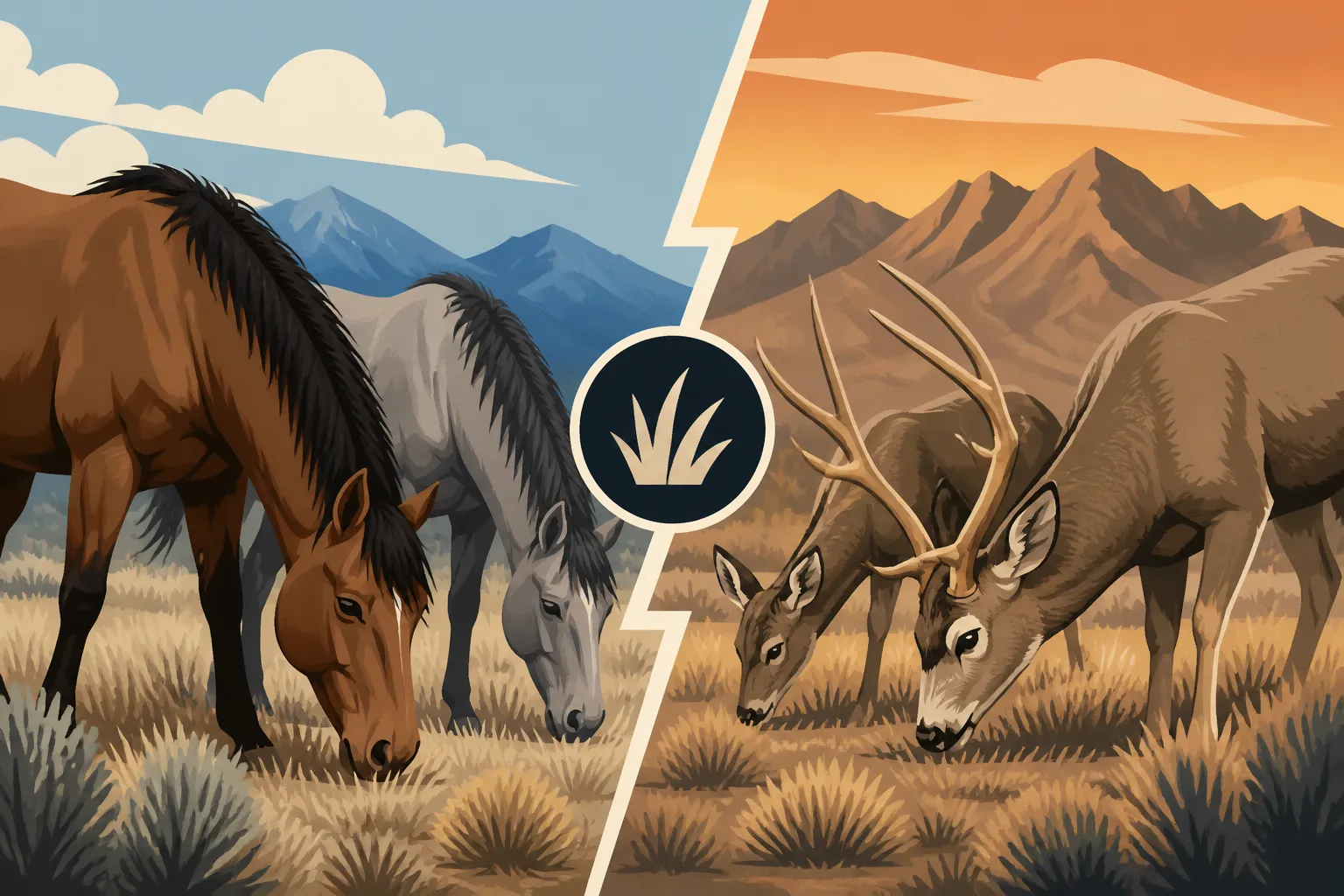
Wild horses, being generalist grazers, can consume a wide variety of plants, often preferring grasses but turning to shrubs and other vegetation when grasses become scarce. This puts them in direct competition with many native species who rely on those exact same resources. In an environment already prone to How Drought Affects Great Basin Deer, this competition becomes even more pronounced and impactful. It's a zero-sum game when resources dwindle, and something has to give.
Direct Competition for Food and Water Resources
The phrase "competition for forage" might sound academic, but on the ground in Nevada, it translates into very real consequences for the health and numbers of our big game herds. Imagine trying to feed an entire family from a pantry that's already half-empty, and then a larger, hungrier family moves in next door and starts taking from the same shelves. That's essentially what happens with wild horses and native wildlife.
Impact on Deer and Elk Forage
Mule deer and elk, while they share some dietary overlaps, have distinct foraging preferences that include specific grasses, forbs, and browse. Deer, for example, are primarily browsers, relying heavily on woody shrubs like bitterbrush and sagebrush, especially in winter. Elk are more adaptable, shifting between grasses and browse depending on the season and availability. Wild horses, being generalist grazers, can significantly reduce the availability of grasses, which then pushes other grazers like elk to rely more on browse. This, in turn, can increase pressure on those critical woody plants that mule deer depend on.
Consider a unit where winter range is already limited. If a large herd of wild horses has been grazing there year-round, the critical nutritional resources that deer and elk need to survive the colder months and bounce back for spring fawning or calving might be severely depleted. This can lead to weaker animals, lower fawn/calf survival rates, and overall reduced herd health and productivity. When you're Reading a Nevada Hunt Unit Before You Apply, understanding the prevalence of wild horses can offer a clue to the underlying health of the resident deer or elk population.
Effects on Bighorn Sheep and Pronghorn Habitat
The impact isn't limited to just deer and elk. Desert Bighorn Across Southern Nevada and pronghorn also face challenges. Bighorn sheep, adapted to steep, rugged terrain, rely on the sparse, hardy vegetation found in their high-elevation habitats. While they might not directly encounter horses as often due to terrain, any degradation of lower elevation transition zones or water sources can indirectly impact them. Pronghorn, iconic speedsters of the open flats, are unique in their preference for forbs and sagebrush. They are also incredibly efficient grazers. However, large herds of horses can trample and consume these plants, reducing vital food sources, particularly during critical fawning periods or harsh winters.
For both bighorn and pronghorn, access to water is paramount, especially in Nevada's arid climate. Wild horses require significant amounts of water daily and can monopolize natural springs and developed guzzlers. This can deter other species from accessing crucial water points, forcing them to travel further or risk dehydration. Knowing Hunting Water in Nevada's Driest Country is a key strategy for hunters, and understanding how horse populations might affect those water sources is critical.
Overgrazing and Habitat Degradation
Beyond simply eating the same plants, wild horses can cause extensive habitat degradation through overgrazing and trampling. Their hooves are designed for locomotion, not delicate foraging, and repeated traffic in an area can compact soils, destroy delicate cryptogamic crusts (which are essential for soil health and water retention), and increase erosion. When an area is overgrazed, native plant communities can be replaced by invasive species like cheatgrass, which offers poor forage value and increases wildfire risk.
This isn't just about a few less plants; it's about a fundamental shift in the ecological health of the land. Overgrazed areas retain less moisture, can't support as many insects (which are vital for upland birds and young game animals), and become less resilient to other environmental stressors. This habitat degradation directly affects the carrying capacity for all wildlife, making it harder for deer, elk, and antelope populations to thrive, even in years with good rainfall.
| Forage Preference Comparison | Wild Horses (Equus caballus) | Mule Deer (Odocoileus hemionus) | Elk (Cervus canadensis) | Pronghorn (Antilocapra americana) |
|---|---|---|---|---|
| Primary Diet Type | Generalist Grazer | Browser | Grazer/Browser (mixed) | Forb/Shrub Specialist |
| Preferred Forage | Grasses, some forbs & shrubs | Woody shrubs (sagebrush, bitterbrush), forbs | Grasses, forbs, some browse | Forbs, sagebrush, other shrubs |
| Water Needs | High (daily access) | Moderate (can get moisture from plants) | High (daily access) | Moderate (can get moisture from plants) |
| Typical Impact | Overgrazing, trampling, soil compaction | Selective browsing, minimal soil impact | Grazing, some browsing, moderate soil impact | Selective browsing, minimal soil impact |
| Competition Overlap | High with elk & pronghorn (grasses, forbs), moderate with deer (shrubs when stressed) | Moderate with elk (some browse) | High with horses (grasses), moderate with deer (browse) | High with horses (forbs, some shrubs) |
Management Strategies and Hunter Implications
Managing wild horse populations on public lands is an incredibly contentious and complex issue, fraught with emotional arguments, legal battles, and practical challenges. As hunters, understanding the various management strategies and their effectiveness, or lack thereof, can help us better interpret what we see in the field and adjust our expectations.
Current Management Approaches by Federal Agencies
The Bureau of Land Management (BLM) and the U.S. Forest Service are the primary agencies responsible for managing wild horses and burros on designated Herd Management Areas (HMAs). Their mandate is to manage these populations to maintain healthy herds and healthy rangelands, often referring to an "Appropriate Management Level" (AML). However, in many areas, current wild horse populations vastly exceed the established AMLs.
Management tools generally include gathers, where horses are rounded up and removed from the range. These removed horses are then offered for adoption or sale. Fertility control, such as darting mares with PZP (porcine zona pellucida) to prevent conception, is also employed in some areas, but it's labor-intensive and difficult to implement on a scale large enough to significantly curb population growth across vast landscapes. The effectiveness of these strategies is a constant debate, and the backlog of unadopted horses in holding facilities presents its own set of challenges. As a hunter, while you might not directly participate in management, being aware of these efforts, or the lack thereof, in your chosen units is part of E-Scouting a Nevada Unit Before the Season.
How Forage Competition Affects Hunt Unit Productivity
From a hunter's perspective, severe forage competition directly translates to lower carrying capacity for big game, which in turn means fewer animals, smaller trophy potential, and potentially tougher hunting conditions. When you're looking at draw odds and harvest statistics, the presence of thriving wild horse populations in a unit can be a silent, yet powerful, indicator of suppressed game numbers. Units with high horse densities often correspond with lower mule deer or elk fawn ratios, as mothers struggle to find enough quality forage to produce milk and support their young. This directly impacts Why Fawn Ratios Predict Next Season's success.
It's not just about animal numbers, either. Animals under nutritional stress may have smaller body sizes and less robust antler or horn growth. While a truly mature buck might still grow a great rack regardless of conditions, the overall health of the herd dictates the potential of the younger age classes. Therefore, if you're evaluating Where Nevada Publishes Harvest Data or Reading a Nevada Hunt Statistics Table, always consider the ecological context, including the wild horse situation, to get a more complete picture of a unit's potential.
Using Information to Inform Your Hunt Planning
Knowing about wild horse populations in a unit won't directly tell you where the deer are, but it provides crucial context. If you're researching a unit known for high wild horse numbers, you should adjust your expectations. This might mean:
- Focusing on less impacted areas: Look for pockets within the unit where horses might not congregate as heavily, perhaps due to terrain, lack of water, or historical management.
- Prioritizing water sources: If water is monopolized, you might need to find alternative sources or hunt areas that game can access more easily. Remember that How Guzzlers Concentrate Desert Game, but if horses are camped out on them, that concentration effect for deer or elk diminishes.
- Adapting scouting efforts: Instead of looking for lush, heavily grazed areas, focus on more remote, rugged terrain where native forage might persist better.
- Leveraging technology: Tools like GoHunt can provide overlays for herd management areas, recent gather data, or even satellite imagery showing vegetation health. This kind of platform can be invaluable for cross-referencing published data with on-the-ground realities.
- Understanding species-specific impacts: A unit with high horse numbers might have a more noticeable impact on elk or pronghorn (which are direct grazers) than on mule deer (which are primarily browsers, though they also eat grasses and forbs).
Ultimately, understanding the presence and impact of wild horses adds another layer of sophistication to your hunt planning. It's about being a more informed, ecologically aware hunter, and making the best decisions given the realities of the Nevada landscape.
Disclaimer
This article is for general informational purposes only and does not constitute professional advice. Laws, prices and regulations vary by location and change over time. Consult a qualified professional for guidance on your specific situation.