Closing the Last Hundred Yards on a Pronghorn
If you've spent any time chasing pronghorn across Nevada's vast, open country, you know the frustration. You spot a magnificent buck, make what feels like a textbook stalk for a mile, only to have him trot off casually at 500 yards, seemingly having known you were there the entire time. Closing that final hundred yards on these incredibly wary animals is often the make-or-break moment of an entire hunt. This guide is all about giving you the tools and insights to conquer that last, critical stretch of ground.
The Pronghorn's Super Senses: Why They're So Tough
Let's be real, pronghorn are built different. They've evolved in wide-open spaces where survival means spotting danger from miles away and outrunning anything that gets too close. Understanding why they're so hard to approach is the first step to figuring out how to beat them at their own game. It's not just about being quiet; it's about being invisible and undetectable to an animal that literally has superpowers.
Vision: The 8x Binoculars of the Plains
Imagine having binoculars permanently affixed to your eyes, and that's essentially what a pronghorn has. Their eyes are enormous relative to their skull size, giving them an incredible field of view – almost 360 degrees without moving their head. And the magnification? Many experts believe they have vision equivalent to 8-power binoculars. That means they can spot a twitch of movement, a glint of metal, or an unnatural shape against the horizon from distances that would make a mule deer look nearsighted. This unparalleled vision is why the last 100 yards, when you're much larger in their field of view, becomes such a monumental challenge. They're constantly scanning, and any slight misstep on your part, any exposed elbow or hat brim, will send them packing before you even know they saw you.
Speed and Reaction: Built for Escape
If their vision is their early warning system, their speed is their escape hatch. Pronghorn are the fastest land animals in North America, capable of hitting speeds over 60 miles per hour. But it's not just top-end speed that's impressive; it's their acceleration. They can go from a standstill to top speed in a flash, and their endurance allows them to maintain that pace for miles. What this means for a hunter is that once they detect you, the window for a shot shrinks to almost nothing. There's no "second chance" with a pronghorn. If they decide you're a threat, they're gone, often covering several hundred yards in mere seconds, leaving you watching a dust cloud disappear over the horizon. You rarely get a second opportunity on the same animal on the same day if you spook them.
Hearing and Smell: Secondary but Still Potent
While their eyes are their primary defense, don't underestimate their other senses. Pronghorn have decent hearing, especially for high-frequency sounds. A crunch of gravel, a rustle of clothing, or an unnatural noise can certainly alert them, particularly if the wind isn't strong enough to mask your approach. Their sense of smell, while perhaps not as legendary as a whitetail deer's, is still very capable. In the dry, open air of Nevada, scent can travel surprisingly far, especially on calm mornings or evenings when thermals are rising or falling. If you're downwind and approaching, they'll often catch your scent before they see you, even if you've been careful with your hygiene. Always keep the wind in mind, as even a slight swirl can blow your cover.
Strategic Pre-Stalking: Setting the Stage
Before you even think about putting boot to sage, you need to conduct a thorough reconnaissance. This isn't just about finding the animal; it's about understanding its environment, its behavior, and how you can exploit the subtle advantages the landscape offers. Skipping this crucial phase is like trying to win a chess game without looking at the board.
Glassing and Assessment: Knowing Your Target
Your binoculars and spotting scope are your most important tools in pronghorn country. You need to spend serious time glassing from a distance, long before the animal knows you're there. Look for high points that offer expansive views and use powerful optics to really pick apart the landscape. When you spot a buck, don't immediately start planning your stalk. Instead, observe him carefully. What is he doing? Is he bedded, feeding, or moving? Which direction is he heading? Are there other pronghorn with him? Often, it's the does and fawns that bust you because they are more numerous and equally vigilant. Also, pay close attention to the terrain immediately surrounding him. Are there any washes, draws, rock outcroppings, or thick sage patches nearby? These will be your potential cover. Platforms like GoHunt can be incredibly useful here. Using their mapping tools, you can pre-scout potential stalking lanes and identify terrain features from home, giving you a huge leg up once you're in the field. This detailed pre-scouting helps you identify optimal spots to set up for glassing from afar, which is half the battle with pronghorn.
Identifying a Stalking Lane: The Path of Least Resistance
Once you have a solid understanding of the pronghorn's location and the surrounding topography, it's time to identify your stalking lane. This isn't always a straight line; in fact, it rarely is. You're looking for a route that offers the most continuous cover, keeps you out of their line of sight, and, crucially, keeps the wind in your favor. Think about a circuitous route if necessary. Sometimes a half-mile detour to stay in a deep wash or behind a low ridge is infinitely better than a direct path that exposes you at 400 yards. Look for any folds in the terrain, even subtle ones, that can provide a few extra feet of concealment. These small elevation changes are often too minor to notice from a distance with the naked eye, but with good optics and careful planning, they can be a game-changer. The goal is to reach a point where you are within that crucial 100-200 yard range, hidden, and ready for your final approach, as discussed in Spot and Stalk Antelope on Nevada's Open Flats.
The Art of Concealment: Using Nevada's Landscape
Nevada's basin and range country might look flat and barren, but it's actually full of subtle terrain features that, when used correctly, can provide the cover you desperately need to close the distance on pronghorn. It's about thinking like a ghost, using every ripple and shadow to your advantage.
Terrain Features: Your Best Friends in Open Country
This is where your map reading skills and on-the-ground observation really come into play. Small washes, dry creek beds, erosion gullies, and even slight rises in the ground can provide amazing concealment. The key is to get inside them or behind them. Don't just walk along the edge; get down low. A wash that's only three feet deep can hide a prone or crawling hunter perfectly. The rolling nature of the high desert, with its endless series of gentle slopes and draws, can be a blessing if you learn to read it. Use a low ridge or a small knoll to mask your initial approach, then drop into a draw that leads in the right direction. Every piece of terrain that breaks your silhouette or gets you below their line of sight is gold. Remember that pronghorn are usually looking horizontally, so anything that makes you disappear below that plane is a huge advantage. You need to be incredibly mindful of Terrain That Hides an Approach in Open Country. For example, a small rimrock outcropping might seem insignificant from afar, but getting behind it can give you a critical 50 yards of hidden movement.
Camouflage and Movement Discipline: Becoming Part of the Landscape
Your camouflage isn't just about color; it's about breaking up your outline and blending into the texture of the environment. While a good pattern certainly helps, your movement (or lack thereof) is far more important. Pronghorn detect movement above all else. When you're making your final approach, every step needs to be agonizingly slow and deliberate. If you have to move, do it when the pronghorn's head is down feeding or when its vision is momentarily obscured by another animal or a clump of sage. Even then, move at a snail's pace, pausing frequently to scan for detection. Think of it like a game of "red light, green light." When they look up, you freeze. When they put their head down, you inch forward. This also applies to gear: no rattling water bottles, no jingling zippers, and certainly no exposed skin glinting in the sun. A quick note on footwear: choose quiet boots with good grip. A misplaced pebble crunching underfoot can ruin an entire stalk.
Playing the Wind: The Invisible Factor
In the wide-open expanse of Nevada, the wind isn't just a nuisance; it's a vital, invisible partner in your hunt. Understanding its nuances and how it interacts with the terrain can make or break your final approach to a pronghorn. Ignore it at your peril.
Reading Wind Direction and Thermals: Understanding Air Currents
Before you even take your first step on a stalk, you need to know exactly what the wind is doing. A simple wind checker, whether it's a bottle of powder or a piece of string, is an indispensable tool. Constantly monitor the wind, especially as you move into different terrain features. Wind can swirl unexpectedly in washes and around hills. But it's not just surface wind; you need to consider thermals. In the mornings, as the ground heats up, air tends to rise, carrying scent uphill. In the evenings, as the ground cools, air often falls, carrying scent downhill. These subtle air currents can betray you even if the surface wind seems to be in your favor. Spend time observing the terrain and how it might channel or disrupt airflow. You might have a steady crosswind for a mile, but as you drop into a canyon, it could completely change, swirling your scent directly to the antelope. It's critical to be proficient at Reading Wind on a Long Sage Stalk because the Great Basin is notorious for tricky, unpredictable breezes.
Maintaining the Advantage: Staying Downwind
This rule is non-negotiable for pronghorn. You must stay downwind. If that means adding another mile to your stalk, or even abandoning it and re-evaluating, then so be it. Approaching from upwind, even with the keenest visual concealment, is almost guaranteed to end in failure when you get within 200-300 yards. Their noses are good enough to pick up human scent from surprising distances in clear, dry air. It's a common mistake to prioritize a shorter, visually easier stalk over one that respects the wind. A pronghorn that smells you will often bolt without ever seeing you, leaving you wondering what went wrong. The best practice is to approach with the wind either directly in your face or quartering into it from either side. This keeps your scent cone behind you and away from the animal. Sometimes, a pronghorn will bed down in a spot that makes a downwind approach nearly impossible. In those situations, you might have to wait for them to move, or choose to try an alternative approach like a decoy if the terrain allows.
| Stalking Technique | Primary Benefit | Best Use Case | Risk Factor |
|---|---|---|---|
| Low Crawl | Maximum concealment, very low profile | Extremely flat, open ground with minimal cover | Slow, physically demanding, limited visibility |
| Crouch/Kneel Walk | Faster than crawling, maintains low profile | Moderate sagebrush, shallow draws, broken ground | Requires constant awareness of animal's head up |
| Walking Behind Cover | Efficient, good speed | Deep washes, significant ridges, dense sage patches | Must stay completely out of sight, easy to expose |
| Decoy Assisted Stalk | Draws attention, provides visual distraction | Open flats, calm conditions, two-person teams | Requires good timing, can spook if not executed well |
| Waiting for Movement | Least risky, conserves energy | When pronghorn are bedded in a bad spot, high wind | Requires immense patience, animal may move away |
The Final 100 Yards: Making the Move
This is it. You've navigated the long distances, read the wind, and used every piece of cover available. Now you're within striking distance, perhaps 200 yards, looking at that last critical 100 yards. This is where patience, precision, and sometimes a bit of boldness come into play.
Crawling and Low Crawling: Getting Under Their Line of Sight
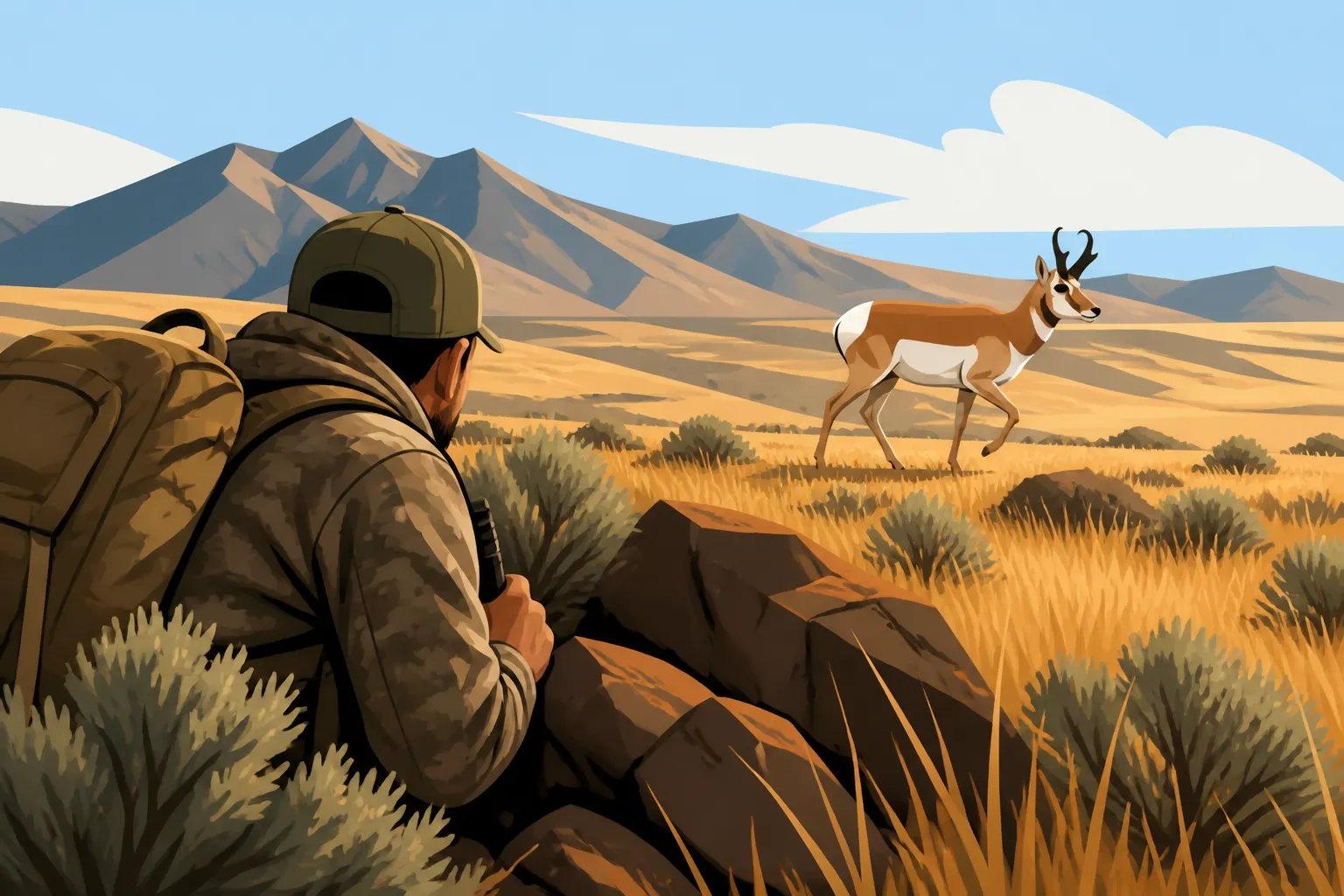
When you're within a few hundred yards on open ground, often the only way forward is on your belly. A full low crawl means your body is as flat to the ground as possible, moving only inches at a time, using your elbows and knees to propel you. It's slow, it's dirty, and it's exhausting, but it works. The goal is to get so low that you disappear into the shortest sagebrush or the slightest depression in the ground. You're effectively getting under the pronghorn's primary line of sight, which is typically looking horizontally. When you're crawling, keep your rifle close, often pushing it ahead of you, ready to be deployed quickly. Practice this at home so you know how to move silently and efficiently. If you're wearing a backpack, try to keep it low profile or even take it off and push it ahead of you if the situation demands it. This extreme level of stealth is crucial because the closer you get, the larger your profile appears, even if you’re just a few inches taller.
Utilizing Decoys: A Game-Changer for Pronghorn
Pronghorn are incredibly curious animals, and this curiosity can be exploited with a well-placed decoy. A decoy can be an absolute game-changer, especially on those super-flat, wide-open plains where traditional cover is non-existent. There are generally two ways to use a decoy:
- Solo Approach: If you're alone, you can sometimes use a decoy (often a silhouette of a buck or doe) to draw the animal's attention while you crawl into a shooting position. The trick is to raise the decoy, get its attention, then quickly drop to concealment and get into position. The pronghorn will often stare at the decoy, giving you a precious few seconds to move. You need to be incredibly fluid and fast, however, as their attention span can be short.
- Two-Person Team: This is where decoys truly shine. One hunter carries and operates the decoy, moving slowly and deliberately to draw the pronghorn's focus. The second hunter, often crawling 50-100 yards behind or to the side, uses the decoy as a distraction to close the final distance and get into a shooting lane. The decoy operator can even "stalk" the pronghorn by slowly raising and lowering the decoy, imitating another animal. The key here is communication and coordination. The pronghorn will fixate on the decoy, often allowing the shooter to move into a much closer, more comfortable position. This method is incredibly effective and can turn a hopeless stalk into a successful one. Remember, the goal of the decoy is often not to bring the pronghorn directly to you, but to freeze it or distract it long enough for you to get within range and set up a solid shot. This is a tactic detailed in Using a Decoy on Nevada Pronghorn. GoHunt sometimes features discussions and reviews of popular pronghorn decoys, which can be helpful in selecting the right one for your hunt.
Shot Opportunity and Ethical Considerations
You've made the perfect stalk, your heart is pounding, and the pronghorn is finally within range. Now comes the moment of truth. This isn't just about making the shot; it's about making an ethical shot and ensuring a quick, humane recovery.
When to Take the Shot: Patience and Confidence
Once you've reached your final position, don't rush the shot. Take a moment to catch your breath, settle your nerves, and confirm your target. Ensure the animal is broadside or slightly quartering away, offering the largest vital area. If the pronghorn is facing directly at you or directly away, wait. Patience is a virtue here. Get into the steadiest shooting position possible – prone is almost always best in open country, using a bipod or a backpack as a rest. For those longer shots, knowing your Rifle Zero Distance for Long Sage Shots and practicing with your specific setup is paramount. Dial your scope or use your holdovers with confidence. The adrenaline will be high, but focus on the fundamentals: breath control, sight picture, and a smooth trigger squeeze. Don't be afraid to pass on a shot if you don't feel 100% confident. A clean, ethical kill is always the priority.
Ethical Recovery and Minimizing Disturbance
After the shot, watch the animal through your scope or binoculars until it goes down or disappears. Pay attention to its reaction. Did it run off? Which direction? Did it stumble? Note any landmarks where you last saw it. Even if you see it fall, approach cautiously and with your rifle ready. Pronghorn can be tough, and a seemingly dead animal can sometimes get up and run. Once you confirm the animal is down, tag it immediately according to Nevada regulations. Field dress it promptly, especially in warmer weather, to ensure the meat cools quickly. In Nevada's vastness, a downed animal can sometimes be surprisingly hard to find, so paying close attention to landmarks is crucial. Being prepared with a good knife, gloves, and perhaps a game bag is essential for a quick and respectful recovery.
Disclaimer
Please note that hunting regulations, seasons, and unit boundaries can change. Always consult the most current Nevada Department of Wildlife (NDOW) regulations before planning and embarking on any hunt. This guide is for informational purposes only and does not replace official state regulations or hunter education.