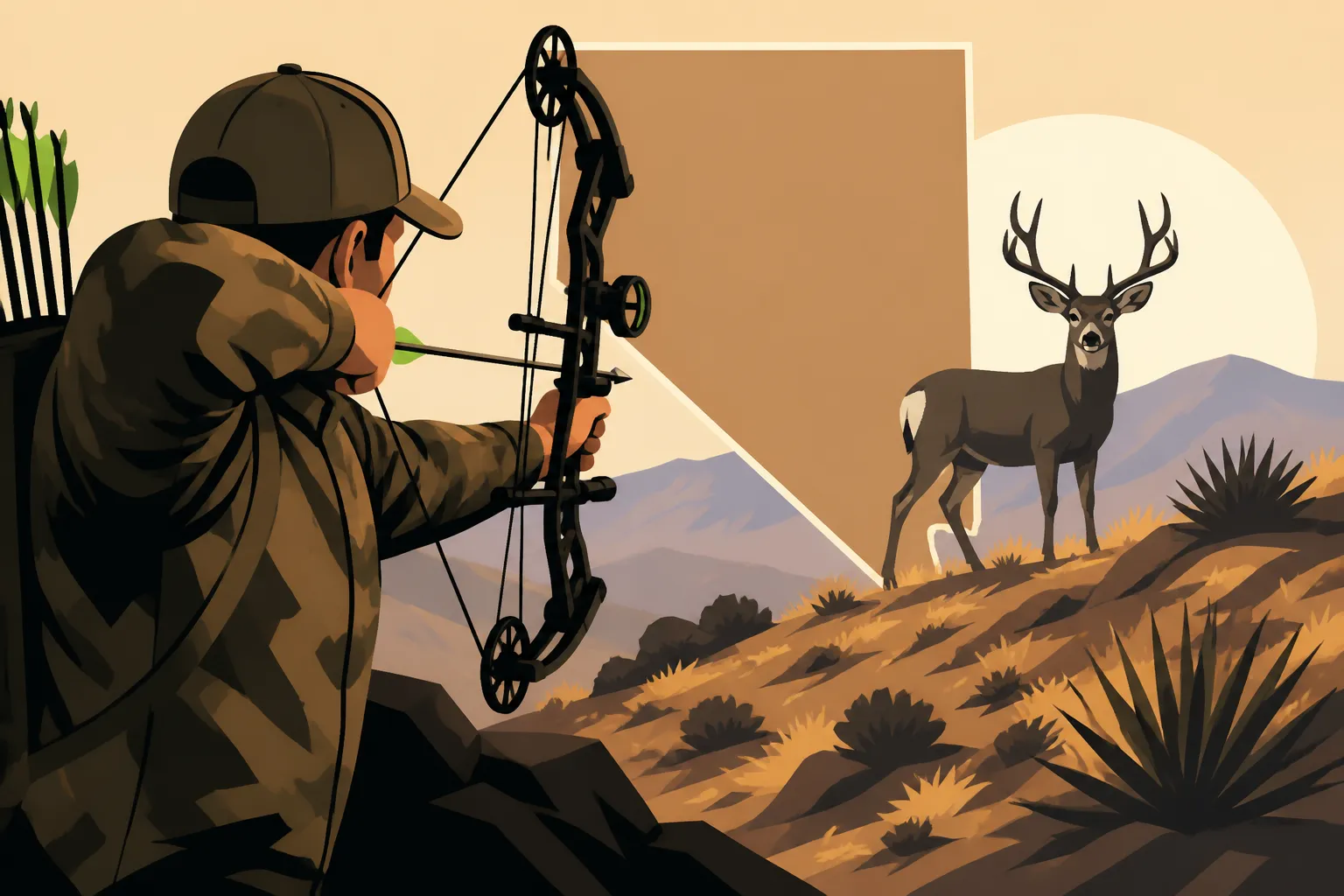
How Close a Bowhunter Needs to Get on Mule Deer
There’s nothing quite like the immense frustration of spotting a magnificent mule deer buck across a wide-open Nevada basin, only to realize he’s well beyond your comfortable bowhunting range. The sheer vastness of our landscape makes closing the distance on these wary animals a monumental challenge for any archer. This guide will dive deep into understanding what it really means to get "close enough" in Nevada’s unforgiving terrain, and how you can hone your skills and strategy to consistently put yourself in ethical bow range.
Understanding the "Effective Range" Myth for Bowhunting
Many bowhunters spend hours on the practice range, confidently sending arrows into targets at 50, 60, or even 80 yards. It feels good, right? You’re stacking arrows, you’re consistent, and you might even think that’s your "effective range." But here’s the cold, hard truth: your practice range effective range is almost never your hunting effective range, especially when chasing Nevada mule deer. The myth that your practice yardage translates directly to field conditions is one of the biggest pitfalls I see bowhunters fall into, leading to disappointing outcomes and, sometimes, unethical shots.
Why Your Practice Range Isn't Your Hunting Range
Think about it: at the practice range, you're usually calm, focused, and free from external pressures. There's no adrenaline coursing through your veins, no quartering-away buck suddenly turning broadside, no swirling winds trying to mess with your shot. You're not breathing heavily from a mile-long stalk up a steep hill, nor are you worried about brush deflecting your arrow or the sun glinting off your sight. The controlled environment of the range simply doesn't replicate the dynamic, unpredictable, and often high-stress situations you'll face in the field. When that giant velvet buck steps out from behind a juniper, your heart rate spikes, your muscles tense, and all that calm confidence from the backyard range can evaporate. It's a completely different mental and physical game, and it directly impacts your ability to execute a precise, ethical shot.
Factors That Shorten Your Effective Range in the Field
Several critical factors conspire to shrink your true effective range once you're out there. First and foremost is the animal itself. A mule deer isn't a static target; it's a living, breathing creature capable of "jumping the string" – reacting to the sound of your bow by dropping or moving before the arrow arrives. This reaction time becomes exponentially more dangerous with increased distance. What might be a perfect heart shot at 20 yards could easily become a gut shot at 40 yards if the deer ducks even a few inches. Then there's the environment: unpredictable wind gusts, shadows, subtle terrain changes that obscure parts of the animal, and uneven footing all demand more from you and reduce your margin for error. Think about the fatigue from a long hike, the quick decision-making under pressure, or even just the awkward body position you might find yourself in after a crawl. All these elements chip away at your ability to make a clean shot, forcing you to mentally shorten your comfortable distance. This is why many seasoned bowhunters aim for a maximum shot distance in the field that is often 10-20 yards less than what they can consistently achieve on a flat, calm range.
Reading Nevada's Mule Deer: Behavior and Terrain
To consistently get within bow range of Nevada mule deer, you have to become a student of their behavior and the landscape they call home. Our state's terrain is uniquely challenging – vast, open, and often sparsely vegetated, which means there are fewer places to hide. Understanding how mule deer use this terrain to their advantage, and consequently how you can use it to yours, is paramount to success. It's less about sheer athleticism and more about observation, patience, and cunning.
Mule Deer Senses and Awareness in Open Country
Mule deer possess an incredible suite of senses that make them notoriously difficult to approach. Their eyesight, while not as good at distinguishing stationary objects as a human's, is phenomenal at detecting movement. In the wide-open sagebrush country, a slight shift in your silhouette can instantly send a buck bounding away. Their hearing is also acute, capable of picking up the faintest crunch of gravel underfoot or the rustle of clothing. But perhaps their most formidable defense is their nose. Mule deer can detect human scent from astonishing distances, and a misplaced wind can ruin a stalk before it even begins. This is why playing the wind is non-negotiable in Nevada. You absolutely must keep the wind in your face or quartering to you. Ignore this, and you'll be treated to nothing more than a rapidly disappearing white rump. You can't outrun their senses, so you have to outsmart them by moving slowly, deliberately, and always minding your scent and sound.
Using Terrain to Your Advantage on a Stalk
Nevada's basin and range topography, with its endless series of ridges, draws, and washes, is actually a bowhunter's best friend if you learn to read it correctly. The key is to recognize "dead ground" – areas where you can move without being seen by the deer. This means using every fold in the earth, every sparse juniper, every rock outcropping as cover. A deep wash might offer a perfect concealed approach for hundreds of yards, allowing you to bypass multiple deer you couldn't otherwise reach. A small rise could be enough to break your silhouette as you creep over a ridge, giving you a precious few yards closer. The art of Using Draws and Rims to Close Distance is a skill you'll develop with practice, but it starts with meticulous e-scouting using tools like GoHunt to identify potential routes and cover. Before you even step foot in a unit, you should be looking at satellite imagery, identifying key topographical features, and mapping out possible stalk paths. This isn't just about getting close to the buck you've spotted; it's about predicting where deer will be and positioning yourself accordingly.
Understanding Mule Deer Bedding and Feeding Habits
Mule deer patterns are largely dictated by their need for food, water, and security. They tend to feed most actively in the early mornings and late evenings, often moving to more open areas or lower elevations where forage is abundant. During the heat of the day, especially in Nevada's often scorching sun, they'll seek out thick cover for bedding, typically on north-facing slopes, under large junipers, or in small pockets of taller brush that offer shade and concealment. Often, they'll bed with a good view of their back trail, allowing them to see or smell anything approaching from behind.
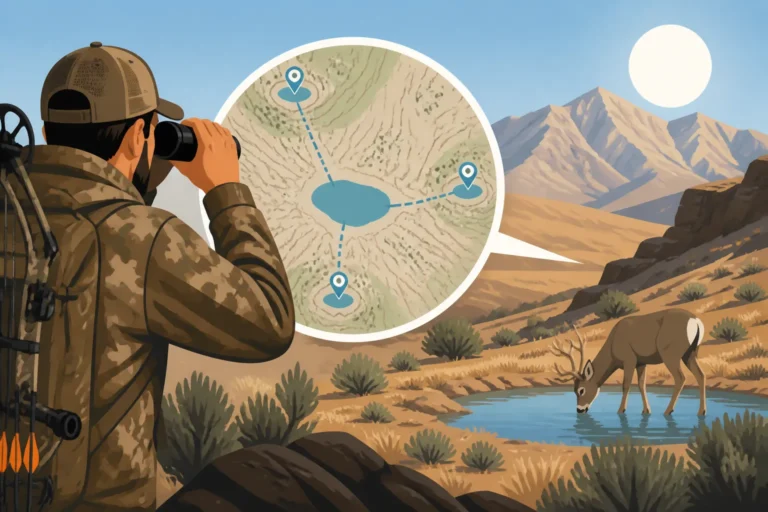
Understanding these habits helps you plan your approach. If you spot a buck feeding in the morning, rather than rushing a stalk, consider letting him feed towards a more advantageous bedding area. Or, if you locate a bedded buck, use that knowledge to anticipate his escape routes and how you might intersect him. Knowing Hunting Water in Nevada's Driest Country can also be a game-changer, as deer are often concentrated around limited water sources, especially during dry periods, providing predictable ambush points or starting points for a stalk.
Mastering the Stalk: Techniques for Closing the Gap
The actual stalk is where the rubber meets the road for a bowhunter. It's a test of patience, discipline, and often, sheer mental fortitude. Blowing a stalk is incredibly common, even for seasoned hunters, but learning from those experiences and refining your techniques will dramatically increase your chances of success. It’s about being present in the moment and making smart decisions, often under pressure.
The Art of Concealed Movement: Playing the Wind and Sun
Moving undetected in Nevada's open landscapes requires a level of stealth that feels almost unnatural. It means moving at a snail's pace, sometimes taking minutes to cover a single yard. Always use available cover, no matter how small. If you're out in the sage, use the tallest sagebrush as a screen, moving from one clump to the next. When crossing open ground, get as low as possible – crawling on hands and knees, or even belly crawling if necessary. This low profile drastically reduces your visibility. More importantly, always remember the wind. Reading Wind on a Long Sage Stalk isn't just about direction; it's about understanding thermals and how they shift throughout the day, especially in mountainous terrain. Early mornings might see thermals pulling scent downhill, while midday often has them rising. The sun can also be your ally or enemy; keeping it in the deer's eyes or using its harsh light to obscure your movement can give you a critical edge. Never, ever silhouette yourself against the skyline, especially when you're close to striking distance.
Patience and Waiting Games: When to Hold Tight
Sometimes, the best move is no move at all. You might spot a buck in a position where a direct stalk is impossible due to lack of cover, swirling winds, or other deer nearby. In these scenarios, patience is your most valuable weapon. Instead of forcing a bad stalk, consider waiting. Deer move, they shift, and often, they'll move into a more favorable position for you. This might mean waiting for hours, or even a full day, until conditions are right. Set up in a concealed position, use your optics – like a good spotting scope and binoculars (check out Optics Power for Nevada's Long Sightlines) – to keep tabs on the buck, and observe its patterns. Is it heading towards a draw? Is it getting ready to bed down? Sometimes, letting the deer come to you by setting up along a travel corridor or near a water source is far more effective than trying to chase it across a flat. This kind of disciplined patience is a hallmark of successful bowhunters in challenging environments like Nevada.
Calling and Decoying: When It Works (and When It Doesn't)
While more common for elk or whitetails, calling and decoying can occasionally work for mule deer, though it's often a high-risk, high-reward strategy. Mule deer are generally not as vocal as elk, and their response to calls can be unpredictable. However, during the rut, a snort-wheeze or grunt call might challenge a dominant buck or attract a curious one. Decoying, especially using a "stalking decoy" where the decoy is mounted to your bow, can be effective in specific scenarios, particularly during the rut or if you're trying to close the last few critical yards in very open country. The idea is to present the deer with a non-threatening or challenging visual target that distracts from your movement. Brands like Ultimate Predator Gear make excellent stalking decoys. The key with both calling and decoying is knowing when to deploy them. In heavily pressured areas or outside the rut, they can often spook deer. However, in low-pressure units or when a buck is already curious, they might just provide that critical distraction you need to get within a 30-yard window.
Shot Placement and Ethics: Making the Moment Count
Even after executing a flawless stalk and getting into your desired range, the hunt isn't over. The shot itself is the culmination of all your effort, and ethical shot placement is non-negotiable. As bowhunters, we owe it to the animal to ensure a quick, clean harvest. This means understanding anatomy, choosing the right equipment, and being prepared for the immediate aftermath of the shot.
Broadhead Selection and Arrow Dynamics for Mule Deer
Choosing the right broadhead is crucial for mule deer, especially given their tough hide and bone structure. While mechanical broadheads offer wider cutting diameters and can be more forgiving with slight shot angle variations, fixed-blade broadheads generally provide superior penetration, particularly if they encounter bone. Nevada’s Broadhead Requirements for Bowhunting allow both, but you need to ensure your choice meets minimum cutting diameter and blade count. Regardless of whether you choose mechanical or fixed, practice extensively with your hunting broadheads. They often fly differently than field points, and you need to be absolutely confident in their accuracy out to your maximum ethical hunting range. A well-tuned bow and arrow combination, where broadheads consistently hit with your field points, will give you the confidence needed when that moment of truth arrives. Ensure your arrows are adequately spined for your bow’s draw weight and length, and that your total arrow weight is sufficient for good kinetic energy and momentum for penetration.
Ethical Shot Angles and Recovery Strategies
The ideal shot for a mule deer is a broadside or slightly quartering-away shot, targeting the vitals (lungs and heart) located just behind the shoulder. Avoid quartering-to shots, as they present a much smaller vital target and a higher risk of hitting non-vital areas, leading to a prolonged recovery. If a buck is perfectly broadside, aim slightly lower and further back than you might think, just behind the crease of the shoulder, to catch both lungs and potentially the heart. For a quartering-away shot, aim to exit through the opposite shoulder, ensuring maximum penetration through the vitals.
Even with a perfect shot, recovery is not always instant. Always observe the deer’s reaction to the shot and listen for signs of a hit. Mark the exact spot of the shot, and the deer’s last known direction. If the shot felt good and the deer acted hit, give it time – often 30 minutes to an hour for a lung shot, and longer (4-6 hours or more) for a liver or gut shot – before beginning your track. This allows the animal to bed down and expire, rather than being pushed further. When tracking, look for blood, broken branches, and tracks. Utilize a good tracking app on your phone, like those offered by GoHunt, to mark the trail and grid search effectively. Remember the Meat Salvage Requirements for Big Game in Nevada; do everything in your power to recover the animal.
Gear and Practice for Success in Open Country
Success in bowhunting Nevada mule deer isn't just about stealth and patience; it's also about having the right tools and knowing how to use them. The vastness and ruggedness of the Great Basin demand specific gear choices and a dedicated practice regimen that goes beyond the casual backyard shooting session.
Optics for Long-Range Scouting and Stalking
In Nevada, your eyes are your most important tool, and high-quality optics are an extension of those eyes. You'll spend hours, sometimes days, Glassing Nevada's Basin and Range for Mule Deer from a vantage point, picking apart distant hillsides for the flicker of an ear or the gleam of an antler. A good pair of 10x or 12x binoculars on a tripod is essential for scanning. Don't skimp on glass; clear, bright optics reduce eye strain and allow you to discern details at extreme distances. When you spot a potential buck, a powerful spotting scope (20-60x or even 80x) becomes invaluable for judging the animal, assessing its size, and verifying it's a legal buck before you commit to a stalk. This saves countless wasted miles. Brands like Vortex, Swarovski, and Kowa are popular choices among serious Western hunters. Beyond spotting, a rangefinder is non-negotiable. Practice ranging objects frequently while scouting to develop a keen eye for distance. Many rangefinders also offer angle compensation, which is critical when shooting up or down steep terrain, as it provides the "shoot-to" distance rather than the line-of-sight distance.
Developing a Consistent Practice Routine for Variable Distances
Your practice routine needs to reflect the reality of hunting. Don't just shoot at 20 or 30 yards. Instead, incorporate shooting at varying, unmarked distances. Practice judging distances without a rangefinder and then verify your accuracy. Shoot from different positions – kneeling, sitting, even awkward angles, replicating what you might encounter in the field. Practice shooting after a strenuous activity, like a quick run or a set of jumping jacks, to simulate the adrenaline and heavy breathing of a real hunting scenario. This helps you learn to control your breathing and calm your nerves under pressure. Get comfortable with your maximum ethical range, but also practice shooting at extremely close distances (5-10 yards), as you never know when a deer might pop up right in front of you. A good training plan outlined by a resource like Building a Practice Routine Before Opener can make all the difference. Remember, the goal isn't just to hit the target, it's to consistently hit the kill zone of the target, even when fatigued or stressed.
Mental Game: Patience and Persistence
Bowhunting mule deer in Nevada is as much a mental game as it is a physical one. The odds are often stacked against you, and setbacks are a guarantee. Developing a strong mental game, characterized by unwavering patience and relentless persistence, is what separates those who occasionally connect from those who consistently find success.
Managing Expectations and Dealing with Blown Stalks
Let’s be honest: you’re going to blow stalks. Many of them. Sometimes the wind will swirl, sometimes another deer will bust you, sometimes you’ll make too much noise. It’s part of the game. The key is not to let these setbacks deflate your spirit or make you rush the next opportunity. Understand that mule deer are incredible survivors in a tough environment, and they've earned their wariness. Manage your expectations by embracing the challenge. The reward of a successful bowhunt in Nevada comes from overcoming these difficulties, not from avoiding them. Each blown stalk is a learning opportunity. What went wrong? Could you have chosen a different approach? Was your wind check insufficient? Analyze, learn, and move on. Don't let frustration cloud your judgment for the next potential encounter. Remind yourself that the effort itself is part of the experience, and the success rate for bowhunting mule deer in the wide-open West is inherently low; that's part of its appeal.
The Importance of Pre-Season Physical and Mental Preparation
Nevada bowhunts are grueling. You'll cover miles on foot, often in rough terrain, at varying elevations, and under unpredictable weather conditions. Physical fitness is not just about endurance; it's about being able to perform under duress. Being in good shape means you can hike further, glass longer, and execute a stalk with more control and less fatigue. This translates directly to better decision-making and steadier shots. Beyond physical prep, mental preparation is equally vital. Visualize successful stalks, ethical shots, and efficient recoveries. Practice calming techniques. Get comfortable with discomfort. Read about the areas you'll be hunting, using resources like GoHunt to familiarize yourself with the topography and historical harvest data. Understanding what to expect, and embracing the grind, will make you a far more effective and resilient hunter. Think of it like training for a marathon: you wouldn't just show up on race day without putting in the miles. The same applies to Preparing Physically for Long Glassing Days and the demanding nature of a Western bowhunt.
| Factor Affecting Ethical Shot Distance | Impact on Hunter Performance | Strategy to Mitigate |
|---|---|---|
| Wind Conditions | Arrow drift, scent detection | Constant wind checks, use terrain for buffer |
| Animal Movement/Reaction | String jumping, target shift | Aim for closer shots, anticipate movement |
| Hunter Fatigue/Adrenaline | Shaky aim, poor judgment | Physical conditioning, controlled breathing |
| Terrain Complexity | Awkward shooting angles, cover | Practice varied positions, use rangefinder w/ angle comp |
| Light Conditions | Visibility, target acquisition | Use low-light optics, avoid shooting in poor light |
| Vegetation Interference | Arrow deflection | Clear shooting lanes, wait for clear shot |
Disclaimer
Hunting is an inherently dangerous activity. Always prioritize safety and adhere to all local, state, and federal regulations. This content is for informational purposes only and should not be considered a substitute for official hunter education or professional guidance. Stay safe and hunt ethically.