Nevada’s Roads Are Long and Its Services Are Far Apart
Heading out into Nevada's vast hunting grounds is an experience unlike any other, but if you've ever found yourself miles from pavement with a sputtering fuel gauge or a flat tire and no cell service, you know the stark reality: services are few and far between, and the distances are immense. This guide is all about preparing you for those long stretches, ensuring you're self-sufficient and safe when the nearest town is an hour's drive and the next human might be days away.
Understanding the Vastness: Nevada's Landscape Dictates Logistics
Nevada isn't just a big state; it's a different kind of big. We're talking about the Great Basin, where mountain ranges rise abruptly from wide, sagebrush-covered valleys, and the scale of things can completely reorient your expectations. This unique geography directly impacts everything from your travel time to your emergency preparedness.
The Scale of the Great Basin
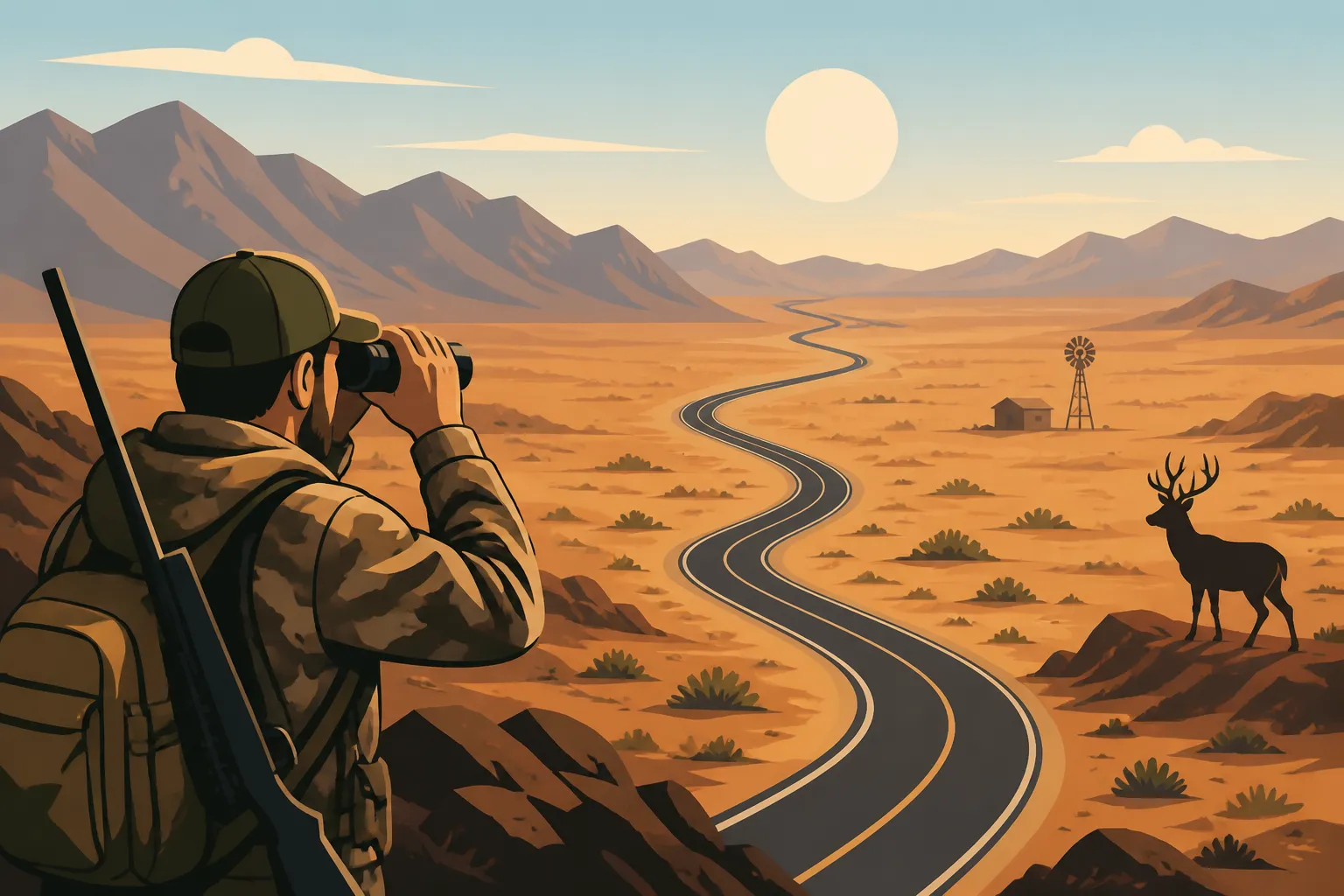
When you look at a map of Nevada, those long, straight roads might seem inviting, promising quick passage. But what a map often doesn't convey is the sheer emptiness between points. You might drive for thirty or forty minutes without seeing another vehicle, let alone a gas station, store, or even a house. This isn't like driving through many other western states where small towns are scattered more frequently. Here, "town" might just be a cluster of twenty homes and a single mercantile that closes at 5 PM on a Tuesday.
It's easy to underestimate the distance when you're looking at a digital map at home. A "short hop" between one hunting unit and another can turn into a multi-hour commitment, especially if you're taking dirt roads. A common mistake is assuming that once you're off the main highway, you'll still find convenient services. The reality is, once you leave the major interstates and state routes, you're truly on your own, often in country that hasn't changed much in a hundred years. This is why understanding Why Nevada Deer Hunting Is a Glassing Game is so crucial, as you'll spend more time looking from afar than covering ground quickly.
Public Land Dominance and Its Implications
Nevada is often called the most federally owned state in the Lower 48, with the vast majority of its land managed by the Bureau of Land Management (BLM) and the Forest Service. While this means incredible public access for hunters, it also means a distinct lack of developed infrastructure. You won't find ranger stations with convenience stores every few miles, nor will you see private land with businesses catering to travelers. It's truly wild country.
This immense public domain, like the Humboldt-Toiyabe National Forest or countless BLM acres, translates into miles and miles of unpaved, often poorly maintained roads that spiderweb across the landscape. The very nature of BLM Ground Is Where Most Nevada Hunting Happens means that the infrastructure we often take for granted – good roads, emergency services, communication networks – is largely absent. This isn't a complaint; it's just the reality of hunting these incredible spaces, and it demands a higher level of self-reliance than many hunters are accustomed to.
The Reality of Nevada's Roads: What to Expect
Forget perfectly paved roads once you turn off the highway. Nevada's backcountry roads are a world unto themselves, demanding respect and proper preparation. Ignoring their unique challenges can quickly turn a hunting trip into a survival situation.
Graded Dirt Roads and Washed-Out Tracks
Most "roads" in the backcountry are simply dirt tracks, many of which are minimally maintained. Main county roads might see a grader once or twice a year, leaving a relatively smooth, albeit dusty, surface. But as you venture deeper, these quickly degrade into two-track trails, often with significant ruts, washouts, and embedded rocks. A sudden rainstorm, common in late summer or fall, can transform a passable road into a muddy impassable mess or erode it away entirely, creating unexpected hazards.
It's not uncommon to encounter long stretches of washboard, which can rattle your vehicle to pieces and loosen anything not securely tied down. Then there are the stretches of deep, powdery dust that act like talcum powder, obscuring vision and coating everything. In other areas, sharp volcanic rock or basalt can be relentless on tires. Planning Vehicle Prep for Remote Nevada Roads isn't just a suggestion; it's essential for preventing breakdowns that leave you stranded.
Navigation Without Cell Service
One of the biggest realities of Nevada's backcountry is the near-total absence of cell service outside of major towns and along the busiest interstates. Relying on your phone for navigation or emergencies is a gamble you simply can't afford to take. Even if you have a spotty signal near a high ridge, it's often too unreliable for consistent use.
This is where traditional mapping, or robust offline digital mapping solutions, become absolutely critical. Tools like onX Hunt, when downloaded for offline use, can be a lifesaver, allowing you to track your position, identify land ownership, and navigate even when your phone has no bars. Always carry a physical map and compass as a backup, and know how to use them. Before you head out, read up on Cell Coverage Across Nevada Hunt Units so you know what to expect.
Planning for Fuel: Beyond the Last Gas Station
Running out of gas miles from anywhere is a classic Nevada hunting nightmare. It's a mistake easily avoided with careful planning and an understanding of the distances involved.
Calculating Fuel Needs for Backcountry Travel
The first rule of fuel in Nevada is simple: fill up whenever you have the chance, even if your tank is only half-empty. You never know how far the next station is, or if it will even be open. Factor in not just the miles you expect to drive, but also the rugged terrain and slow speeds of backcountry roads, which drastically reduce fuel efficiency. Your truck might get 20 MPG on the highway, but that can drop to 10-12 MPG or even less when crawling over rocks in four-wheel drive.
When calculating, overestimate, always. Don't just plan for the drive in and out; consider your daily scouting drives, retrieving an animal, and any unexpected detours. A good rule of thumb is to have enough fuel for your planned trip plus at least 50% extra, ideally more. This extra capacity should be carried in approved fuel containers, securely strapped down, far from heat sources. It's not uncommon for serious hunters to carry 10-20 gallons of extra fuel on extended trips. Knowing How Far Apart Nevada Fuel Stops Are is vital for this planning.
Carrying Extra Fuel Safely and Legally
Carrying extra fuel is common practice, but it needs to be done correctly. Use purpose-built fuel cans (like Jerry cans) that are sealed and designed for transport. Never use old plastic water jugs or containers not specifically made for gasoline or diesel. Secure them tightly in your truck bed, ideally in a separate compartment or a dedicated carrier. Remember, a full 5-gallon fuel can is heavy, and it needs to stay put over bumpy terrain.
Also, be mindful of local regulations regarding fuel transport, especially if you're crossing state lines or entering specific federal land units. And always, always handle fuel away from open flames, hot engines, or sparks. Spilling fuel in the backcountry isn't just a mess; it's an environmental hazard and a fire risk. Make sure your vehicle is in good shape to handle the extra weight and demands by checking Carrying Extra Fuel on a Nevada Hunt.
Water, Food, and Supplies: Self-Sufficiency is Key
In Nevada's arid environment, water is life, and adequate supplies are not merely convenient, but critical for survival. You cannot rely on finding potable water in the backcountry.
Hydration in the Desert: More Than You Think
The desert climate is incredibly drying. You'll sweat more than you realize, even on cool days, and the low humidity means that sweat evaporates quickly, fooling your body into thinking you're not losing as much fluid. Dehydration can creep up quickly, leading to fatigue, poor judgment, and serious health risks. A good starting point is at least one gallon of water per person per day for drinking, plus extra for cooking, washing, and emergencies.
For a multi-day hunt, this means carrying a substantial amount of water. Think about multiple 5-gallon jugs in your vehicle, and then smaller bottles or hydration packs for daily excursions on foot. Water filtration systems or purification tablets are excellent backups but should never replace carrying ample clean water. Don't forget electrolyte mixes – they can be a game-changer when you're exerting yourself in the dry air. Always be prepared with Water You Must Carry on a Desert Day Hunt.
Non-Perishable Food and Emergency Rations
Beyond water, a well-stocked pantry of non-perishable food is essential. Even if you plan on fresh meals for camp, always have a backup supply of shelf-stable foods: canned goods, dried fruits, nuts, jerky, energy bars, and instant meals. This isn't just for convenience; it's your emergency buffer if your trip gets unexpectedly extended due to weather, a vehicle breakdown, or an injured partner.
Pack extra days' worth of food than you anticipate needing. A simple breakdown that leaves you stranded for 24-48 hours means you'll be glad for those extra meals. Keep some "go-bag" rations easily accessible, separate from your main camp food, so you can grab them if you need to hike out or wait for help. Preparing for Long Days in Open Terrain goes beyond just physical conditioning; it includes meticulous planning of your nutritional needs.
Essential Supplies Beyond the Basics
Think beyond just food and water. A comprehensive first-aid kit is non-negotiable, well-stocked for cuts, sprains, snake bites (yes, Snake Awareness on an August Archery Hunt is important), and other common backcountry ailments. Include personal medications, pain relievers, and any allergy treatments. Other vital supplies include:
- Communication Devices: Satellite messenger (Garmin InReach, Zoleo) or satellite phone.
- Shelter: Emergency blankets, tarp, or small tent.
- Fire Starters: Waterproof matches, lighter, fire steel.
- Navigation: Physical maps, compass, downloaded onX Hunt maps, GPS.
- Lighting: Headlamp, flashlight, extra batteries.
- Tools: Multi-tool, knife, small shovel, axe or saw.
- Repair Kit: Tire plug kit, air compressor, basic vehicle tools, duct tape, zip ties.
- Warmth: Extra layers of clothing, even in mild weather, as temperatures can drop drastically.
Here's a quick checklist for critical supplies:
| Category | Essential Items | Notes |
|---|---|---|
| Hydration | 1+ gallon water/person/day, electrolyte mixes, purification tablets/filter | Overestimate water needs in arid climate. |
| Food | Non-perishable meals for duration + 3 extra days, high-energy snacks, jerky | Account for unexpected delays. |
| Navigation | GPS device, physical maps (topo/unit), compass, downloaded onX Hunt maps, external battery pack | Redundancy is key, especially with no cell service. |
| Communication | Satellite messenger (InReach, Zoleo) or sat phone, fully charged cell phone (for emergency only if service exists) | Crucial for summoning help. |
| First Aid | Comprehensive kit (bandages, antiseptics, pain relievers, personal meds, snake bite kit, splint) | Tailor to potential injuries and group needs. |
| Shelter | Emergency blankets, tarp, small emergency tent, sleeping bag (if temperatures may drop) | Protection from elements if stranded. |
| Fire | Waterproof matches, multiple lighters, fire steel, tinder | For warmth, cooking, signaling. Check Fire Restrictions During Hunting Season. |
| Tools/Repair | Multi-tool, knife, shovel, tire repair kit, air compressor, jumper cables, basic tool kit, duct tape, zip ties | For vehicle issues and general utility. |
| Lighting | Headlamp, flashlight, spare batteries | For navigating in the dark, camp tasks. |
| Clothing | Layered clothing system for varying temperatures, rain gear, sturdy boots | Nevada's weather can change quickly. |
Communication and Safety in Remote Areas
The vastness of Nevada's hunting grounds means you are truly on your own. This makes reliable communication and a solid safety plan paramount, not just a good idea.
The Role of Satellite Communication Devices
As mentioned, cell service is a rare luxury. This means your primary line of communication in an emergency needs to be a satellite device. A personal satellite messenger, like a Garmin InReach or Zoleo, allows you to send and receive text messages, share your location, and, most importantly, trigger an SOS call to emergency services, even from the most remote canyons. These devices work anywhere you have a clear view of the sky.
A satellite phone offers voice communication, which can be invaluable for detailed conversations with loved ones or emergency personnel. While more expensive, the ability to have a direct conversation can streamline emergency response. Whichever device you choose, make sure you understand how to use it, test it regularly, and keep it charged. Ensure family members back home know your route and expected return, and instruct them on what to do if they don't hear from you. Discussing Satellite Messenger Use in Remote Country with your hunting partners is a smart pre-hunt conversation.
Emergency Preparedness Protocols
Beyond gear, a well-thought-out emergency protocol for your hunting party is critical. Before you ever leave home, discuss "what if" scenarios:
- Separation: What do you do if you get separated from your hunting partner? Establish rendezvous points, times, and clear search parameters.
- Injury: What's the plan if someone gets hurt? Who carries the first aid kit? Who activates the SOS?
- Vehicle Breakdown: Who stays with the vehicle? Who hikes out for help, and in what direction?
- Lost: What are the steps if you become disoriented? "Stay put" is often the best advice, especially if others know your general location.
These conversations might seem morbid, but they are crucial for reducing panic and enabling efficient action when an actual emergency strikes. Remember, even minor injuries can become serious quickly in a remote, arid environment without immediate help.
Vehicle Preparedness: Your Lifeline in the Backcountry
Your vehicle is your most important tool and often your only shelter in Nevada's backcountry. Treating it as such, and ensuring it's ready for the abuse, is non-negotiable.
Off-Road Capable Vehicles and Their Maintenance
Forget the family sedan for Nevada hunting. You need a high-clearance, four-wheel-drive vehicle, preferably with all-terrain tires. Trucks, SUVs, and Jeeps are common choices. Even then, your vehicle needs to be in top mechanical condition. Regular maintenance, fresh fluids, good brakes, and a healthy battery are crucial. A breakdown in the middle of nowhere is exponentially worse than one on the side of a highway.
Before every trip, conduct a thorough inspection: check all fluids (oil, coolant, brake fluid, power steering), inspect belts and hoses for cracks or wear, test all lights, and ensure your four-wheel drive engages correctly. Carry spare fuses, belts, and basic hand tools. Knowing What Nevada Backroads Do to a Tire will emphasize why your tires are perhaps the single most critical component.
Tire Strategy and Repair Kits
Your tires will take a beating. Invest in robust, off-road-specific tires (All-Terrain or Mud-Terrain) with good sidewall protection. Standard highway tires are an invitation for flats on rocky Nevada roads. And never, ever go into the backcountry without a full-sized spare tire, and ideally, two. Make sure your spare is properly inflated and accessible. A basic tire plug kit, an air compressor (12V that plugs into your vehicle), and a tire pressure gauge are absolute necessities.
Learn how to plug a tire, change a flat, and air up a tire yourself. Practicing in your driveway is a lot better than learning in the dark, in a cold wind, with a flat tire. Consider having a high-lift jack if your vehicle is lifted, as standard jacks may not be sufficient on uneven ground. When planning your route, consider Choosing Boots for Sharp Volcanic Rock for yourself, and equally robust tires for your vehicle.
Emergency Scenarios: What Could Go Wrong and How to Prepare
It's not about being paranoid; it's about being prepared for the unpredictable nature of the wild. Thinking through worst-case scenarios can literally save lives.
Getting Stranded: Vehicle Breakdown or Getting Stuck
One of the most common and dangerous scenarios is a vehicle breakdown or getting stuck. Whether it's a flat tire, an engine issue, or getting high-centered on a rock, suddenly your mobile base camp is immobile. The first rule is: don't panic. The second rule: stay with your vehicle. Your vehicle is a much larger and more visible object for search and rescue than a lone person. It also offers shelter from the elements.
If you have a satellite messenger, use it to call for help, providing your exact coordinates. If not, activate your emergency plan with your hunting partners. Ensure you have enough water, food, and warm clothing to survive for at least 72 hours while awaiting rescue. Your Vehicle Recovery Gear for Nevada Roads should include a heavy-duty tow strap, shackles, a shovel, and possibly traction boards.
Lost in the Vastness: Disorientation and Navigation Failure
It's surprisingly easy to get disoriented in the Great Basin. The terrain can look very similar for miles, and without clear landmarks, a short walk can turn into a navigational nightmare. A simple hike from camp to a glassing point can go sideways if you lose your bearings, especially as daylight fades.
If you realize you are lost, the most important thing is to stay calm. Consult your physical map and compass, or your offline GPS/onX Hunt maps. Try to retrace your steps. If you're truly disoriented, it's often best to "stop, think, observe, and plan" (STOP). If night is falling, find shelter, build a fire (if safe and legal), and wait for daylight. Signaling for help (three shots, three flashes, three whistles) is a universal distress signal. Knowing The Grid Glassing Method, Step by Step isn't just for finding game; it helps you stay oriented in expansive terrain.
Leveraging Technology for Remote Navigation
While physical maps are paramount, modern technology, when used correctly, can dramatically enhance your safety and effectiveness in Nevada's remote hunting areas.
Offline Mapping Apps: Your Digital Lifeline
This is where brands like onX Hunt truly shine. These apps allow you to download detailed basemaps and satellite imagery for your specific hunting unit before you ever leave cell service. This means you have a full, interactive map of land ownership, roads, trails, water sources (like those crucial guzzlers), and topographic contours right on your phone or tablet, even when you have no signal.
With onX Hunt, you can mark your truck, camp, potential game sightings, and even the direction of travel for a stalk. The GPS function in your device will continue to work, showing your exact location on the downloaded map. This is an invaluable tool for navigating, especially on complex public land boundaries or when trying to find your way back to camp in the dark. Many hunters swear by onX Hunt for its accuracy and ease of use in the field.
Harnessing Digital Tools for Pre-Season Scouting
Beyond in-field navigation, online platforms and apps are game-changers for pre-season scouting. GoHunt is an excellent example of a tool that provides incredible data for hunters. It offers detailed draw odds, harvest statistics, and unit profiles, helping you decide where to even apply for a tag in Nevada's complicated draw system. Reading a Nevada Hunt Unit Before You Apply becomes much easier with such resources.
Combining these scouting tools with satellite imagery from onX Hunt or other sources lets you virtually "walk" your unit from home. You can identify potential access roads, locate water sources like springs and guzzlers (which often concentrate game, making Hunting Water in Nevada's Driest Country a key strategy), find bedding areas, and plan your approach long before you set foot on the ground. This kind of detailed E-Scouting saves valuable time and effort, especially when traveling long distances to hunt.
| Tool Category | Purpose | Key Features for Nevada Hunting |
|---|---|---|
| Offline Mapping App | In-field navigation & land ownership | GPS tracking, downloaded basemaps (topo/satellite), land ownership layers, waypoints, mileage calculator (e.g., onX Hunt) |
| Data & Scouting Platform | Research & planning before the hunt | Draw odds, harvest data, unit profiles, herd statistics, weather overlays, species-specific info (e.g., GoHunt) |
| Satellite Messenger | Emergency communication & tracking | SOS button, 2-way text messaging, location sharing, weather forecasts |
| Weather App (Offline Capable) | Field weather predictions | Hourly/daily forecasts, wind speed/direction, precipitation, temperature (requires pre-download or sat device integration) |
| Digital Camera/Phone Camera | Documenting the hunt & scouting | Photo/video, geo-tagging images for later review (e.g., trail camera photos) |
The Nevada Mindset: Embracing Self-Reliance
Ultimately, hunting Nevada is an exercise in self-reliance. The long roads and sparse services aren't just logistical challenges; they're an intrinsic part of the experience, shaping your hunt and demanding a higher level of preparation.
Preparing for Isolation and Unpredictability
It's easy to think of "the wilderness" as something you visit for a day or two. In Nevada, you become part of it. Embrace the isolation. Understand that you might not see another soul for days. This mental preparedness is as important as the physical. Be comfortable being uncomfortable, and be ready to adapt. The weather can change in an instant, a road can become impassable, or an unexpected mechanical issue can arise.
Your ability to remain calm, think clearly, and rely on your training and equipment will define your success and safety. From a Remote Road Conditions Across Nevada perspective, expecting the unexpected is the only true expectation. This isn't just about bagging an animal; it's about the entire journey, the challenge, and the deep satisfaction of truly earning your experience in one of the wildest corners of the Lower 48.
The Rewards of a Well-Prepared Hunt
Despite the challenges, or perhaps because of them, hunting Nevada offers unparalleled rewards. The sheer vastness, the solitude, the breathtaking beauty of the Basin and Range, and the incredible wildlife opportunities are addictive. When you pull off a successful hunt in this demanding landscape, knowing you were prepared for every curveball, the sense of accomplishment is profound.
It all boils down to respect: respect for the land, respect for the animals, and respect for the inherent challenges. Go in prepared, with your vehicle serviced, your tank full, your water abundant, and your communication lines open, and you'll find that the long roads and distant services become part of the adventure, not an obstacle to it. Packing an Animal Out of Roadless Country will be a challenge you're ready for, knowing you've thought through all the logistics.
Disclaimer
This article is for general informational purposes only and does not constitute professional advice. Laws, prices and regulations vary by location and change over time. Consult a qualified professional for guidance on your specific situation.